Saturday, 28 July 2012
Other Goddesses- Charites
Charites/Kharites/Graces/Gratiae- There were three in number usually, Aglaea/Algaea/Aglaia (Splendor), Euphrosyne (Mirth), and Thalia (Good Cheer), Cleta/Kleta to the Spartans. The goddesses of grace, charm, beauty, nature, pleasure, fertility, play, relaxation and floral decoration. They acted as attendants for Aphrodite and/or Hera.
They were usually thought to be daughters of Zeus and Eurynome (Titaness of water meadows, an Okeanid and Zeus' third wife), or Zeus and Eunomia (goddess of good order, a Horaie and daughter of Zeus and Themis), or Eurymedousa. They were also thought to be daughters of Helios and Aegele/Aigle (Okeanid), or Dionysus and Kronois, or Dionysus and Aphrodite.
Other names include Auxo (probably a name taken from the Hourai), Charis/Kharis/Grace, Hegemone, Phaenna, Pasithea/Pasithee, Eudaimonia, Paidia, Pandaisia, Pannykhis, and Antheia.
Aglaea was the goddess of beauty, splendor, glory, magnificence and adornment, also named Charis (grace) and Kale (beauty). She was wife to Hephaestus after he divorced Aphrodite and with him became mother to the younger Charites- Eucleia/Eukleia (Good Repute), Eupheme (Acclaim), Euthenia (Prosperity), and Philophrosyne (Welcome).
Sostratus says that Aphrodite bickered with the Charites over who was most beautiful, the seer Teiresias chose Kale/Aglaea and Aphrodite turned him into an old woman as punishment but Kale gave him beautiful hair. Charis/Kharis/Grace were probably just other names for her.
Euphrosyne was the goddess of joy, mirth and merriment. Sometimes she was companion to Acratus/Akratos, the spirit of unmixed wine who was an attendant of Dionysus.
Thalia was the goddess of good cheer, festivity and rich banquets. Pandaisia was probably another name for her.
Hegemone was the goddess of plants.
Pasithea was the goddess of rest and wife to Hypnos, the god of sleep, given to him by Hera in exchange for putting Zeus to sleep for a second time and risking his wrath.
Antheia was the goddess of flowers.
They were often in the company of Apollo, the Muses and the Horai.
Nonnus mentioned how when Aphrodite competed with Athena over weaving helped her, Pasithea made the spindle turn, Peitho dressed the wool, and Aglaea gave Aphrodite the yarn and thread.
Their Roman counterparts were the Gratiae/Graces.
Hesiod describes them as 'fair cheeked' with 'beaming' or 'sparkling' eyes, whilst Sappho calls them 'rosy-armed', and Ibycus says they are 'blue-eyed'.
Labels:
aglaea,
algaea,
charis,
charites,
euphrosyne,
grace,
graces,
gratiae,
kharis,
kharites,
pasiphae,
thalia
Friday, 27 July 2012
Other Goddesses- Cybele
Cybele/Kybele/Matar/Magna Mater/Meter Theon- mother goddess, also a goddess of protection, nature, mountains, and wild animals. Originally an Anatolian goddess, she was linked to Gaia, Rhea and Demeter.
She could also be linked to Artemis as a wilderness and animal goddess and Dionysus as a goddess associated with wild cats (Dionysus was linked to tigers) whose procession was usually accompanied by wine and music.
Pausanias describes Cybele as being born as both male and female, and called Agdistis, born from Zeus' semen falling onto Gaia while he slept. The gods fearing this being cut the male organ away and from it grew an almond tree, the female remaining was sibling. A nymph, Nana, ate an almond from the tree and became impregnated with Attis.
Attis was exposed as a child and suckled by a he-goat. He grew up and was to marry a princess but the goddess appeared before him and he, and the king, went mad and cut off his genitals, Cybele then asked Zeus to give him a form that would not rot or age. He became a god of vegetation, depicted a shepherd with a crook or panpipes. Sometimes he was killed by a boar sent by Zeus in punishment for introducing the cult of Cybele. With Cybele he was her priest attendant as well as lover.
The Corybantes/Korybantes and Dactyl were her followers. The Corybantes were male armed, crested dancers who drummed, they drummed to drown out infant Zeus' crying so that Cronus would not hear, alternatively the Kuretes, Rhea's attendants, did this. The dactyl were linked to her and/or Rhea, they were small phallic beings who practised metalwork and magic and were usually ten in number.
She turned Atalanta and Hippomenes/Melanion into lions for making love in Zeus' temple. Alternatively, Zeus himself, Rhea or Aphrodite did this, Aphrodite because they did not honour her properly.
Sabazios may have been a son of hers, he was a horseman and Phrygian/Thracian sky god, he was later linked to Dionysus.
Aura the Titaness goddess of the breeze is sometimes said to be a daughter of hers, alternatively she was the daughter of the Titan Lelantos/Lelantus and the Okeanid Periboea/Periboia. She was raped by Dionysus after saying Artemis was too womanly to be a virgin and went mad. Alternatively, Dionysus loved her and compelled Aphrodite to make her love him but she went mad giving birth to their twins. She ate one son and the other, Iakkhos/Iacchus was rescued by Artemis and became a demigod attendant of Artemis.
Another daughter was Nicaea/Nikaia, a Naiad, and a daughter with the river god Sangarius/Saggarios, she was a follower of Artemis seduced by Dionysus with Hypnos' help. One story says she was loved by the shepherd Hymnus but killed him causing Eros to take vengeance. Dionysus got her drunk and impregnated her while she was asleep, after giving birth she hung herself. Their daughter was Telete daimon of Bacchic orgies.
King Gordius/Gordias of Phrygia was a lover of hers or consort and they are said to have adopted Midas, the infamous king with the golden touch. Alternatively, Midas was simply Gordias' son.
She is depicted with a polos (high, cylindrical hat) and a chiton usually in a lion drawn chariot.
The Romans called her Magna Mater (Great Mother).
She could also be linked to Artemis as a wilderness and animal goddess and Dionysus as a goddess associated with wild cats (Dionysus was linked to tigers) whose procession was usually accompanied by wine and music.
Pausanias describes Cybele as being born as both male and female, and called Agdistis, born from Zeus' semen falling onto Gaia while he slept. The gods fearing this being cut the male organ away and from it grew an almond tree, the female remaining was sibling. A nymph, Nana, ate an almond from the tree and became impregnated with Attis.
Attis was exposed as a child and suckled by a he-goat. He grew up and was to marry a princess but the goddess appeared before him and he, and the king, went mad and cut off his genitals, Cybele then asked Zeus to give him a form that would not rot or age. He became a god of vegetation, depicted a shepherd with a crook or panpipes. Sometimes he was killed by a boar sent by Zeus in punishment for introducing the cult of Cybele. With Cybele he was her priest attendant as well as lover.
The Corybantes/Korybantes and Dactyl were her followers. The Corybantes were male armed, crested dancers who drummed, they drummed to drown out infant Zeus' crying so that Cronus would not hear, alternatively the Kuretes, Rhea's attendants, did this. The dactyl were linked to her and/or Rhea, they were small phallic beings who practised metalwork and magic and were usually ten in number.
She turned Atalanta and Hippomenes/Melanion into lions for making love in Zeus' temple. Alternatively, Zeus himself, Rhea or Aphrodite did this, Aphrodite because they did not honour her properly.
Sabazios may have been a son of hers, he was a horseman and Phrygian/Thracian sky god, he was later linked to Dionysus.
Aura the Titaness goddess of the breeze is sometimes said to be a daughter of hers, alternatively she was the daughter of the Titan Lelantos/Lelantus and the Okeanid Periboea/Periboia. She was raped by Dionysus after saying Artemis was too womanly to be a virgin and went mad. Alternatively, Dionysus loved her and compelled Aphrodite to make her love him but she went mad giving birth to their twins. She ate one son and the other, Iakkhos/Iacchus was rescued by Artemis and became a demigod attendant of Artemis.
Another daughter was Nicaea/Nikaia, a Naiad, and a daughter with the river god Sangarius/Saggarios, she was a follower of Artemis seduced by Dionysus with Hypnos' help. One story says she was loved by the shepherd Hymnus but killed him causing Eros to take vengeance. Dionysus got her drunk and impregnated her while she was asleep, after giving birth she hung herself. Their daughter was Telete daimon of Bacchic orgies.
King Gordius/Gordias of Phrygia was a lover of hers or consort and they are said to have adopted Midas, the infamous king with the golden touch. Alternatively, Midas was simply Gordias' son.
She is depicted with a polos (high, cylindrical hat) and a chiton usually in a lion drawn chariot.
The Romans called her Magna Mater (Great Mother).
Other Goddesses- Amphitrite
Amphitrite- a sea goddess, wife to Poseidon and either a Nereid (daughter of Nereus and Doris), or an Okeanid (daughter of Okeanos and Tethys).
Eustathius says he saw at Naxos with her sister the Nereids and abducted her. Another tale says she fled to Atlas, Poseidon sent minions to find her and one, Delphinus found her and wooed her on Poseidon's behalf. For his success, Poseidon created a dolphin constellation.
When Minos demanded that Theseus prove he was a son of Poseidon by fetching a signet ring he threw into the sea, Theseus went after it and found himself in Poseidon's home. Down there Amphitrite, according to the Bacchylides gave him a purple cloak and garland, according to Pausanias and Hyginus she gave him a gold crown and the ring.
She attended the birth of Apollo with Rhea, Dione, Themis and Ichnaea.
Sometimes she is said to have turned Scylla into a monster out of jealously. Scylla was a nymph or naiad, possibly a daughter of Phorcys or Crataeis, she was loved by either Poseidon or Glaucus and out of jealousy Amphitrite or Circe poisoned the waters she bathed in causing her to be turned into a monster with tentacle legs, four/six dog heads at her waist, long necks, a cat's tail and four eyes.
She turned the Alkyonides/Alcyonides into halycons when they threw themselves into the sea. They were the seven daughters of Alyconeus/Alykoneus the eldest of the Gigantes who was killed by Heracles, after he attacked him when he was driving away the cattle of Geryon, he killed him with a club after dragging him from his homeland. His daughters were called- Alkippe/Alkippa/Alcippe, Anthe, Asteria/Asterie, Drimo, Methone, Pallene, and Phthonia/Chthonia/Phosthonia.
With Poseidon she was mother to Triton, the half-man, half-fish sea god who could still the waves with a conch shell; Rhode the nymph who was Helios wife (though she may have been a daughter of Poseidon and Halia, a sea nymph, or Polyphe, an Okeanid); Cymopoleia/Kymopoleia, a sea nymph of violent storms at sea who was married to the Hekantonkherie Briareus/Briareos, also a god of sea storms; and Benthesicyme/Benthesikyme, a sea nymph and wave goddess who was married to Enalos. Homer described her as mother to dolphins, seals, fish and other creatures of the sea.
Pindar described her as 'goddess of the golden spindle'. She had nets in her hair, and crab claws at her forehead, and was usually shone in a throne or in a chariot with her husband. Bacchylides described the Nereids as having fire at their limbs and golden ribbons in their hair and described Amphitrite as 'august ox-eyed' whilst Pausanias called her blue eyed. Venilia, goddess of the calm waters and the wind was also considered a wife of Neptune.
Her Roman counterpart was Salacia/Salachia the goddess of salt water and sometimes springs. She wore a crown of seaweed.
Eustathius says he saw at Naxos with her sister the Nereids and abducted her. Another tale says she fled to Atlas, Poseidon sent minions to find her and one, Delphinus found her and wooed her on Poseidon's behalf. For his success, Poseidon created a dolphin constellation.
When Minos demanded that Theseus prove he was a son of Poseidon by fetching a signet ring he threw into the sea, Theseus went after it and found himself in Poseidon's home. Down there Amphitrite, according to the Bacchylides gave him a purple cloak and garland, according to Pausanias and Hyginus she gave him a gold crown and the ring.
She attended the birth of Apollo with Rhea, Dione, Themis and Ichnaea.
Sometimes she is said to have turned Scylla into a monster out of jealously. Scylla was a nymph or naiad, possibly a daughter of Phorcys or Crataeis, she was loved by either Poseidon or Glaucus and out of jealousy Amphitrite or Circe poisoned the waters she bathed in causing her to be turned into a monster with tentacle legs, four/six dog heads at her waist, long necks, a cat's tail and four eyes.
She turned the Alkyonides/Alcyonides into halycons when they threw themselves into the sea. They were the seven daughters of Alyconeus/Alykoneus the eldest of the Gigantes who was killed by Heracles, after he attacked him when he was driving away the cattle of Geryon, he killed him with a club after dragging him from his homeland. His daughters were called- Alkippe/Alkippa/Alcippe, Anthe, Asteria/Asterie, Drimo, Methone, Pallene, and Phthonia/Chthonia/Phosthonia.
With Poseidon she was mother to Triton, the half-man, half-fish sea god who could still the waves with a conch shell; Rhode the nymph who was Helios wife (though she may have been a daughter of Poseidon and Halia, a sea nymph, or Polyphe, an Okeanid); Cymopoleia/Kymopoleia, a sea nymph of violent storms at sea who was married to the Hekantonkherie Briareus/Briareos, also a god of sea storms; and Benthesicyme/Benthesikyme, a sea nymph and wave goddess who was married to Enalos. Homer described her as mother to dolphins, seals, fish and other creatures of the sea.
Pindar described her as 'goddess of the golden spindle'. She had nets in her hair, and crab claws at her forehead, and was usually shone in a throne or in a chariot with her husband. Bacchylides described the Nereids as having fire at their limbs and golden ribbons in their hair and described Amphitrite as 'august ox-eyed' whilst Pausanias called her blue eyed. Venilia, goddess of the calm waters and the wind was also considered a wife of Neptune.
Her Roman counterpart was Salacia/Salachia the goddess of salt water and sometimes springs. She wore a crown of seaweed.
Other Goddesses- Iris
Iris from Fantasia
Iris- goddess of the rainbow and a messenger goddess. The daughter of Thaumas, god of wonders in the sea and son to Pontus and Gaia, and the Okeanid Electra/Elektra or Ozomene. Her siblings were the Harpies- Aellopos/Aello, Podarge/Celaeno/Calaeno/Kelaino, and Okypete/Ocypete, Isis' twin Arce/Arke, messenger to the Titans until after Titanomachy when Zeus took her winged shoes and cast her into Tartarus, and the river god Hydaspes who was sometimes seen as a child of Okeanos and Tethys.
She was thought to supply the clouds with rain and Ovid also describes her as replenshing Hera with rain. She was thought to be a cupbearer to the gods and thus could be linked to Hebe and Ganymede.
Zeus sent her to call Demeter back from her exile once she was reunited with Persephone. She was sent either to tell Hera of the birth of Apollo or to fetch Eileithyia to help Leto birth him. Homer had her in the role of messenger goddess in his Iliad, she went to the Trojans and Helen in the likeness of people they knew. Zeus ordered her to turn Hera and Athena back from Troy as they were defying him. He also ordered her to order Poseidon back as well. Hera sent her to Hypnos on several occasions, once bidding him to send a dream of the drowned Ceyx to Alycone so that she would know his fate, then to put the Thebans to sleep, and then in the disguise of Nyx to persuade him to put Zeus to sleep in exchange for Pasithea as a bride. Zeus sent her to Heracles in one version of the myth to permit him to free Prometheus.
Iris saved Aphrodite in the Trojan War when she was injured by Diomedes. Iris took her from the battlefield in her chariot and took her to Olympus.
Hera had her preserve the bodies of those slain in The Seven Against Thebes, when King Creon/Kreon forbid their burial.
Her main story was stopping the Boreads (Calais and Zetes/Zethes) from killing the Harpies. The two sons of Boreas were Argonauts who drove the Harpies from Phineus who they were tormenting on behalf of the gods. Iris promised the Harpies would leave Phineus alone if spared. After this Phineus told the Argonauts how to get through the Clashing Rocks.
Euripides had her driving Heracles to madness with Lyssa (spirit of mad rage, frenzies, rabies) driving him to kill his wife Megara and their children. This was probably in connection with Iris being a servant of Hera's.
She was usually viewed as Hera's loyal servant and messenger, whilst Hermes would have been Zeus' messenger, although Iris could work for other gods and goddesses. She also rarely went to the Underworld, that role was left to Hermes. In her association with the rainbow she could be linked to the sky and sea.
Sometimes she was a virgin goddess, other times she was viewed as the wife of Zephyrus/Zephyros, god of the west wind. They had a son together, Pothos/Pothus, god of sexual longing and desire, one of the Erotes with Himeros and Eros. Often though Pothus is thought to be sibling to Himeros and Eros and a child of Aphrodite. Probably to explain Pothus being a Erote, Eros was said by Alcaeus to be a son of Iris and Zephyrus.
Some people also suggest that Iris was wife to Morpheus, an idea probably brought about from the painting by Baron Pierre-Narcisse Guérin of Iris visting Morpheus.
Iris was depicted as young, beautiful with golden wings, a winged staff or herald's rod, and a jug. She was described as 'fleet-footed' or 'wind-swift footed'.
She had no Roman counterpart.
She was usually viewed as Hera's loyal servant and messenger, whilst Hermes would have been Zeus' messenger, although Iris could work for other gods and goddesses. She also rarely went to the Underworld, that role was left to Hermes. In her association with the rainbow she could be linked to the sky and sea.
Sometimes she was a virgin goddess, other times she was viewed as the wife of Zephyrus/Zephyros, god of the west wind. They had a son together, Pothos/Pothus, god of sexual longing and desire, one of the Erotes with Himeros and Eros. Often though Pothus is thought to be sibling to Himeros and Eros and a child of Aphrodite. Probably to explain Pothus being a Erote, Eros was said by Alcaeus to be a son of Iris and Zephyrus.
Some people also suggest that Iris was wife to Morpheus, an idea probably brought about from the painting by Baron Pierre-Narcisse Guérin of Iris visting Morpheus.
Iris was depicted as young, beautiful with golden wings, a winged staff or herald's rod, and a jug. She was described as 'fleet-footed' or 'wind-swift footed'.
She had no Roman counterpart.
Thursday, 19 July 2012
Other Goddesses- Persephone
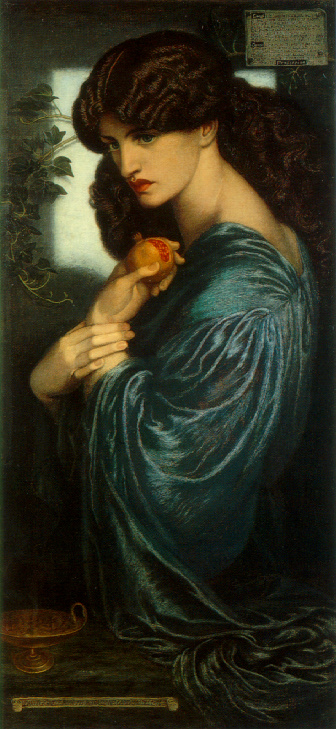
Persephone/Kore/Proserpina- goddess of the Underworld, spring, growth and vegetation. She was the daughter of Demeter and Zeus, and with her mother was linked to the Eleusinian Mysteries, a cult based around the afterlife. In one account Apollodorus called her a daughter of Zeus and Styx, but this is the only accound where she is not a child of Demeter and Zeus.
In her role as a vegetation goddess she was known as Kore, the maiden, it was after Hades abducted her that she seemed to become Persephone. In Arcadia she was called Despoina, the mistress. Originally Despoina/Despoena/Despoine was a seperate entity, a daughter of Demeter and Poseidon, a goddess of mysteries whose real name was known only to those intiated into the Eleusinian Mysteries. She later became linked to Persephone.
Persephone was a beautiful young maiden and Hermes, Ares, Apollo and Hephaestus all offered her gifts in an attempt to woo her- Hermes a rod, Ares a spear and cuirass, Apollo a lyre and Hephaestus a necklace. Demeter rejected the gifts and kept her daughter from the suitors.
Persephone's most infamous story is her abduction by Hades. Hades fell in love with her and asked his brother Zeus for permission to have her as his bride. Without Demeter or Persephone's consent, Zeus agreed that Hades could take Persephone for wife. So when Persephone was playing in the fields, usually with Okeanids, nymphs and/or Athena and Artemis, gathering flowers, Hades came up from the ground in a black or gold chariot, either visible or invisible, and abducted Persephone. In one account the nymph or naiad Cyane/Kyane tried to stop Hades, she cited her consentual relationship with the river god Anapos/Anapis to persuade Hades to woo Persephone but he ignored her and either he turned her into a spring or she cried in grief and became one.
When Demeter realised her daughter was missing she wandered the daughter with torches trying to find her, taking resident with several mortals as she did. Some sources say that the goddess Hecate accompanied her. Eventually she was informed by Helios, in some sources because Hecate suggested seeking him out, that Hades had abducted her daughter.
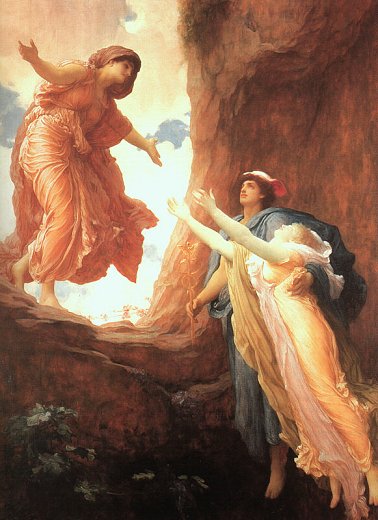
It was only after the earth began to waste away as Demeter neglected her duties as a harvest goddess that Zeus was finally forced to demand the return of Persephone. Either Hecate or Hermes went to retrieve the goddess. Persephone had eaten of the Underworld, six or four pomegranate seeds, and it was a rule of the Moirae that whoever ate of the Underworld had to stay there. Hermes or Zeus made a deal with Hades and Demeter, Persephone would stay in the Underworld with Hades for a third of the year and would spend the other two thirds of the year with Demeter. The result was the four seasons- Spring and Summer were when Demeter rejoiced to be with her daughter, Autumn came as the harvest goddess grew sad over her daughter's looming departure and Winter was when Demeter was without Persephone. In some stories Persephone actually spent half the year with her mother and half with her husband.
One story mentions Ascalaphus/Askalaphos a son of the river of pain Acheron and the Underworld nymph Orphne/Styx/Gorgyra who was Hades' orchadist. He was the one who told the gods that Persephone had eaten in the Underworld and was punished by being turned into a screech owl. Hades then made the screech owl his bird.
With Hades she is usually said to have had no children as the god of the dead cannot have children. However, there are sources that give them children, or mention Persephone having children with Zeus Khthonios, thought to mean the Underworld Zeus and therefore Hades rather than his brother. Melinoe was a goddess of ghosts, she wandered the earth followed by ghosts and brought madness and nightmares to men. Described as being half dark and half light because she was a daughter of Zeus (light) and Persephone (dark) or Hades (dark) and Persephone (light). One hymn tells how Zeus came to Persephone in the form of Hades and seduced her, and for that Hades mangled her flesh in some fashion. She was described as a nymph and was linked to Hecate and the Erinyes.
Macaria/Makaria may have been another daughter, she was the goddess of blessed death, a merciful counterpart to Thanatos she was said to be a daughter of Hades but no mother is given.
The Erinyes are sometimes said to be daughters of Hades and Persephone, though their parents are also given to be Gaia by Ouranos' blood, Nyx, just Hades, or Poine/Poene the spirit of retribution and vengeance. Depicted as having bat or bird wings, blood dripping eyes, dog bodies or/and waists with serpents around them, three are named- Alecto, Megaera and Tisiphone. They punished people who broke oaths, killed their parents, murdered or harboured criminals, and also punished criminals in the Underworld. They were also known as the Eumenides, the Kindly Ones, suggesting a gentler aspect.
With Zeus, Persephone had a son known as Zagreus. Zeus seduced Persephone in the form of a serpent, their son was killed by Titans instigated by a jealous Demeter. They distracted the child with toys and then ripped him to shreds, leaving only his heart. He turned into his several animal forms to escape them but died in the form of a bull. Zeus , Rhea, Athena, Persephone or Hermes recovered the heart and Zeus had Semele swallow the heart and within her the child was reformed as Dionysus. Nonnus mentions that Zeus seduced Persephone before she was wed and that the child played with Zeus' thunderbolts upon his throne and was intended to be his successor. In this story Zagreus is linked with Dionysus saying to be his first form but in other stories the two are two seperate Dionysus, the second being a child of Zeus and Semele and reborn from Zeus' thigh. Zagreus is also linked to Iacchus/Iacchos/Iakchos, a child originally born of Demeter and Poseidon said to carry torches, he was said to be like a star. He was linked to Dionysus and Zagreus, said to be born in the Underworld. Nonnus referred to him as the third Dionysus.
Adonis was another lover though no children came from this union. Adonis was a beautiful child born as the result of incest between Myrrha/Smyrna a princess of Crete and her father King Cinyras. She either simply loved her father or was driven to it by the Erinyes or Aphrodite, possibly because she failed to honour the goddess. After discovering what had happened, Cinyras tried to kill her but she fled and he possibly killed himself, alternatively Apollo killed him after beating him in a music contest Cinyras challenged him to. After wandering in grief the gods turned Myrrha into a myrrh tree. Aphrodite then found her baby, Adonis, in the tree. Aphrodite entrusted the baby to Persephone who then refused to give him back. Zeus or Calliope was forced to intervene and it was decided that Adonis would spend one third of the year with Persephone, one third with Aphrodite and the final third with whoever he chose, naturally he picked Aphrodite.
Adonis was killed by a boar, either sent by Apollo, Artemis or Ares, or Apollo or Ares in disguise, and returned to the Underworld.
Pseudo-Hyginus credited her with creating man from clay, a talent usually given to Prometheus, or in the case of Pandora, Hephaestus. In this obscure story Persephone (here she was called Cura/Koure) created man, Zeus gave man life and the pair disputed over a name for man. Gaia wanted it named for her since it had been made from her and the dispute was taken to Cronus who deemed that he be called homo since he was named from humus.
As Queen of the Underworld she showed kindness to several souls. When Sisyphus was dragged to the Underworld by Thanatos he persuaded either Persephone or Hades to allow him to return to the upper world because his wife had not buried him properly. The god or goddess complied and he ahd to be dragged back by Hermes.
When Orpheus came to the Underworld for his wife Eurydice/Eurydike, Persephone was moved by his music and granted him permission to take his wife back, or persuaded her husband to allow Eurydice to return. There was a clause though, Orpheus must not look back for his wife on their journey out but he did because she limped and he feared she was not there and she was forced to remain in the Underworld.
When the princess Alcestis offered her own life in exchange for her husband Admetus Persephone sent her back and had them both spared. Admetus was a king who had treated Apollo kindly when he had to serve him as a shepherd, his penance for killing the Cyclopes. Apollo got the Moirae drunk and arranged for them to agree that Admetus would be spared death if another volunteered in his place. It is suggested that he faced death for forgetting to sacrifice to Artemis. When not even his elderly parents would sacrifice themselves, his wife Alcestis agreed to. In other versions of the story it is Heracles who rescues Alcestis, either by wrestling Thanatos or Hades for her.
When Boeotia was struck by a plague and Erinyes and the oracle said two maidens must be sacrificed, the daughters of Orion- Menippe and Metioche, known as the Coronides/Koronides, volunteered themselves and killed themselves with their shuttles. Persephone and Hades, or just Persephone, took pity on them and turned them into comets. Ironically, it was Persephone and Hades who caused the pestilence.
She also permitted Heracles to take Cerebus away for his task and to free Theseus, and in some accounts Peirithoos as well, and compelled him to stop wrestling Menoites the keeper of Hades' cattle, who fought Heracles when he killed one. Alternatively, it was just Hades or Hades and Persephone who permitted the hero to take Cerberus.
She also helped Eros' lover Psyche when she came to the Underworld on a task for Aphrodite. Aphrodite sent her to fetch Persephone's box of beauty. Persephone received her hospitably and gave her the box. However, she did also offer her food, perhaps a trick, and in the box was sleep, as Psyche discovered when she opened it. Of course, it is thought that Persephone meant the sleep for Aphrodite rather than Psyche.
As well as kind Persephone could be wrathful. She is said to have turned her husband's lover, the naiad Minthe/Mintha into a mint plant when the nymph boasted of being more beautiful than the goddess. Alternatively, she crushed her with her foot then transformed her, or crushed her to dust and Hades transformed her, or it was Demeter who crushed her when she boasted that she was more beautiful than Persephone and that Hades would return to her.
Ironically though, another nymph lover of Hades' Leuce who was turned into a white poplar tree after she died, became Persephone's sacred plant. It was also suggested that she was a companion of the goddess.
When King Kreon refused to allow the burial of those who died in the Seven Against Thebes, Persephone and Hades inflicted Thebes with a plague, stopped only when two maidens were sacrificed.
Other stories that involve Persephone are Peirithoos' attempt to abduct her and the sacrifice of Macaria. Peirithoos was king of the Lapiths and a friend of Theseus, they decided they deserved daughters of Zeus as wives and so abducted Helen of Troy for Theseus and then went to the Underworld to abduct Persephone for Peirithoos. Hades received them politely and bid them to sit, they sat down on chairs of forgetfulness and found themselves bound their by serpents. When Heracles came for Cerberus he was able to rescue Theseus but in most accounts he could not save Peirithoos because his crime was too great.
Macaria was a daughter of Heracles who with her siblings fled her father's rival King Eurystheus after her father's death. They found sanctuary with King Demophon of Athens but Eurystheus threatened war unless he was given the siblings. An oracle promised victory for Athens only if a maiden was sacrificed to Persephone. Not willing to have a lottery and see someone else die for her, Macaria volunteered and was sacrificed and a spring was named after her.
Persephone's companions were said to be Hecate, who regularly accompanied her from the Underworld to her mother and was her minister, and Leuce/Leuka/Leukippe, an Okeanid who Hades loved and was changed into a white poplar after her death. Before her abduction she was with nymphs, Artemis and Athena.
She is usually shown as young, beautiful, robed and carrying a sheaf of grain or a sceptre. Oppian called her dark eyed and in her role as the Underworld Queen she was known as 'awful' or 'dread' Persephone. She was also called Queen of the Shades.
The poplar tree, white rose, Asphodel plant, pomegranate and narcissus plant were all sacred to her as were bats, talking birds, rams and monkeys.
Her Roman counterpart was Proserpina/Proserpine a fertility goddess who was the partner of Liber, the god of viticulture and wine, before she became the wife of Pluto. In one tale a man named Valerius found his children sick and prayed to the gods for help, they told him to go to Tarentum and pray to the Underworld gods there. He obeyed, dug the foundations for a temple but found the remains of one there so rebuilt it for Proserpina and Pluto. After this his children recovered. In her abduction myth it was Venus who started the whole thing, ordering Cupid to hit Pluto with an arrow because she wanted him to know love.
Tuesday, 17 July 2012
Other Goddesses- Hecate
Hecate/Hekate/Hecat/Trivia- the goddess of witchcraft, the crossroads, night, storms ghosts, the moon, herbs and poisons, and necromancy. The daughter of the Titans Perses (destruction) and his cousin Asteria (stars), a Titaness who was the sister of Leto and turned herself into a quail to escape Zeus. This made Hecate, an only child, cousin to Artemis and Apollo, and granddaughter to Coeus, who was Titan of the axis around the heavens, and Phoebe, a Titaness of the moon. With these connections it is easy to see how Hecate was linked to the moon, usually the dark side of the moon when Artemis became a moon goddess.
Occasionally she is a daughter of Zeus, Nyx, the rustic god Aristaeus/Aristaios who was a son of Apollo and Cyrene who discovered bee keeping, a mortal King named Perses who was brother to Aeetes, and a son of Helios, or Demeter.
She was a powerful goddess with dominion over heaven, earth and sea, though she later became an Underworld goddess.
She aided Zeus against the Titans and so was allowed to retain her power over earth, sky and sea after the Titan war. She also fought against the Gigantes, defeating Klytios/Clytius with fire brands.
She helped Demeter find Persephone, accompanying her on her search with torches and suggesting she go to Helios. She also heard Persephone scream when she was abducted by Hades but did not see the deed occur. After she became Persephone's minister and loyal companion. Rarely she is seen to have been one of Persephone's companions when abducted, along with Artemis and Athena.
She showed favour to Galanthis/Galinthias Alcmene's servant who helped Alcmene with the birth of Heracles. Realising that the goddess of chilbirth Eileithyia had her legs closed and was preventing the birth of Heracles, Galanthis told the goddess that the baby was born. The goddess relaxed at the news so that the baby actually was born. In outrage Eileithyia or Hera turned her into a weasel or polecat. In another version the Moirai were also involved, and it was they who transformed Galanthis. Hecate took pity on her and made the weasel her sacred animal.
She showed favour to Queen Hecuba/Hekabe/Hecabe in a similar manner after the gods turned her into a black dog when she snarled at her captor Odysseus or alternatively, after she blinded or murdered King Polymestor and killed his sons because he had killed her own, Polydorus, when he was met to be keeping him safe. In a third version she became a dog after going mad at the sight of her dead children, Polydorus and Polyxena. Hecate made the dog her familiar and a sacred animal to her.
She helped Medea who was a priestess of hers by teaching her how to create poisons and potions and appeared to aid with making Jason immune to the flames of Aeetes' bronze bulls.
She was said to be able to create and stop storms, making her popular with sailors and shepherds. She also helped Hermes to increase livestock.
She transformed the witch Gale into a black polecat or marten for having abnormal sexual desires.
Sometimes she was viewed as a virgin goddess but in other tales she was a consort of Hermes and/or her husband was Aeetes. She was linked to Hermes because they were both associated with ghosts, roads, travelling between the realms of the living and the dead, and guiding Persephone back to the upper world. It is thought that she was the Brimo who lost her virginity to the god and that Brimo was simply another name for her.
As a wife to Aeetes she was viewed also as his niece, and with him was mother to Circe, Medea and Aegialeus, and possibly Absyrtus and Chalciope. Circe and Medea were great sorceresses, Aegialeus, or more popularily Absyrtus, was killed and dismembered by Medea to delay Aeetes pursuit of Medea and Jason, and Chalciope married Phrixus who gave Aeetes the Golden Fleece. Perses overthrew Aeetes but was killed by Medea who then restored her father. Most commonly, the Oceanid Ediyia was their mother, though her sister Asterodia is also given as Absyrtus' mother, as is the Nereid Neaera, or a woman named Eurylyte may have been there parents. Usually, Circe is seen as Aeetes' sister not his daughter.
Diodorus said that as a daughter of Perses she was a huntress who made poisons that she tested on strangers by lacing their food with it.
Sometimes she also viewed as the mother of the cursed Scylla/Skylla siring her with Phorcys/Phorkys in the disguise of a being called Kratais. Phorcys was a god of the dangerous in the deep sea, and a father of monsters with his consort Ceto, a sea goddess who was the daughter of sea god Pontus/Pontos and Gaia, and may have been Crataeis/Kratais/Krataiis/Trienus. It is hard to tell as these epithets were used for both goddesses. Alternatively, Phorcys had Scylla with the cursed queen Lamia, or Triton had her with Lamia. Scylla herself was cursed either by a jealous Circe or Amphitrite because Glaucus, a sea god, or Poseidon loved her. They poisoned the waters she bathed in and she became a monster with twelve tentacle legs, four/six dog heads at her waist, a cat's tail, or twelve feet and wolves' heads.
She was also given another daughter, Empusa/Empousa, daughter to her and Mormo, a spirit that accompanied Hecate and bit bad children. Initially Empusa was beautiful with flaming hair and brazen shoes and she drank the blood of sleeping men. She was later depicted with a donkey's leg and a bronze leg. In later myth the same Empusae (Empuse- singular) were spectres of Hecate's who guarded roads and devoured travellers. They ran, hid and uttered screams at insults.
In a strange story, Hecate was a mortal priestess to Artemis, linked to her priestess Iphigenia, the daughter Agamemnon was to sacrifice to Artemis to atone for killing a deer in a grove sacred to her and/or boasting that he was a better hunter than her. Artemis took the girl from the altar, substituing her with a deer, she then took her to Tauris where she became a priestess. Agamemnon was to sacrifice her so that the Greek fleets would have the winds to sail to Troy, he tricked her and her mother Clytemnestra by saying he was summoning Iphigenia to wed Achilles. Clytemnestra realised it was a lie when she spoke to Achilles who then vowed to see the girl spared, learning the truth Iphigenia willingly agreed to be sacrificed. In some versions she did die. Hesiod called her Iphimede and said Artemis transformed her into the goddess Hecate.
As a goddess of necromancy she was called upon by several people. Aeson/Aison and his wife the witch Alcimede/Alkimede brought back Aeson's deceased father Cretheus/Kretheus in a blood ritual to learn about their son Jason, they sent him back by appeasing Hecate with a black bull. Teiresias sacrificed black oxen and sheep to her in a grove sacred to her and offered wine, milk and honey as well to summon shades.
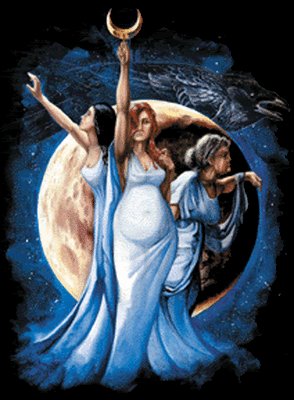
Depicted as a triple goddess and sometimes named as a crone goddess it is easy to see how she became linked to the maiden, mother, crone concept as she was a virgin goddess, a mother, and a crone. Having divinity over earth, heaven and sky may have also explained this triple aspect and as a trinity goddess she was linked to Selene, Artemis and Persephone, or Kore, Persephone and Hecate, or Persephone, Demete and Hecate. Through her connection to Persephone, Kore and Demeter she was a fertility goddess, associated with crops. She was also popular in the households of women.
She was also linked to Keres, the goddess of violent death who were daughters of Nyx and Erebus, and looked for the dead and dying on the battlefield.
She was depicted at crossroads with three heads facing in different directions, usually the heads of maidens but occassionally of animals (dog, snake, horse, cow, boar). She is usually shown holding two torches and sometimes is in a maiden's knee-length skirt and hunting boots, and with keys on her person and accompanied by dogs. A Greek lyric described her as golden shining attendant of Aphrodite, Apollonius said she was garlanded with twigs of oak and snakes,
Her sacred animals were dogs, polecats, weasels, black horses, red mullets, and frogs. Her sacred plants were oak, yew, garlic, cypress, the poisonous aconite, belladonna (deadly nightshade), the healing dittany, which was considered an aphrodisiac and the hallucinogenic mandrake.
Her Roman counterpart was the goddess Trivia. Trivia was a goddess of graveyards, crossroads and witchcraft who travelled invisible at night, heralded by the barking of dogs. She kidnapped maidens to assist her.
Monday, 25 June 2012
Children of Nyx
Nyx/Nox- as mentioned in Creation was sometimes seen as the first goddess, sometimes a child of Panes, sometimes of Chaos, her consort was Erebus with whom she had many children, she also had some through parthenogenesis. She was the goddess of night and rarely appeared in myth. The most prominent tale she featured in was told by Homer, when Hypnos, her son, fled to her to escape Zeus' rage after he put him to sleep at the behest of Hera so she could send a storm to plague Heracles' ship. Zeus would have thrown Hypnos into the sea if he had not hid behind his mother Nyx but fearing Nyx's wrath, Zeus left Hypnos alone.
Erebus/Erebos- was the personification of darkness, sibling and consort to Nyx. A region in the Underworld was also named for him. He was said to envelope the edges of the world and the Underworld with dark mists.
The children linked to these deites are: Aether, Hemera, Eros, Momus, Moros, Thanatos, Hypnos, Oneiroi, Charon, Eris, Ponos, Hesperides, Keres, Moirai, Nemesis, Apate, Dolus, Lyssa, Maniae, Eleos, Sophrosyne, Philotes, Geras, Epiphron, Hybris, and Oizys.
Aether/Aither/Acmon- The first born, he was the personification of upper air, that is the air that the gods' breathed, not ordinary air. His name meant light and as such the air he personified was considered bright and glowing. This was also the boundary that seperated Tartarus from the rest of the world. Ouranos the Titan of the sky, depicited as a brass dome, was above him and the ordinary air was below him, this was known as Aer/Khaos and was seen as another aspect of the first Chaos/Khaos, the invisible air between heaven and earth. Erebus/Erebos was the third personification of air, the dark mists in the land of the dead.
Normally seen as a child of Nyx and Erebus, he was also sometimes just a child of Erebus, a child of Anake and Khronos, just Khronos, or Chaos.
He a female counterpart in Aithre/Thea the Titaness of sight and shining light who was associated with gold, silver and jewels. He was paired with his sister Hemera and with her he was parent to Thalassa, sometimes Gaea/Gaia, and sometimes Ouranos. Gaia was also given to either have just appeared or to be a child of Hydrus, whilst Ouranos was sometimes just a child of Aether, or of Aether and Gaia, or of just Gaia, or of Nyx.
With Gaia he may have also been parent to the Algea, Dolus, Lyssa, Penthos, the Pseudologoi, Horkos/Horcus, Poena/Poine, Lethe, Aergia, and the Hysminae/Hysminai. The Algea, Horucs, Lethe, the Hysminae and the Pseudologoi may have been children of just Eris, Dolus of Erebus and Nyx, Lyssa of just Nyx.
By himself Aether was also possibly parent to the Nephelae/Nephelai, cloud nymphs, alternatively they were daughters of Tethys, or Okeanos.
Hemera- a daughter of Nyx and Erebus, or sometimes a daughter of Nyx and Chronos, or Chaos, and the personification of day. She was consort to her brother Aether and with him parent to Gaia, Ouranos and Thalassa, or just Thalassa.
She lived in Tartarus with her mother and left it as her mother was returning. She was displaced by the dawn goddess Eos in myth with Eos taking greater importance.
Eros/Cupid- the personification of procreation, also a god of love and desire, sometimes he had no parents, other times he was a child of Chaos or Nyx or Erebus and Nyx, or he was a later god and a child of Aphrodite and Ares, though it is possible there were too Eros, one the primordial deity and the other the playful child of Aphrodite.
According to Hesiod, he emerged without parents after Chaos, Gaia and Tartarus. Aristophanes says he hatched from an egg laid in Erebus and that he had golden wings. Thus he could be linked to Phanes/Protogonos, a primordial deity of procreation and new life who emerged from an egg with gold wings and was entwined with a serpent. He was a child of Ananke and Chronos.
Momos/Momus- the god of daimon (spirit) of satire, mockery, blame, censure, ridicule, complaint, scorn and criticism. A child of Nyx and Erebus or just Nyx.
He criticised the gods and was exiled from Olympus for it. He criticised Hephaestus for making man without a door in breast through which his thoughts could be seen, and when he was asked to judge a contest between Zeus, Poseidon and Athena over their creations- man, a bull and a house, he criticised all of them. He criticised man for lacking a window in his heart so his neighbour could see his plans, the bull for not having eyes under its horns so it could see what it was attacking, and the house for being made without wheels. He mocked Zeus for his violent nature and his lust and for having two sons equally villainous. He also either viewed only Aphrodite as blameless or insulted her sandals. His twin was Oizys.
Interestingly he is now linked with Mardi Gras.
His counterpart is Eupheme the daimon of praise and good omens.
Moros- a son of Nyx and Erebus or just Nyx he was the god of doom.
Thanatos/Thanatus/Mors/Letus/Letum- the god of death, usually said to be specifically non-violent death as the Keres dealt with violent death, and twin of Hypnos/Somnus and son to Nyx and Erebus. Homer says Zeus charged him and his brother with taking the body of the hero Sarpedon from Troy and returning it to his homeland, Lycia. When Zeus ordered Thanatos to chain up King Sisyphus in Tartarus, as Sisyphus had told the river god Asopus that it was Zeus who took his daughter Aegina, Sisyphus asked Thanatos to demonstrate how his chains worked. Thanatos complied and was trapped until Ares freed him, tired of there being no death in warfare.
When King Admetus was to die Apollo persuaded the Moirai to take another in his place, when his parents refused his wife Alcestis offered herself. When Thanatos came for Alcestis Heracles wrestled him for her life and won.
He was often depicted as a winged youth or a youth carrying a butterfly, poppies or an upside down torch and with a sword, and was usually with his twin. He was displaced by Hermes who as a psychopomp guided the dead to the Underworld. Sometimes he was depicted as bearded.
His Roman counterpart Mors/Letus/Letum was in Roman art a male but in poetry a female, usually pale and clothed in black.
Hypnos/Somnus- the god of sleep and twin to Thanatos, a son of Erebus and Nyx. He dwelt in a cave without a door and with poppies growing outside it. The sun did not shine in this cave and it was usually said to be in Erebus, said to have river of forgetfulness, Lethe, flowing through it.
With his brother Thanatos he was charged by Zeus to carry Sarpedon's body from Troy to Lycia.
He put Zeus to sleep at Hera's behest so that she could send a storm to attack Heracles' boat. When Zeus awoke he was in a rage and would have thrown Hypnos into the sea if he had not hid with his mother Nyx, who even Zeus feared. When Hera asked Hypnos to again put Zeus to sleep, during the Trojan War, promising him a throne of gold he refused until she offered him the Charite Pasithea as a wife. He then went to Poseidon letting him know that Zeus was asleep and that Poseidon could thus take action in the Trojan War.
He put Endymion to sleep with his eyes open at his own request, either so Endymion could watch his lover Selene or so that Hypnos could see his eyes.
He was depicted as a youth either bearded or beardless with wings on his shoulders or head, carrying an inverted torch or poppies or a jar with water from the river Lethe in it.
The Oneiroi were his brothers or children and helpers.
Oneiroi- The daimons of dreams they were said to be a thousand in number and dark winged. Either the children of Hypnos or of Nyx or Erebus and Nyx. They lived in a cave in Erebus and passed through a gate of horn to deliver prophetic dreams or a gate of ivory to deliver meaningless dreams. Ovid named three- Morpheus, Icelus/Icelos/Ikelos/Phobetor and Phantasos/Phantasus.
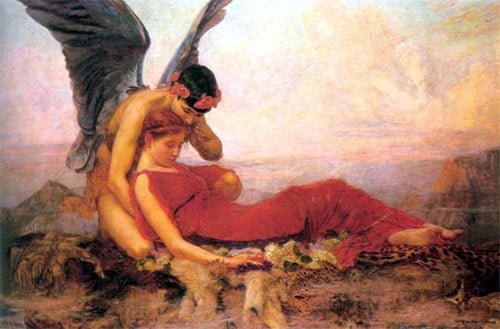
Morpheus was the leader of the Oneiroi and he appeared in the dreams of rulers in the form of a human, and he shaped dreams. He may have been the dream spirit sent by Zeus to Agamemnon in the Illiad. There was a wilted elm tree in his domain on which he hung fashioned dreams, which appeared as winged phantom shapes.
Phobetor was associated with nightmares and animals and monsters in dreams and he appeared in the mortal realm in the form of any animal he wished. His true name was Icelus/Icelos/Ikelos, which means semblance. The word phobia comes from his name.
Phantasos was associated with inanimate objects in dreams and it is from his name that the words fantasy and phantom likely come from.
There was also another daimon of nightmares- Epiales/Epialos/Epioles/Epialtes who may have been another of the Oneiroi.
Charon/Kharon- a son of Erebus and Nyx he was a servant of Hades and ferryman to the dead. He received the dead from Hermes and ferried them across the river of pain Acheron/Akheron in exchange for an obol/danake coin that was placed in their mouth when they were buried. Those unburied or buried without the coin were left to wander the other side of Acheron for a hundred years and appeared as ghosts on earth.
He was shown as an ugly seaman in reddish-brown clothes with a ferryman's pole, bearded and with flashing, angry eyes possibly of a bluish-grey colour.
He could be linked with the Etruscan god Charun/Charu/Karun, he had pointed ears, snakes around his arms, blue skin, snakes in his hair, a vulture's hooked nose, tusks, fiery eyes, wings, and a beard, and he guarded the Underworld with a hammer. He guided the dead and may have punished or protected them with his hammer as well, and he was helped by Vanth a female demon who was a winged, benevolent guide to the dead.
Eris/Discordia- the goddess of strife and discord. A daughter of Nyx or of Zeus and Hera. Hesiod said there were in fact two Strife's, one who was cruel and linked to war and battle, and one a daughter of Zeus who was kinder. She was linked with the war goddess Enyo, and Homer viewed them as one and the same.
She was given many children- Ponos (hard labour and toil, who may have been a son of Erebus and Nyx), Lethe (forgetfulness and oblivion, who may have been a daughter of Aether and Gaia), Limos/Limus (hunger), and Ate (delusion, folly, reckless impulse) whose father was Zeus, the Algea/Algos (pain, suffering, grief, distress), the Hysminae (non-martial fighting and combat), the Neikea/Neicea (quarrels, feuds, grievances), the Pseudologi (lies), and Horkos/Horcus (oath) (who all may have been children of Aether and Gaia as well), the Amphilogiai (disputes, debate), Dysnomia (lawlessness), the Phonoi (murder, killing, slaughter), the Androctasiae/Androktasiai (battlefield slaughter), and the Machae/Makhai (battle and combat).
Her most famous story is about the golden apple that started the Trojan War. Angry at not being invited to Peleus and Thetis' wedding, Eris threw a golden apple into the party, The Apple of Discord, which was enscribed kalliste/kallisti meaning for/to the most beautiful/the fairest. Athena, Hera and Aphrodite all laid claim to it and Zeus charged the prince of Troy Paris/Alexander with judging the winner as he had promised to award a golden crown to whoever had a bull better than this and when Ares disguised himself as a bull, Paris fairly awarded him the prize, thus it was the fairness that prompted Zeus to pick him to decide the fairest goddess. Paris picked Aphrodite when she promised him Helen of Troy, the most beautiful woman in the world, for a wife.
When the couple Aedon and Polytechnos boasted to love each other more than Zeus and Hera, Hera sent Eris to cause trouble. She caused them to have a competition when Polytechnos was making a chair and Aedon was doing embroidery, whoever finished first should present the other with a female slave. Aedon finished first, furious Polytechnos went to Aedon's father and tricked him into giving over her sister Chelidonis on the pretence that Aedon wanted to see her. He raped Chelidonis and then dressed her as a slave, swore her to silence and gave to Aedon. Chelidonis then lamented her fate and was overheard by Aedon, they plotted revenge and killed Polytechnos' son Itys and fed him to Polytechnos. Polytechnos was then bound, smeared in honey and exposed to insects. Zeus then turned him into a pelican, Aedon into a nightingale and Chelidonis into a swallow. This story was very like that of the princesses Procne and Philomela.
Ponos- a son of Eris or of Eerebus and Nyx, he was the personification of hard labour and toil.
Hesperides- goddess or nymphs of the evening, they tended a garden at the far west at the edge of Okeanos. Daughters of Nyx, Nyx and Erebus, Atlas and Hesperis, Hesperos, Zeus and Themis, or Phorcys/Phorkys and Ceto. They guarded Hera's garden of golden apples, which a gift to her from Gaia on her wedding day to Zeus, they guarded this with a hundred-headed dragon called Ladon, who was placed there by Hera because she did not fully trust the Hesperides.
They were three or seven in number and their given names were- Aigle/Aegle, Arethusa/Arethousa, Erytheia/Erytheis/Erythea, Hesperia/Hespereia/Hespere/Hespera/ Hesperusa/Hesperethoosa/Hesperthousa/Hesperthusa, Chrysothemis/Khrysothemis, Lipara, and Asterope. They were said to be good singers.
They also guarded the winged sandals, the kibisis (knapsack), and the helmet of invisibility that Perseus needed. Athena told him to find them for these items and he went to the Graeae who gave him directions after he took their tooth and eye from them. Alternatively Perseus just received a knapsack from the Hesperides and the sandals, a sword and the helmet from Hermes, or the sandals from Hermes and the sword and helmet from Zeus. The Gorgons lived near them.
For his Eleventh Labour, Heracles had to retrieve some apples from the Hesperides' Garden. He got directions from the Old Man of the Sea (Pontus, Glaucus, Phorcys or Nereus) and then finding it asked Atlas to fetch them. He held the sky up whilst Atlas did this and then when Atlas refused to take his burden back, after obtaining the apples, Heracles tricked him into it by asking him to hold it while he adjusted his cloak. In another version Heracles slew Ladon. Athena then returned the apples once Heracles' labour was completed.
Ovid mentioned how Atlas guarded the garden and was warned that a son of Zeus would take the apples from them. When Perseus arrived and asked for sanctuary Atlas tried to throw him out and Perseus used Medusa's head to turn him to stone.
The golden apple that Eris threw into the party at Peleus and Thetis' wedding 'for the fairest' may have come from this garden, as may have the golden apples that caused Atalanta to lose the race against Melanion. Melanion received these apples from Aphrodite and threw them down to distract Atalanta so that he might win the race against her and gain her as a bride.
Keres- female daimons of violent death. They were children of just Nyx or of Nyx and Erebus. They were bloodthirsty with gnashing teeth, claws and wings. They ripped out souls on the battlefields with their claws. Their names were: Anaplekte (quick death), Akhlys (mist of death), Nosos (disease), Ker (destruction), and Stygere (hateful).
Their Roman equivalents were Letum (death) and Tenebrae (shadows).
Moirai/Moiraie/Moerae/Fates/Parcae/Fata- daughters of Nyx, Nyx and Erebus, Chronos and Nyx, Zeus and Themis, Ananke, Chaos, or Okeanos and Gaia. They were three in number- Clotho/Klotho/Nona, the spinner, Lachesis/Lakhesis/Decima, the allotter, and Atropos/Aisa/Morta, the inevitable.
They controlled the thread of mortals' lives from birth to death, deciding how long they should live, and even Zeus was subject to their will. They appeared three nights after a child's birth to determine their fate. As such they appeared to Althaea after the birth of her son Meleager with a burning brand and determined he would live until it burned out. Althaea doused the brand and hid it until Meleager killed his uncles when they stole the pelt of the Calydonian Boar from Atalanta after Meleager had gifted it to her. Furious at her brothers' deaths, Althaea threw the brand into a fire.
Apollo got them drunk in order to get them to prolong the life of his friend Admetus, they agreed that another could take his place. His wife Alcestis agreed to take his place and was saved from Thanatos by Heracles.
They were white robed, ugly, old women who were sometimes lame. They assisted Hermes' with inventing the alphabet, killed the Gigantes Agrius/Agrios and Thoas/Thoon with bronze clubs, and in some versions poisoned the monster Typhon with fruit.
Clotho sang of things that are and carried a spindle and the book of fate. She was the youngest and chose who was born and when. She brought Pelops back from the dead after his father Tantalus killed him and tried to trick the gods into eating him.
Lachesis sang of things that were and carried a measuring rod. She was the middle of the three and decided how much time each person was allowed in life. Hesiod says she also allowed people to choose their next life.
Atropos sang of things that would be and carried a scroll, a wax tablet, a sundial, a pair of scales and shears. She was the oldest and chose how people would die.
They were linked to the Erinyes, who punished people for wrongful murders as murder went against fate, the childbirth goddess Eileythia, the Keres, and sat at the throne of Zeus or Hades. According to Plato they had their own thrones and sang with the Sirens.
Their Roman equivalents were the Parcae- Nona, Decima and Morta. Nona was also a goddess of pregnancy, Decima of childbirth and Morta of pain and death.
Nemesis/Rhamnousia/Rhamnusia- was the goddess of retribution and vengeful fate. She was a daughter of Nyx, Nyx and Erebus, Okeanos or Zeus. She was neither good nor bad, granting that which was deserved. She was associated with resentment for those who had obtained good fortune unfairly.
Her names Rhamnousia and Rhamnusia came from being worshipped at Rhamnous in Attica.
Sometimes she is said to be the mother of Helen of Troy, and also her siblings Clytemnestra, and the Dioscuri Castor and Pollux, having conceived them in the form of a goose to Zeus in the form of a swan. In other versions she lays the egg from which Helen is hatched and it is found by Leda. Alternatively, Leda is simply her mother.
The Telchines/Telkhines, four sea demons who invented metalworking are sometimes given as her children with Tartarus, at other times they are children of Pontus and Gaia, Ouranos and Gaia, Thalassa, or Poseidon.
Apate/Fraus- a child of Nyx, or Nyx and Erebus, she was the personification of deceit, guile, fraud and deception. Her counterpart was her sibling Dolus/Dolos, and her companions were her siblings the Pseudologoi. She may have been one of the evils in Pandora's jar.
Fraus was her Roman counterpart, the personification of treachery and fraud she had a woman's head, a snake's body and a scorpion's tail and helped Mercury.
Dolus/Dolos- the personification of trickery, craftiness, treachery, and guile he was a child of Nyx and Erebus, or Aether and Gaia. An apprentice of Prometheus, he accompanied his siblings the Pseudologoi, and his counterpart was his sister Apate.
Lyssa/Lytta/Ira/Furor/Rabies- a daughter of Nyx and Ouranos or of Aether and Gaia. The goddess/daimon of rage, fury, frenzy, rabies and raging madness. She was linked to the Maniae. Hera asked her to make Heracles insane and though she obeyed it was with reluctance. She was also sent by Dionysus to drive the Minyades mad, daughters of Minyas who neglected the worship of Dionysus and were driven mad as a consequence. She was also linked to the hunter Actaeon/Aktaion, specifically his maddened dogs who tore him apart after he was turned into a stag by Artemis.
Her Roman name was Ira, Furor or Rabies, sometimes she was seen as multiple deities- Irae/Furores.
Maniae/Maniai- daughters of Nyx though no source states this. The personification of madness, insanity and crazed frenzy. They worked with Lyssa and the Erinyes. They are also called nursemaids of Eros but whether in jest, irony or simply truth as Eros can be cruel, is unknown.
Eleos- a child of Nyx and Erebus, either the god or goddess of mercy, pity and compassion. The goddess Anaideia (ruthlessness, shamelessness) was their opposite. Heracles' children sought refuge at his altar in Athens from Eurystheus who was Heracles' rival and set his Twelve Labours, he sought to kill them after their father Heracles died. They survived and Eurystheus and his sons were killed.
Adrastos/Adrastus/Adrestus, a king of Argos during The Seven Against Thebes, went to the same altar after he lost and fled to Athens to beseech Theseus for aid.
Sophrosyne- daughter of Erebus and Nyx, and the goddess of moderation, temperance, self-control and restraint. She may have been one of the good things that escaped Pandora's jar. Her Roman equivalents were Continentia and Sobrietas.
Philotes- a daughter of just Nyx or Nyx and Erebus, she was the goddess of friendship, sexual intercourse and affection. The Neikea (quarrels, feuds) opposed her.
Geras/Senectus- a son of just Nyx or Nyx and Erebus and the personification of old age. He was viewed as a shrivelled, old man. His opposite was the goddess of youth, Heracles' last wife- Hebe, daughter of Zeus and Hera. He was shown on vases with Heracles though the story behind it is unknown. His Roman equivalent was Senectus.
Epiphron- a son of Erebus and Nyx and the personification of prudence, thoughtfulness, carefulness, shrewdness and sagacity.
Hybris/Petulantia- a daughter of Nyx and Erebus, or of Dyssebia (impiety) she was the goddess of impiety, wantonness, recklessness, pride, arrogance and outrageous behaviour. She was the mother of Corus/Koros the personification of insolence and distain, and of Dyssebia sometimes. Her Roman equivalent was Petulantia.
Oizys/ Miseria- a daughter of Nyx or Nyx and Erebus, she was the goddess of misery, woe, suffering and distress. Her twin was Momos. Her Roman name was Miseria.
Erebus/Erebos- was the personification of darkness, sibling and consort to Nyx. A region in the Underworld was also named for him. He was said to envelope the edges of the world and the Underworld with dark mists.
The children linked to these deites are: Aether, Hemera, Eros, Momus, Moros, Thanatos, Hypnos, Oneiroi, Charon, Eris, Ponos, Hesperides, Keres, Moirai, Nemesis, Apate, Dolus, Lyssa, Maniae, Eleos, Sophrosyne, Philotes, Geras, Epiphron, Hybris, and Oizys.
Aether/Aither/Acmon- The first born, he was the personification of upper air, that is the air that the gods' breathed, not ordinary air. His name meant light and as such the air he personified was considered bright and glowing. This was also the boundary that seperated Tartarus from the rest of the world. Ouranos the Titan of the sky, depicited as a brass dome, was above him and the ordinary air was below him, this was known as Aer/Khaos and was seen as another aspect of the first Chaos/Khaos, the invisible air between heaven and earth. Erebus/Erebos was the third personification of air, the dark mists in the land of the dead.
Normally seen as a child of Nyx and Erebus, he was also sometimes just a child of Erebus, a child of Anake and Khronos, just Khronos, or Chaos.
He a female counterpart in Aithre/Thea the Titaness of sight and shining light who was associated with gold, silver and jewels. He was paired with his sister Hemera and with her he was parent to Thalassa, sometimes Gaea/Gaia, and sometimes Ouranos. Gaia was also given to either have just appeared or to be a child of Hydrus, whilst Ouranos was sometimes just a child of Aether, or of Aether and Gaia, or of just Gaia, or of Nyx.
With Gaia he may have also been parent to the Algea, Dolus, Lyssa, Penthos, the Pseudologoi, Horkos/Horcus, Poena/Poine, Lethe, Aergia, and the Hysminae/Hysminai. The Algea, Horucs, Lethe, the Hysminae and the Pseudologoi may have been children of just Eris, Dolus of Erebus and Nyx, Lyssa of just Nyx.
By himself Aether was also possibly parent to the Nephelae/Nephelai, cloud nymphs, alternatively they were daughters of Tethys, or Okeanos.
Hemera- a daughter of Nyx and Erebus, or sometimes a daughter of Nyx and Chronos, or Chaos, and the personification of day. She was consort to her brother Aether and with him parent to Gaia, Ouranos and Thalassa, or just Thalassa.
She lived in Tartarus with her mother and left it as her mother was returning. She was displaced by the dawn goddess Eos in myth with Eos taking greater importance.
Eros/Cupid- the personification of procreation, also a god of love and desire, sometimes he had no parents, other times he was a child of Chaos or Nyx or Erebus and Nyx, or he was a later god and a child of Aphrodite and Ares, though it is possible there were too Eros, one the primordial deity and the other the playful child of Aphrodite.
According to Hesiod, he emerged without parents after Chaos, Gaia and Tartarus. Aristophanes says he hatched from an egg laid in Erebus and that he had golden wings. Thus he could be linked to Phanes/Protogonos, a primordial deity of procreation and new life who emerged from an egg with gold wings and was entwined with a serpent. He was a child of Ananke and Chronos.
Momos/Momus- the god of daimon (spirit) of satire, mockery, blame, censure, ridicule, complaint, scorn and criticism. A child of Nyx and Erebus or just Nyx.
He criticised the gods and was exiled from Olympus for it. He criticised Hephaestus for making man without a door in breast through which his thoughts could be seen, and when he was asked to judge a contest between Zeus, Poseidon and Athena over their creations- man, a bull and a house, he criticised all of them. He criticised man for lacking a window in his heart so his neighbour could see his plans, the bull for not having eyes under its horns so it could see what it was attacking, and the house for being made without wheels. He mocked Zeus for his violent nature and his lust and for having two sons equally villainous. He also either viewed only Aphrodite as blameless or insulted her sandals. His twin was Oizys.
Interestingly he is now linked with Mardi Gras.
His counterpart is Eupheme the daimon of praise and good omens.
Moros- a son of Nyx and Erebus or just Nyx he was the god of doom.
Hypnos and Thanatos
Thanatos/Thanatus/Mors/Letus/Letum- the god of death, usually said to be specifically non-violent death as the Keres dealt with violent death, and twin of Hypnos/Somnus and son to Nyx and Erebus. Homer says Zeus charged him and his brother with taking the body of the hero Sarpedon from Troy and returning it to his homeland, Lycia. When Zeus ordered Thanatos to chain up King Sisyphus in Tartarus, as Sisyphus had told the river god Asopus that it was Zeus who took his daughter Aegina, Sisyphus asked Thanatos to demonstrate how his chains worked. Thanatos complied and was trapped until Ares freed him, tired of there being no death in warfare.
When King Admetus was to die Apollo persuaded the Moirai to take another in his place, when his parents refused his wife Alcestis offered herself. When Thanatos came for Alcestis Heracles wrestled him for her life and won.
He was often depicted as a winged youth or a youth carrying a butterfly, poppies or an upside down torch and with a sword, and was usually with his twin. He was displaced by Hermes who as a psychopomp guided the dead to the Underworld. Sometimes he was depicted as bearded.
His Roman counterpart Mors/Letus/Letum was in Roman art a male but in poetry a female, usually pale and clothed in black.
Hypnos and Nyx
Hypnos/Somnus- the god of sleep and twin to Thanatos, a son of Erebus and Nyx. He dwelt in a cave without a door and with poppies growing outside it. The sun did not shine in this cave and it was usually said to be in Erebus, said to have river of forgetfulness, Lethe, flowing through it.
With his brother Thanatos he was charged by Zeus to carry Sarpedon's body from Troy to Lycia.
He put Zeus to sleep at Hera's behest so that she could send a storm to attack Heracles' boat. When Zeus awoke he was in a rage and would have thrown Hypnos into the sea if he had not hid with his mother Nyx, who even Zeus feared. When Hera asked Hypnos to again put Zeus to sleep, during the Trojan War, promising him a throne of gold he refused until she offered him the Charite Pasithea as a wife. He then went to Poseidon letting him know that Zeus was asleep and that Poseidon could thus take action in the Trojan War.
He put Endymion to sleep with his eyes open at his own request, either so Endymion could watch his lover Selene or so that Hypnos could see his eyes.
He was depicted as a youth either bearded or beardless with wings on his shoulders or head, carrying an inverted torch or poppies or a jar with water from the river Lethe in it.
The Oneiroi were his brothers or children and helpers.
Morpheus
Oneiroi- The daimons of dreams they were said to be a thousand in number and dark winged. Either the children of Hypnos or of Nyx or Erebus and Nyx. They lived in a cave in Erebus and passed through a gate of horn to deliver prophetic dreams or a gate of ivory to deliver meaningless dreams. Ovid named three- Morpheus, Icelus/Icelos/Ikelos/Phobetor and Phantasos/Phantasus.
Morpheus was the leader of the Oneiroi and he appeared in the dreams of rulers in the form of a human, and he shaped dreams. He may have been the dream spirit sent by Zeus to Agamemnon in the Illiad. There was a wilted elm tree in his domain on which he hung fashioned dreams, which appeared as winged phantom shapes.
Phobetor was associated with nightmares and animals and monsters in dreams and he appeared in the mortal realm in the form of any animal he wished. His true name was Icelus/Icelos/Ikelos, which means semblance. The word phobia comes from his name.
Phantasos was associated with inanimate objects in dreams and it is from his name that the words fantasy and phantom likely come from.
There was also another daimon of nightmares- Epiales/Epialos/Epioles/Epialtes who may have been another of the Oneiroi.
The ferryman Charon
Charon/Kharon- a son of Erebus and Nyx he was a servant of Hades and ferryman to the dead. He received the dead from Hermes and ferried them across the river of pain Acheron/Akheron in exchange for an obol/danake coin that was placed in their mouth when they were buried. Those unburied or buried without the coin were left to wander the other side of Acheron for a hundred years and appeared as ghosts on earth.
He was shown as an ugly seaman in reddish-brown clothes with a ferryman's pole, bearded and with flashing, angry eyes possibly of a bluish-grey colour.
He could be linked with the Etruscan god Charun/Charu/Karun, he had pointed ears, snakes around his arms, blue skin, snakes in his hair, a vulture's hooked nose, tusks, fiery eyes, wings, and a beard, and he guarded the Underworld with a hammer. He guided the dead and may have punished or protected them with his hammer as well, and he was helped by Vanth a female demon who was a winged, benevolent guide to the dead.
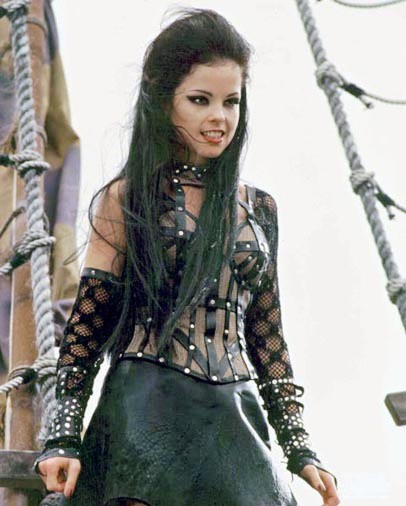
Discord from Xena/ Hercules the Legendary Journeys
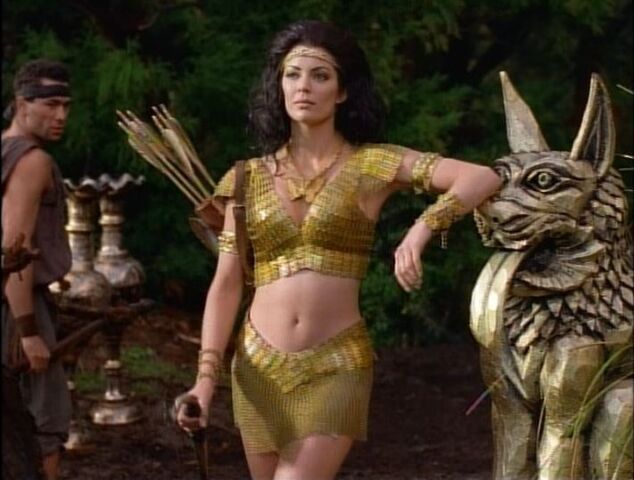
Eris/Discordia- the goddess of strife and discord. A daughter of Nyx or of Zeus and Hera. Hesiod said there were in fact two Strife's, one who was cruel and linked to war and battle, and one a daughter of Zeus who was kinder. She was linked with the war goddess Enyo, and Homer viewed them as one and the same.
She was given many children- Ponos (hard labour and toil, who may have been a son of Erebus and Nyx), Lethe (forgetfulness and oblivion, who may have been a daughter of Aether and Gaia), Limos/Limus (hunger), and Ate (delusion, folly, reckless impulse) whose father was Zeus, the Algea/Algos (pain, suffering, grief, distress), the Hysminae (non-martial fighting and combat), the Neikea/Neicea (quarrels, feuds, grievances), the Pseudologi (lies), and Horkos/Horcus (oath) (who all may have been children of Aether and Gaia as well), the Amphilogiai (disputes, debate), Dysnomia (lawlessness), the Phonoi (murder, killing, slaughter), the Androctasiae/Androktasiai (battlefield slaughter), and the Machae/Makhai (battle and combat).
Her most famous story is about the golden apple that started the Trojan War. Angry at not being invited to Peleus and Thetis' wedding, Eris threw a golden apple into the party, The Apple of Discord, which was enscribed kalliste/kallisti meaning for/to the most beautiful/the fairest. Athena, Hera and Aphrodite all laid claim to it and Zeus charged the prince of Troy Paris/Alexander with judging the winner as he had promised to award a golden crown to whoever had a bull better than this and when Ares disguised himself as a bull, Paris fairly awarded him the prize, thus it was the fairness that prompted Zeus to pick him to decide the fairest goddess. Paris picked Aphrodite when she promised him Helen of Troy, the most beautiful woman in the world, for a wife.
When the couple Aedon and Polytechnos boasted to love each other more than Zeus and Hera, Hera sent Eris to cause trouble. She caused them to have a competition when Polytechnos was making a chair and Aedon was doing embroidery, whoever finished first should present the other with a female slave. Aedon finished first, furious Polytechnos went to Aedon's father and tricked him into giving over her sister Chelidonis on the pretence that Aedon wanted to see her. He raped Chelidonis and then dressed her as a slave, swore her to silence and gave to Aedon. Chelidonis then lamented her fate and was overheard by Aedon, they plotted revenge and killed Polytechnos' son Itys and fed him to Polytechnos. Polytechnos was then bound, smeared in honey and exposed to insects. Zeus then turned him into a pelican, Aedon into a nightingale and Chelidonis into a swallow. This story was very like that of the princesses Procne and Philomela.
Ponos- a son of Eris or of Eerebus and Nyx, he was the personification of hard labour and toil.
Hesperides- goddess or nymphs of the evening, they tended a garden at the far west at the edge of Okeanos. Daughters of Nyx, Nyx and Erebus, Atlas and Hesperis, Hesperos, Zeus and Themis, or Phorcys/Phorkys and Ceto. They guarded Hera's garden of golden apples, which a gift to her from Gaia on her wedding day to Zeus, they guarded this with a hundred-headed dragon called Ladon, who was placed there by Hera because she did not fully trust the Hesperides.
They were three or seven in number and their given names were- Aigle/Aegle, Arethusa/Arethousa, Erytheia/Erytheis/Erythea, Hesperia/Hespereia/Hespere/Hespera/ Hesperusa/Hesperethoosa/Hesperthousa/Hesperthusa, Chrysothemis/Khrysothemis, Lipara, and Asterope. They were said to be good singers.
They also guarded the winged sandals, the kibisis (knapsack), and the helmet of invisibility that Perseus needed. Athena told him to find them for these items and he went to the Graeae who gave him directions after he took their tooth and eye from them. Alternatively Perseus just received a knapsack from the Hesperides and the sandals, a sword and the helmet from Hermes, or the sandals from Hermes and the sword and helmet from Zeus. The Gorgons lived near them.
For his Eleventh Labour, Heracles had to retrieve some apples from the Hesperides' Garden. He got directions from the Old Man of the Sea (Pontus, Glaucus, Phorcys or Nereus) and then finding it asked Atlas to fetch them. He held the sky up whilst Atlas did this and then when Atlas refused to take his burden back, after obtaining the apples, Heracles tricked him into it by asking him to hold it while he adjusted his cloak. In another version Heracles slew Ladon. Athena then returned the apples once Heracles' labour was completed.
Ovid mentioned how Atlas guarded the garden and was warned that a son of Zeus would take the apples from them. When Perseus arrived and asked for sanctuary Atlas tried to throw him out and Perseus used Medusa's head to turn him to stone.
The golden apple that Eris threw into the party at Peleus and Thetis' wedding 'for the fairest' may have come from this garden, as may have the golden apples that caused Atalanta to lose the race against Melanion. Melanion received these apples from Aphrodite and threw them down to distract Atalanta so that he might win the race against her and gain her as a bride.
Keres- female daimons of violent death. They were children of just Nyx or of Nyx and Erebus. They were bloodthirsty with gnashing teeth, claws and wings. They ripped out souls on the battlefields with their claws. Their names were: Anaplekte (quick death), Akhlys (mist of death), Nosos (disease), Ker (destruction), and Stygere (hateful).
Their Roman equivalents were Letum (death) and Tenebrae (shadows).
The Fates from Xena
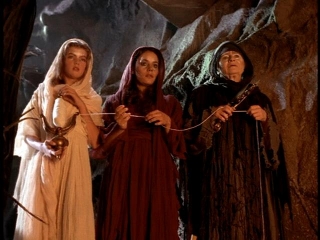
Moirai/Moiraie/Moerae/Fates/Parcae/Fata- daughters of Nyx, Nyx and Erebus, Chronos and Nyx, Zeus and Themis, Ananke, Chaos, or Okeanos and Gaia. They were three in number- Clotho/Klotho/Nona, the spinner, Lachesis/Lakhesis/Decima, the allotter, and Atropos/Aisa/Morta, the inevitable.
They controlled the thread of mortals' lives from birth to death, deciding how long they should live, and even Zeus was subject to their will. They appeared three nights after a child's birth to determine their fate. As such they appeared to Althaea after the birth of her son Meleager with a burning brand and determined he would live until it burned out. Althaea doused the brand and hid it until Meleager killed his uncles when they stole the pelt of the Calydonian Boar from Atalanta after Meleager had gifted it to her. Furious at her brothers' deaths, Althaea threw the brand into a fire.
Apollo got them drunk in order to get them to prolong the life of his friend Admetus, they agreed that another could take his place. His wife Alcestis agreed to take his place and was saved from Thanatos by Heracles.
They were white robed, ugly, old women who were sometimes lame. They assisted Hermes' with inventing the alphabet, killed the Gigantes Agrius/Agrios and Thoas/Thoon with bronze clubs, and in some versions poisoned the monster Typhon with fruit.
Clotho sang of things that are and carried a spindle and the book of fate. She was the youngest and chose who was born and when. She brought Pelops back from the dead after his father Tantalus killed him and tried to trick the gods into eating him.
Lachesis sang of things that were and carried a measuring rod. She was the middle of the three and decided how much time each person was allowed in life. Hesiod says she also allowed people to choose their next life.
Atropos sang of things that would be and carried a scroll, a wax tablet, a sundial, a pair of scales and shears. She was the oldest and chose how people would die.
They were linked to the Erinyes, who punished people for wrongful murders as murder went against fate, the childbirth goddess Eileythia, the Keres, and sat at the throne of Zeus or Hades. According to Plato they had their own thrones and sang with the Sirens.
Their Roman equivalents were the Parcae- Nona, Decima and Morta. Nona was also a goddess of pregnancy, Decima of childbirth and Morta of pain and death.
Nemesis from Hercules the Legendary Journeys
Nemesis/Rhamnousia/Rhamnusia- was the goddess of retribution and vengeful fate. She was a daughter of Nyx, Nyx and Erebus, Okeanos or Zeus. She was neither good nor bad, granting that which was deserved. She was associated with resentment for those who had obtained good fortune unfairly.
Her names Rhamnousia and Rhamnusia came from being worshipped at Rhamnous in Attica.
Sometimes she is said to be the mother of Helen of Troy, and also her siblings Clytemnestra, and the Dioscuri Castor and Pollux, having conceived them in the form of a goose to Zeus in the form of a swan. In other versions she lays the egg from which Helen is hatched and it is found by Leda. Alternatively, Leda is simply her mother.
The Telchines/Telkhines, four sea demons who invented metalworking are sometimes given as her children with Tartarus, at other times they are children of Pontus and Gaia, Ouranos and Gaia, Thalassa, or Poseidon.
Apate/Fraus- a child of Nyx, or Nyx and Erebus, she was the personification of deceit, guile, fraud and deception. Her counterpart was her sibling Dolus/Dolos, and her companions were her siblings the Pseudologoi. She may have been one of the evils in Pandora's jar.
Fraus was her Roman counterpart, the personification of treachery and fraud she had a woman's head, a snake's body and a scorpion's tail and helped Mercury.
Dolus/Dolos- the personification of trickery, craftiness, treachery, and guile he was a child of Nyx and Erebus, or Aether and Gaia. An apprentice of Prometheus, he accompanied his siblings the Pseudologoi, and his counterpart was his sister Apate.
Lyssa/Lytta/Ira/Furor/Rabies- a daughter of Nyx and Ouranos or of Aether and Gaia. The goddess/daimon of rage, fury, frenzy, rabies and raging madness. She was linked to the Maniae. Hera asked her to make Heracles insane and though she obeyed it was with reluctance. She was also sent by Dionysus to drive the Minyades mad, daughters of Minyas who neglected the worship of Dionysus and were driven mad as a consequence. She was also linked to the hunter Actaeon/Aktaion, specifically his maddened dogs who tore him apart after he was turned into a stag by Artemis.
Her Roman name was Ira, Furor or Rabies, sometimes she was seen as multiple deities- Irae/Furores.
Maniae/Maniai- daughters of Nyx though no source states this. The personification of madness, insanity and crazed frenzy. They worked with Lyssa and the Erinyes. They are also called nursemaids of Eros but whether in jest, irony or simply truth as Eros can be cruel, is unknown.
Eleos- a child of Nyx and Erebus, either the god or goddess of mercy, pity and compassion. The goddess Anaideia (ruthlessness, shamelessness) was their opposite. Heracles' children sought refuge at his altar in Athens from Eurystheus who was Heracles' rival and set his Twelve Labours, he sought to kill them after their father Heracles died. They survived and Eurystheus and his sons were killed.
Adrastos/Adrastus/Adrestus, a king of Argos during The Seven Against Thebes, went to the same altar after he lost and fled to Athens to beseech Theseus for aid.
Sophrosyne- daughter of Erebus and Nyx, and the goddess of moderation, temperance, self-control and restraint. She may have been one of the good things that escaped Pandora's jar. Her Roman equivalents were Continentia and Sobrietas.
Philotes- a daughter of just Nyx or Nyx and Erebus, she was the goddess of friendship, sexual intercourse and affection. The Neikea (quarrels, feuds) opposed her.
Geras/Senectus- a son of just Nyx or Nyx and Erebus and the personification of old age. He was viewed as a shrivelled, old man. His opposite was the goddess of youth, Heracles' last wife- Hebe, daughter of Zeus and Hera. He was shown on vases with Heracles though the story behind it is unknown. His Roman equivalent was Senectus.
Epiphron- a son of Erebus and Nyx and the personification of prudence, thoughtfulness, carefulness, shrewdness and sagacity.
Hybris/Petulantia- a daughter of Nyx and Erebus, or of Dyssebia (impiety) she was the goddess of impiety, wantonness, recklessness, pride, arrogance and outrageous behaviour. She was the mother of Corus/Koros the personification of insolence and distain, and of Dyssebia sometimes. Her Roman equivalent was Petulantia.
Oizys/ Miseria- a daughter of Nyx or Nyx and Erebus, she was the goddess of misery, woe, suffering and distress. Her twin was Momos. Her Roman name was Miseria.
Subscribe to:
Posts (Atom)