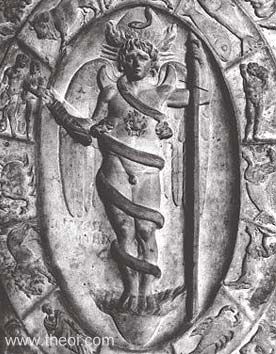
Erebus/Erebos- was the personification of darkness, sibling and consort to Nyx. A region in the Underworld was also named for him. He was said to envelope the edges of the world and the Underworld with dark mists.
The children linked to these deites are: Aether, Hemera, Eros, Momus, Moros, Thanatos, Hypnos, Oneiroi, Charon, Eris, Ponos, Hesperides, Keres, Moirai, Nemesis, Apate, Dolus, Lyssa, Maniae, Eleos, Sophrosyne, Philotes, Geras, Epiphron, Hybris, and Oizys.
Aether/Aither/Acmon- The first born, he was the personification of upper air, that is the air that the gods' breathed, not ordinary air. His name meant light and as such the air he personified was considered bright and glowing. This was also the boundary that seperated Tartarus from the rest of the world. Ouranos the Titan of the sky, depicited as a brass dome, was above him and the ordinary air was below him, this was known as Aer/Khaos and was seen as another aspect of the first Chaos/Khaos, the invisible air between heaven and earth. Erebus/Erebos was the third personification of air, the dark mists in the land of the dead.
Normally seen as a child of Nyx and Erebus, he was also sometimes just a child of Erebus, a child of Anake and Khronos, just Khronos, or Chaos.
He a female counterpart in Aithre/Thea the Titaness of sight and shining light who was associated with gold, silver and jewels. He was paired with his sister Hemera and with her he was parent to Thalassa, sometimes Gaea/Gaia, and sometimes Ouranos. Gaia was also given to either have just appeared or to be a child of Hydrus, whilst Ouranos was sometimes just a child of Aether, or of Aether and Gaia, or of just Gaia, or of Nyx.
With Gaia he may have also been parent to the Algea, Dolus, Lyssa, Penthos, the Pseudologoi, Horkos/Horcus, Poena/Poine, Lethe, Aergia, and the Hysminae/Hysminai. The Algea, Horucs, Lethe, the Hysminae and the Pseudologoi may have been children of just Eris, Dolus of Erebus and Nyx, Lyssa of just Nyx.
By himself Aether was also possibly parent to the Nephelae/Nephelai, cloud nymphs, alternatively they were daughters of Tethys, or Okeanos.
Hemera- a daughter of Nyx and Erebus, or sometimes a daughter of Nyx and Chronos, or Chaos, and the personification of day. She was consort to her brother Aether and with him parent to Gaia, Ouranos and Thalassa, or just Thalassa.
She lived in Tartarus with her mother and left it as her mother was returning. She was displaced by the dawn goddess Eos in myth with Eos taking greater importance.
Eros/Cupid- the personification of procreation, also a god of love and desire, sometimes he had no parents, other times he was a child of Chaos or Nyx or Erebus and Nyx, or he was a later god and a child of Aphrodite and Ares, though it is possible there were too Eros, one the primordial deity and the other the playful child of Aphrodite.
According to Hesiod, he emerged without parents after Chaos, Gaia and Tartarus. Aristophanes says he hatched from an egg laid in Erebus and that he had golden wings. Thus he could be linked to Phanes/Protogonos, a primordial deity of procreation and new life who emerged from an egg with gold wings and was entwined with a serpent. He was a child of Ananke and Chronos.
Momos/Momus- the god of daimon (spirit) of satire, mockery, blame, censure, ridicule, complaint, scorn and criticism. A child of Nyx and Erebus or just Nyx.
He criticised the gods and was exiled from Olympus for it. He criticised Hephaestus for making man without a door in breast through which his thoughts could be seen, and when he was asked to judge a contest between Zeus, Poseidon and Athena over their creations- man, a bull and a house, he criticised all of them. He criticised man for lacking a window in his heart so his neighbour could see his plans, the bull for not having eyes under its horns so it could see what it was attacking, and the house for being made without wheels. He mocked Zeus for his violent nature and his lust and for having two sons equally villainous. He also either viewed only Aphrodite as blameless or insulted her sandals. His twin was Oizys.
Interestingly he is now linked with Mardi Gras.
His counterpart is Eupheme the daimon of praise and good omens.
Moros- a son of Nyx and Erebus or just Nyx he was the god of doom.

Hypnos and Thanatos
Thanatos/Thanatus/Mors/Letus/Letum- the god of death, usually said to be specifically non-violent death as the Keres dealt with violent death, and twin of Hypnos/Somnus and son to Nyx and Erebus. Homer says Zeus charged him and his brother with taking the body of the hero Sarpedon from Troy and returning it to his homeland, Lycia. When Zeus ordered Thanatos to chain up King Sisyphus in Tartarus, as Sisyphus had told the river god Asopus that it was Zeus who took his daughter Aegina, Sisyphus asked Thanatos to demonstrate how his chains worked. Thanatos complied and was trapped until Ares freed him, tired of there being no death in warfare.
When King Admetus was to die Apollo persuaded the Moirai to take another in his place, when his parents refused his wife Alcestis offered herself. When Thanatos came for Alcestis Heracles wrestled him for her life and won.
He was often depicted as a winged youth or a youth carrying a butterfly, poppies or an upside down torch and with a sword, and was usually with his twin. He was displaced by Hermes who as a psychopomp guided the dead to the Underworld. Sometimes he was depicted as bearded.
His Roman counterpart Mors/Letus/Letum was in Roman art a male but in poetry a female, usually pale and clothed in black.

Hypnos and Nyx
Hypnos/Somnus- the god of sleep and twin to Thanatos, a son of Erebus and Nyx. He dwelt in a cave without a door and with poppies growing outside it. The sun did not shine in this cave and it was usually said to be in Erebus, said to have river of forgetfulness, Lethe, flowing through it.
With his brother Thanatos he was charged by Zeus to carry Sarpedon's body from Troy to Lycia.
He put Zeus to sleep at Hera's behest so that she could send a storm to attack Heracles' boat. When Zeus awoke he was in a rage and would have thrown Hypnos into the sea if he had not hid with his mother Nyx, who even Zeus feared. When Hera asked Hypnos to again put Zeus to sleep, during the Trojan War, promising him a throne of gold he refused until she offered him the Charite Pasithea as a wife. He then went to Poseidon letting him know that Zeus was asleep and that Poseidon could thus take action in the Trojan War.
He put Endymion to sleep with his eyes open at his own request, either so Endymion could watch his lover Selene or so that Hypnos could see his eyes.
He was depicted as a youth either bearded or beardless with wings on his shoulders or head, carrying an inverted torch or poppies or a jar with water from the river Lethe in it.
The Oneiroi were his brothers or children and helpers.
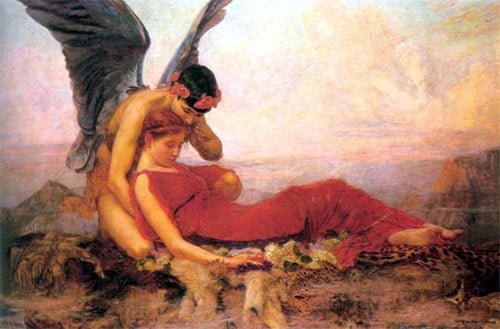
Morpheus
Oneiroi- The daimons of dreams they were said to be a thousand in number and dark winged. Either the children of Hypnos or of Nyx or Erebus and Nyx. They lived in a cave in Erebus and passed through a gate of horn to deliver prophetic dreams or a gate of ivory to deliver meaningless dreams. Ovid named three- Morpheus, Icelus/Icelos/Ikelos/Phobetor and Phantasos/Phantasus.
Morpheus was the leader of the Oneiroi and he appeared in the dreams of rulers in the form of a human, and he shaped dreams. He may have been the dream spirit sent by Zeus to Agamemnon in the Illiad. There was a wilted elm tree in his domain on which he hung fashioned dreams, which appeared as winged phantom shapes.
Phobetor was associated with nightmares and animals and monsters in dreams and he appeared in the mortal realm in the form of any animal he wished. His true name was Icelus/Icelos/Ikelos, which means semblance. The word phobia comes from his name.
Phantasos was associated with inanimate objects in dreams and it is from his name that the words fantasy and phantom likely come from.
There was also another daimon of nightmares- Epiales/Epialos/Epioles/Epialtes who may have been another of the Oneiroi.

The ferryman Charon
Charon/Kharon- a son of Erebus and Nyx he was a servant of Hades and ferryman to the dead. He received the dead from Hermes and ferried them across the river of pain Acheron/Akheron in exchange for an obol/danake coin that was placed in their mouth when they were buried. Those unburied or buried without the coin were left to wander the other side of Acheron for a hundred years and appeared as ghosts on earth.
He was shown as an ugly seaman in reddish-brown clothes with a ferryman's pole, bearded and with flashing, angry eyes possibly of a bluish-grey colour.
He could be linked with the Etruscan god Charun/Charu/Karun, he had pointed ears, snakes around his arms, blue skin, snakes in his hair, a vulture's hooked nose, tusks, fiery eyes, wings, and a beard, and he guarded the Underworld with a hammer. He guided the dead and may have punished or protected them with his hammer as well, and he was helped by Vanth a female demon who was a winged, benevolent guide to the dead.
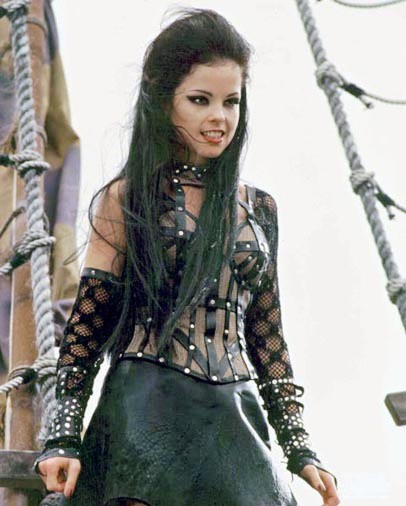
Discord from Xena/ Hercules the Legendary Journeys
Eris/Discordia- the goddess of strife and discord. A daughter of Nyx or of Zeus and Hera. Hesiod said there were in fact two Strife's, one who was cruel and linked to war and battle, and one a daughter of Zeus who was kinder. She was linked with the war goddess Enyo, and Homer viewed them as one and the same.
She was given many children- Ponos (hard labour and toil, who may have been a son of Erebus and Nyx), Lethe (forgetfulness and oblivion, who may have been a daughter of Aether and Gaia), Limos/Limus (hunger), and Ate (delusion, folly, reckless impulse) whose father was Zeus, the Algea/Algos (pain, suffering, grief, distress), the Hysminae (non-martial fighting and combat), the Neikea/Neicea (quarrels, feuds, grievances), the Pseudologi (lies), and Horkos/Horcus (oath) (who all may have been children of Aether and Gaia as well), the Amphilogiai (disputes, debate), Dysnomia (lawlessness), the Phonoi (murder, killing, slaughter), the Androctasiae/Androktasiai (battlefield slaughter), and the Machae/Makhai (battle and combat).
Her most famous story is about the golden apple that started the Trojan War. Angry at not being invited to Peleus and Thetis' wedding, Eris threw a golden apple into the party, The Apple of Discord, which was enscribed kalliste/kallisti meaning for/to the most beautiful/the fairest. Athena, Hera and Aphrodite all laid claim to it and Zeus charged the prince of Troy Paris/Alexander with judging the winner as he had promised to award a golden crown to whoever had a bull better than this and when Ares disguised himself as a bull, Paris fairly awarded him the prize, thus it was the fairness that prompted Zeus to pick him to decide the fairest goddess. Paris picked Aphrodite when she promised him Helen of Troy, the most beautiful woman in the world, for a wife.
When the couple Aedon and Polytechnos boasted to love each other more than Zeus and Hera, Hera sent Eris to cause trouble. She caused them to have a competition when Polytechnos was making a chair and Aedon was doing embroidery, whoever finished first should present the other with a female slave. Aedon finished first, furious Polytechnos went to Aedon's father and tricked him into giving over her sister Chelidonis on the pretence that Aedon wanted to see her. He raped Chelidonis and then dressed her as a slave, swore her to silence and gave to Aedon. Chelidonis then lamented her fate and was overheard by Aedon, they plotted revenge and killed Polytechnos' son Itys and fed him to Polytechnos. Polytechnos was then bound, smeared in honey and exposed to insects. Zeus then turned him into a pelican, Aedon into a nightingale and Chelidonis into a swallow. This story was very like that of the princesses Procne and Philomela.
Ponos- a son of Eris or of Eerebus and Nyx, he was the personification of hard labour and toil.
Hesperides- goddess or nymphs of the evening, they tended a garden at the far west at the edge of Okeanos. Daughters of Nyx, Nyx and Erebus, Atlas and Hesperis, Hesperos, Zeus and Themis, or Phorcys/Phorkys and Ceto. They guarded Hera's garden of golden apples, which a gift to her from Gaia on her wedding day to Zeus, they guarded this with a hundred-headed dragon called Ladon, who was placed there by Hera because she did not fully trust the Hesperides.
They were three or seven in number and their given names were- Aigle/Aegle, Arethusa/Arethousa, Erytheia/Erytheis/Erythea, Hesperia/Hespereia/Hespere/Hespera/ Hesperusa/Hesperethoosa/Hesperthousa/Hesperthusa, Chrysothemis/Khrysothemis, Lipara, and Asterope. They were said to be good singers.
They also guarded the winged sandals, the kibisis (knapsack), and the helmet of invisibility that Perseus needed. Athena told him to find them for these items and he went to the Graeae who gave him directions after he took their tooth and eye from them. Alternatively Perseus just received a knapsack from the Hesperides and the sandals, a sword and the helmet from Hermes, or the sandals from Hermes and the sword and helmet from Zeus. The Gorgons lived near them.
For his Eleventh Labour, Heracles had to retrieve some apples from the Hesperides' Garden. He got directions from the Old Man of the Sea (Pontus, Glaucus, Phorcys or Nereus) and then finding it asked Atlas to fetch them. He held the sky up whilst Atlas did this and then when Atlas refused to take his burden back, after obtaining the apples, Heracles tricked him into it by asking him to hold it while he adjusted his cloak. In another version Heracles slew Ladon. Athena then returned the apples once Heracles' labour was completed.
Ovid mentioned how Atlas guarded the garden and was warned that a son of Zeus would take the apples from them. When Perseus arrived and asked for sanctuary Atlas tried to throw him out and Perseus used Medusa's head to turn him to stone.
The golden apple that Eris threw into the party at Peleus and Thetis' wedding 'for the fairest' may have come from this garden, as may have the golden apples that caused Atalanta to lose the race against Melanion. Melanion received these apples from Aphrodite and threw them down to distract Atalanta so that he might win the race against her and gain her as a bride.
Keres- female daimons of violent death. They were children of just Nyx or of Nyx and Erebus. They were bloodthirsty with gnashing teeth, claws and wings. They ripped out souls on the battlefields with their claws. Their names were: Anaplekte (quick death), Akhlys (mist of death), Nosos (disease), Ker (destruction), and Stygere (hateful).
Their Roman equivalents were Letum (death) and Tenebrae (shadows).
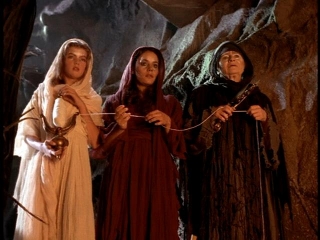
The Fates from Xena
Moirai/Moiraie/Moerae/Fates/Parcae/Fata- daughters of Nyx, Nyx and Erebus, Chronos and Nyx, Zeus and Themis, Ananke, Chaos, or Okeanos and Gaia. They were three in number- Clotho/Klotho/Nona, the spinner, Lachesis/Lakhesis/Decima, the allotter, and Atropos/Aisa/Morta, the inevitable.
They controlled the thread of mortals' lives from birth to death, deciding how long they should live, and even Zeus was subject to their will. They appeared three nights after a child's birth to determine their fate. As such they appeared to Althaea after the birth of her son Meleager with a burning brand and determined he would live until it burned out. Althaea doused the brand and hid it until Meleager killed his uncles when they stole the pelt of the Calydonian Boar from Atalanta after Meleager had gifted it to her. Furious at her brothers' deaths, Althaea threw the brand into a fire.
Apollo got them drunk in order to get them to prolong the life of his friend Admetus, they agreed that another could take his place. His wife Alcestis agreed to take his place and was saved from Thanatos by Heracles.
They were white robed, ugly, old women who were sometimes lame. They assisted Hermes' with inventing the alphabet, killed the Gigantes Agrius/Agrios and Thoas/Thoon with bronze clubs, and in some versions poisoned the monster Typhon with fruit.
Clotho sang of things that are and carried a spindle and the book of fate. She was the youngest and chose who was born and when. She brought Pelops back from the dead after his father Tantalus killed him and tried to trick the gods into eating him.
Lachesis sang of things that were and carried a measuring rod. She was the middle of the three and decided how much time each person was allowed in life. Hesiod says she also allowed people to choose their next life.
Atropos sang of things that would be and carried a scroll, a wax tablet, a sundial, a pair of scales and shears. She was the oldest and chose how people would die.
They were linked to the Erinyes, who punished people for wrongful murders as murder went against fate, the childbirth goddess Eileythia, the Keres, and sat at the throne of Zeus or Hades. According to Plato they had their own thrones and sang with the Sirens.
Their Roman equivalents were the Parcae- Nona, Decima and Morta. Nona was also a goddess of pregnancy, Decima of childbirth and Morta of pain and death.
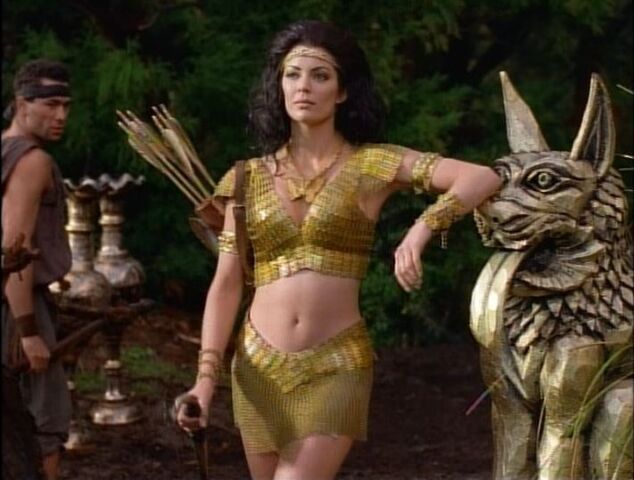
Nemesis from Hercules the Legendary Journeys
Nemesis/Rhamnousia/Rhamnusia- was the goddess of retribution and vengeful fate. She was a daughter of Nyx, Nyx and Erebus, Okeanos or Zeus. She was neither good nor bad, granting that which was deserved. She was associated with resentment for those who had obtained good fortune unfairly.
Her names Rhamnousia and Rhamnusia came from being worshipped at Rhamnous in Attica.
Sometimes she is said to be the mother of Helen of Troy, and also her siblings Clytemnestra, and the Dioscuri Castor and Pollux, having conceived them in the form of a goose to Zeus in the form of a swan. In other versions she lays the egg from which Helen is hatched and it is found by Leda. Alternatively, Leda is simply her mother.
The Telchines/Telkhines, four sea demons who invented metalworking are sometimes given as her children with Tartarus, at other times they are children of Pontus and Gaia, Ouranos and Gaia, Thalassa, or Poseidon.
Apate/Fraus- a child of Nyx, or Nyx and Erebus, she was the personification of deceit, guile, fraud and deception. Her counterpart was her sibling Dolus/Dolos, and her companions were her siblings the Pseudologoi. She may have been one of the evils in Pandora's jar.
Fraus was her Roman counterpart, the personification of treachery and fraud she had a woman's head, a snake's body and a scorpion's tail and helped Mercury.
Dolus/Dolos- the personification of trickery, craftiness, treachery, and guile he was a child of Nyx and Erebus, or Aether and Gaia. An apprentice of Prometheus, he accompanied his siblings the Pseudologoi, and his counterpart was his sister Apate.
Lyssa/Lytta/Ira/Furor/Rabies- a daughter of Nyx and Ouranos or of Aether and Gaia. The goddess/daimon of rage, fury, frenzy, rabies and raging madness. She was linked to the Maniae. Hera asked her to make Heracles insane and though she obeyed it was with reluctance. She was also sent by Dionysus to drive the Minyades mad, daughters of Minyas who neglected the worship of Dionysus and were driven mad as a consequence. She was also linked to the hunter Actaeon/Aktaion, specifically his maddened dogs who tore him apart after he was turned into a stag by Artemis.
Her Roman name was Ira, Furor or Rabies, sometimes she was seen as multiple deities- Irae/Furores.
Maniae/Maniai- daughters of Nyx though no source states this. The personification of madness, insanity and crazed frenzy. They worked with Lyssa and the Erinyes. They are also called nursemaids of Eros but whether in jest, irony or simply truth as Eros can be cruel, is unknown.
Eleos- a child of Nyx and Erebus, either the god or goddess of mercy, pity and compassion. The goddess Anaideia (ruthlessness, shamelessness) was their opposite. Heracles' children sought refuge at his altar in Athens from Eurystheus who was Heracles' rival and set his Twelve Labours, he sought to kill them after their father Heracles died. They survived and Eurystheus and his sons were killed.
Adrastos/Adrastus/Adrestus, a king of Argos during The Seven Against Thebes, went to the same altar after he lost and fled to Athens to beseech Theseus for aid.
Sophrosyne- daughter of Erebus and Nyx, and the goddess of moderation, temperance, self-control and restraint. She may have been one of the good things that escaped Pandora's jar. Her Roman equivalents were Continentia and Sobrietas.
Philotes- a daughter of just Nyx or Nyx and Erebus, she was the goddess of friendship, sexual intercourse and affection. The Neikea (quarrels, feuds) opposed her.
Geras/Senectus- a son of just Nyx or Nyx and Erebus and the personification of old age. He was viewed as a shrivelled, old man. His opposite was the goddess of youth, Heracles' last wife- Hebe, daughter of Zeus and Hera. He was shown on vases with Heracles though the story behind it is unknown. His Roman equivalent was Senectus.
Epiphron- a son of Erebus and Nyx and the personification of prudence, thoughtfulness, carefulness, shrewdness and sagacity.
Hybris/Petulantia- a daughter of Nyx and Erebus, or of Dyssebia (impiety) she was the goddess of impiety, wantonness, recklessness, pride, arrogance and outrageous behaviour. She was the mother of Corus/Koros the personification of insolence and distain, and of Dyssebia sometimes. Her Roman equivalent was Petulantia.
Oizys/ Miseria- a daughter of Nyx or Nyx and Erebus, she was the goddess of misery, woe, suffering and distress. Her twin was Momos. Her Roman name was Miseria.