Showing posts with label son of zeus. Show all posts

Thursday, 14 June 2012

The Other Olympians- Boys- Hephaestus


Hephaestus/Hēphaistos/Vulcan- a god of blacksmiths, technology, fire, sculpting, metals and volcanoes.

The craftsman for the gods he was the son of Zeus and Hera or just Hera alone according to some sources. When Zeus birthed Athena from his head without a parent (her mother was Metis, swallowed by Zeus) Hera was jealous and so conceived Hephaestus without help but he was lame and she cast him down from Olympus in disgust, or he was ugly and she cast him down possibly resulting in his lameness. He was then rescued and raised by Thetis and/or Eurynome.
Some sources argue with this as it is sometimes said that it was he who cracked open Zeus' skull to free Athena, thus making him older than Athena. In this case he was cast down from Olympus by Zeus for trying to save Hera when Zeus bound her by her wrists and ankles for trying to overthrow him with Poseidon and Athena. Hephaestus was then rescued by the Sintians on Lemnos.

In revenge for casting him out, Hephaestus carved a golden throne for Hera and gifted it to her. When she sat on it however she became permanently stuck and Hephaestus abandoned her to this fate. Ares came after him to try and force him back by Hephaestus chased him away with torches. Dionysus then came and got him drunk and brought him back in this state and/or promised him Aphrodite as a bride. Hephaestus freed Hera and Hera welcomed Dionysus as an Olympian in thanks.

He was married to Aphrodite but she was unfaithful to him, particularly with Ares. When Helios informed Hephaestus of their affair he set a trap for them, an invisible net about their bed. When the lovers were trapped he brought the other gods to shame them. Only the males came and Poseidon offered to pay Ares' adulter's fee if Ares did not. Homer, Pseudo-Apollodorus and Nonnus all suggested that Hephaestus divorced Aphrodite for this affair.
He then punished the lovers further by gifting their daughter Harmonia with a cursed necklace on her wedding day. The curse did his work damning her and her descedants.


As a craftsman he crafted many things- weapons, armour, jewellery, palaces, automans- and in one case, a person, specifically the first woman Pandora. He made her from clay and all the gods gifted her with something- Athena robed her, Hermes named her and gave her a voice and trickery, Aphrodite gave her grace and longing, the Charites gave her necklaces, the Horae a crown and Zeus gave her a jar/urn/box/pithos with all the evils in it. She married Prometheus' brother Epimetheus despite Prometheus' warnings and opened the urn unleashing evil onto the world.
Feeling that Prometheus was not yet punishing enough for stealing fire for humans and helping them earn the better part of meat, Zeus had Hephaestus chain Prometheus to a rock where he suffered an eagle feeding on his regenerating liver daily. Hephaestus may have had extra motive as Prometheus was said to have taken the fire from Hephaestus' own forge.
He drove out Adranus/Adranos a fire god from Mt. Etna/Aetna and put his forge there. This mountain was believed to have been named after one of his lovers, the nymph Aetna.


Like many of the other gods he fought in the war against the Gigantes, killing the giant Mimas with molten lava (sometimes Ares is said to have killed him).


His side during the Trojan War is unclear, Homer describes him as having a deep loyalty to his mother Hera who was on the side of the Greeks but he saved the son of Trojan priest Dares, Idaios from Diomedes and yet forged armour for the Greek Achilles at his mother Thetis' request. During the war he also fought the river god Skamandros/Xanthos when he tried to drown Achilles.

He could be kind as well as vengeful as demonstrated by his saving of Idaios. He also aided Orion after he had been blinded by Oenopion for raping his daughter when drunk. Hephaestus gave him his servant Cedalion to be his guide and Orion carried him on his shoulders until he guided to him Helios who cured his blindness, he then returned Cedalion to Hephaestus after that.
When Pelops was killed and served up as food by his father Tantalus and Demeter ate a shoulder, after the gods restored him it was Hephaestus who gave him a new shoulder, of ivory.
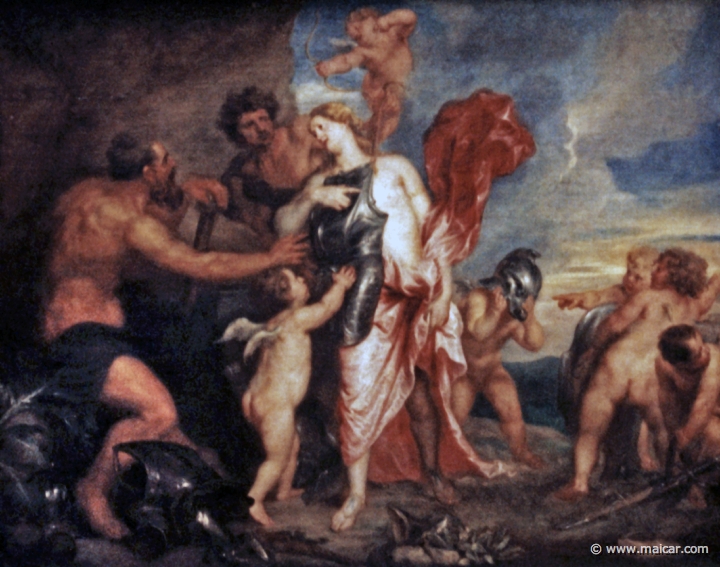

For the gods he built palaces and thrones of marble, gold and bronze. For himself he made golden maidens and automans to help him with his work. For Helios he made a golden boat. For Apollo and Artemis he made bows and arrows. For Athena and/or Zeus the Aegis. For Hermes his winged sandals and helmet. For Aphrodite her girdle.
He built things for mortals as well as the immortals, fashioning gold and silver dogs to guard King Alcinous' palace. He also built a palace for King Aeetes as thanks to his father Helios, who had rescued Hephaestus during the war with the Gigantes. He also made for him fountains with gold, silver, bronze and iron basins that gushed out water, milk, wine and oil, and bulls with bronze hooves that breathed fire. For King Minos he built the bronze giant Talos who ran round the island of Crete three times a day guarding it. He made a wine bowl for Menelaus and a sceptre for his brother Agamemnon.
For many heroes he made weapons. For Perseus his sword, for Achilles' armour, for Heracles' armour, a quiver and bronze rattles to chase off the Stymphalian Birds, for Eos' son Memnon armour,  for Diomedes a cuirass, and for Aphrodite's son Aeneas, armour.
He was helped in his forge by the Cyclopes, his automans and his sons/helpers the Cabeiri/Cabiri/Kabiri/Kabeiroi.

Aphrodite and Hephaestus from Hercules The Legendary Journeys


Though Aphrodite is his most infamous partner Hephaestus, despite being lame and ugly, did have other lovers, even another wife. Aglaea/Aglaia was the youngest Charite/Grace (daughters of Zeus and Eurynome) and was given as either an alternative wife for Hephaestus or his second wife after he divorced Aphrodite. She was a goddess of beauty, splendor, glory, magnificence and adornment and in an interesting twist was a handmaiden of Aphrodite along with her sisters, she was also sometimes a messenger for Aphrodite. With him she had four children- Eucleia/Eukleia (Good Repute and Glory), Plutarch strangely said she was a child of Heracles and Myrto (whose brother was Patroclus) who died a virgin and became a goddess; Eupheme (Acclaim, Praise, Good Omen), her opposite was Momus the god of satire and mockery, and sometimes she was said to have nursed the Muses and had a son Krotos/Crotus, a hunter who kept company with the Muses and invented applause, with Pan; Euthenia (Prosperity), her opposite was Penia/Penae, the personification of poverty and need and Philophrosyne (Welcome, Friendliness, Kindness). These sisters became members of the younger Charites and attendants of Aphrodite.
Hephaestus attempted to rape Athena when she came to him for weapons and he was overcome by beauty. She fled from him but his seamen spilt on her leg, she wiped it off and cast it down to earth, causing Gaia to be impregnated by it. From this union Erichthonius/Erichthonios a future king of Athens was born. He was put in a box by Athena and given to the Athenian king Cecrops' daughters- Herse, Pandrosus and Aglaurus to mind but Herse and Aglaurus opened the box and went mad from the sight killing themselves. They saw the infant either with two snakes or in a form half human and half serpent.
Along with Apollo, Hermes and Ares he tried to woo Persephone with a gift. He offered her a colourful necklace but either she or her mother Demeter turned the suitors away.
Aitna/Aetna was a nymph, a daughter of Ouranos and Gaia or Gaia and the Hecatonchire Briareus. She was arbitrator between Demeter and Hephaestus over Sicily and with Zeus or Hephaestus became mother to the Palici/Palaci/Palikoi, gods associated with geysers, and Thalia/Thaleia a nymph associated with plant life and shoots who was abducted by Zeus in the form of an eagle and is sometimes said to be the mother of the Palici rather than the sister, sometimes Adranus/Adranos is given as the father of the Palici with Thalia.
With Cabeiro/Kabeiro, a sea nymph, he had the Cabeiri/Cabiri/Kabeiroi/Kabiri and the Kabeirides, they were a mystery group of deities who varied in number and were chthonic (associated with the underworld). They varied in depiction, starting out as deities who protected sailors then becoming an old man and his son, Axiocersus and Cadmilus and a female duo, Axierus and Axiocersa. Strabo said their mother was a daughter of Proteus and Rhea but that they had no father. They became craftsmen who helped Hephaestus.
With Anticleia/Antikleia, a mortal woman, he had the bandit Periphetes/ Corynetes a bandit who was lame like his father and had one eye. He killed travellers with a bronze club and was killed by a boulder by Theseus.

Ardalos/Ardalus was a son who invented the flute and built a temple to the Muses.
Cerycon/Kerykon a bandit and king of Eleusis was given as another son though sometimes his father was Poseidon or Branchus. He challenged people to a wrestling match and killed the loser. Theseus killed him.
Olenos/Olenus was another son and a king who fathered Helice/Helike and Aex, nymphs who nursed Zeus when he was an infant. (Obviously this would mean he was around before Zeus and therefore could not be a son of Hephaestus who came after Zeus was grown).
Palaimonios/Palaemonius was a son and one of the Argonauts.
Philottus/Philottos was another son, possibly the same Philottus who was married to Niobe and killed himself when she brought down the wrath of Apollo and Artemis after insulting their mother Leto, leading to the death of all their sons and daughters.
Pylius/Pylios was another son, who cured Philoctetes/Philocthetes of his wound when a snake bit him when he trespassed on the shrine of the nymph Chryse. (In other sources it was Machaon or Podalirius, both sons of Asclepius, who healed Philoctetes.)
Hyginus gives him another son, Spinther, but says nothing about him.

He was depicted as a cripple, usually ugly and at work over his forge or anvil. Sometimes his feet were back to front and he had a stick to aid him. The donkey, crane and fennel plant were sacred to him. The fennel plant was used as a torch in ancient times as it burnt slowly. His symbols were the tongs, anvil and hammer.

His Roman counterpart was Vulcan/Vulcanus, initially a god of fire he was associated with it as both a useful and harmful element. People prayed to him to prevent harmful fires. He was linked to male fertility as well. He was the patron of trades linked to ovens. He was thought to originate from Velchanos, a Cretan god of fire who accompanied the Great Goddess (Cybele), and who was associated with vegetation and springtime.
He was also father to Cacus/Kakos a fire breathing giant who ate humans and nailed their heads to his door who was killed by Hercules after he stole some of the cattle that Hercules had stolen from Geryon for his Tenth Labour. He was given a sister Caca, who some say betrayed him to Hercules. Another son was Caeculus/Kaikalos, a king whose mother was impregnated by a stray spark from her hearth. She exposed her son and he was found by a fire by a group of girls who brought him to his real uncles, the Depidii. He grew up with shepherds before founding the city Praeneste. He could conjure and extinguish fire and was unharmed by it though his eyes were damaged by smoke, making them smaller than normal. He fought against Aphrodite's son Aeneas with Turnus. A third son was another Roman king, Servius Tullius. His mother was Ocrisia, a noblewoman who became slave to Tanaquil, wife of king Tarquinius but was still treated with respect. She either became wife to a friend of Tarquinius or a Vestal Virgin. She was impregnated by a phallus that appeared within the flames she was tending.


The Other Olympians- Boys- Ares


Ares/Mars- the god of war and violence. He was the son of Hera and Zeus, brother to Hebe, the goddess of youth, and Eileithyia, the goddess of childbirth. Sometimes Eris the goddess of strife is his sister, though other times she is a daughter of Nyx not Zeus and Hera. Enyo a goddess of war is sometimes given as another sister.

He was the god of the dangerous, physical more bloody aspects of war whilst his sister and rival Athena was the goddess of the military aspect and generalship. Despite his status as a god of war he suffered loss and humiliation more often than not. He was on the side of the Trojans when they lost the Trojan War and was wounded during the war by Athena and by Diomede.

In the Illiad he was captured by the giants Otus and Ephialtes and held in a bronze urn for thirteen months until their stepmother Eriboea betrayed them and Hermes rescued him. It was then Artemis who tricked them into killing one another.

Hesiod says that Heracles beat him too, knocking him down three times and wounding him in his thigh.
He also failed to bring Hephaestus back when he tricked Hera into sitting on a charmed throne he had built, causing her to be permanently stuck to it. Ares tried to force Hephaestus back to free her but was driven away by flaming torches. In the end Dionysus brought him back drunk and possibly bribed him with Aphrodite as a bride, which angered both she and Ares leading to them being forced to have an affair.
Apollo beat him at boxing during the Olympic games.

Ares could be brave however, he killed Echidna's giant son Ekhidnades and killed Mimas during the Gigantes war. When Sisyphus came for Thanatos and Sisyphus tricked the death god into chaining himself up it was Ares who rescued him. Ares was tired of there being no death on the battlefield.

He showed favour to several people usually in war and especially family members. He gave Aeëtes, the son of Helios and king of Colchis, the sleepless dragon Drakon to guard the Golden Fleece, which hung in a grove sacred to Ares. He gave his son Diomedes, king of Thrace, four man-eating horses, which Diomedes fed strangers to. Heracles fed Diomedes to them and then captured the mares for his Eighth Labour.
The Amazons were his daughters, including their queen Hippolyte/Hippolyta who he gifted his belt/girdle. Heracles had to take this for his Ninth Labour, Hippolyte gave him to him willingly but Hera disguised herself as an Amazon and told the others that Heracles was kidnapping her queen so they attacked him and his men. Heracles killed Hippolyte in the struggle, alternatively they attacked because Heracles' companion Theseus kidnapped the Amazon Antiope for a wife or Hippolyte herself, which case he married her.
He gave his son-in-law Kadmus/Cadmus/Kadmos a spear at his wedding to his daughter Harmonia.
He supported his son Kyknos/Cycnus who killed his guests when he challenged Heracles to single combat.When Cycnus was killed by Heracles Ares tried to avenge him but was stopped by Zeus throwing a lightning bolt between them.
Another Kyknos/Cycnus, in the Shield of Heracles, was a son of Ares who was riding with Ares when they met Heracles and Iolaus. Apollo urged Heracles to fight Cycnus and Athena appeared telling Heracles that Zeus permitted him to kill Cycnus so long as he took no spoils from the fight. Heracles killed Cycnus and Ares attacked him but Athena deflected the blow. Heracles then wounded Ares in the thigh. Ares was then rescued by his sons Phobos and Deimos.
Oenomaus/Oinomaos/Oenamaus was another son of Ares and a king of Pisa. Ares gave him armour, weapons and a chariot. He raced against suitors for his daughters hand in this chariot and when they lost he killed them. He met his comeuppance when Pelops came for his daughter's hand, he asked his lover Poseidon to help and Poseidon gave him a chariot with winged horses. Hippodamia, who loved Pelops, got Oenomaus' charioteer Myrtilus to replace the linchpins in the chariot. The chariot broke and Oenomaus died cursing Myrtilus who was killed by Pelops.
Polyphonte was Ares' granddaughter, she forsook Aphrodite for Artemis becoming a chaste huntress. In outrage Aphrodite made her fall in love with a bear, the result was Artemis turning her and the wilderness on her and two half-bear sons- Orius and Agrius. The sons were cannibals who scorned the gods resulting in Zeus sending Hermes to punish them however he chose. Hermes was going to dismember them but Ares intervened and turned them into an eagle owl and a vulture and their mother into a small owl.

Ares showed his wrath to plenty of people too including his son-in-law Kadmus/Cadmus/Kadmos. Kadmus slayed a dragon, Drakon, sacred to Ares that guarded a spring sacred to him. The dragon killed Kadmus' companions. After killing it Kadmus sowed its teeth on Athena's instructions and from the teeth sprang warriors. Ares made Kadmus serve him for eight years as punishment. Kadmus cursed the fact that a dragon was so highly valued and that he should wish for that life himself, as a result he and Harmonia were turned into snakes by the gods, probably Ares himself.
Alcippe was a daughter of Ares raped by Halirrhothius/Halirrhothios, a son of Poseidon. Ares murdered him and had to stand trial for it. He was acquitted.
He was sometimes said to have killed Adonis, Aphrodite's lover, in the form of a boar out of jealousy. Occassionally Artemis is said to have killed him either jealous of his hunting skills or in revenge for the death of her follower Hippolytus.

He, Apollo and Hermes all tried unsuccessfully to woo Persephone. Ares offered her his spear and cuirass (armour which protects the torso) according to Panopolis Nonnus in the Dionysiaca.
He took many lovers, his most infamous being the goddess of love and beauty Aphrodite. In one infamous incident her husband Hephaestus trapped the two in bed together in an invisible net after Helios reported their infedelity. With Ares he was sometimes the parent of Eros, a god of love, and Anteros, Deimos, Phobos and Harmonia. Anteros the god of unrequited love, Deimos the god of terror and twin of Phobos, the god of fear, and Harmonia the goddess of harmony and concord.
He had an affair with Eos, which led to Aphrodite cursing her with an insatiable appetite.
Enyo, the goddess of war and his female counterpart had Enyalius/Enyalio a minor war god sometimes equated with Ares himself.
Harmonia was a nymph with whom he had the Amazons.
Cyrene/Kyrene a nymph bore him Diomedes and possibly Kyknos/Cyncus.
Sterope/Asterope, another nymph or Pleiad, bore him Oinomaos and possibly Euenos.
Tanagra was a Naiad Ares and Hermes competed for in a boxing match, which Hermes won.
Tereine was a daughter of the river god Strymon, son of Okeanos, with Ares she had a daughter, Thrassa.
With Triteia, daughter of Triton, he had a son, Melanippus.
Aerope was a princess of Arcadia with whom Ares had a son, Aeropus. She died in childbirth but Ares had her corpse continue to supply milk for their son.
With princess Aglaulus, daughter of the Athenian king Cecrops, he had Alcippe/Alkippe, a daughter Poseidon's son raped. Aglaulus also had a son with Hermes, Ceryx/Keryx. With her sisters Herse and Pandrosus she was charged by Athena to guard a box and to never open it. Aglaulus and Herse opened and saw an infant with snakes or an infant half-human and half-snake, Erichthonius, they went insane and killed themselves. In another version, an oracle said a war Athens was at would end if someone sacrificed themselves so Aglaulus killed herself.
Althaea/Althaia, daughter of King Thestius and wife of King Oeneus of Calydon with Ares she had a son, Meleager. She also had Deianeira with Dionysus.
With Astyoche/Astyocheia/Astyokche, a granddaughter of Zeus, he had twins- Askalaphos/Ascakalaphus and Ialmenos/Ialmenus. They were Argonauts, suitors of Helen and warriors in the Trojan War, during which Ascalaphus perished. Ialmenus founded a colony in Colchis.
Parthenopeus is sometimes given as a son of Ares with Atalanta the huntress, other times he is her son with Meleager or Hippomenes. He was exposed by his mother and rescued by a shepherd and possibly raised with Heracles' son Telephus. He died attacking Thebes.
Demonice/Demonike/Demodice/Demodoce was a princess who gave Ares four sons-  Evenus, Molus, Pylus, and Thestius.
With Dotis he had Phlegyas, a son who became king of the Lapiths and father of Ixion who killed his father-in-law Deioneus when he stole Ixion's horses when Ixion failed to pay him for his daughter Dia. Zeus invited him to dine with the gods and he lusted after Hera, Zeus tricked him sleeping with the cloud form of Hera, Nephele, as a result Centauros the first centaur was created and Ixion was punished by being bound to a fiery wheel in Tartarus. Phlegyas was also the father of Coronis who was a lover of Apollo but betrayed him for Ischys, Apollo killed her and in anger Phlegyas torched his temple and Apollo killed him.
Otrere/Otrera was an Amazonian queen who with Ares had the Amazons Hippolyta, Antiope, Melanippe and Penthesilea.
With the princess Phylonome he had the twins Lykastos/Lycastus and Parrhasios/Parrhasius. He seduced her in the form of a shepherd and she exposed her twins, fearful that her father would find them. A she-wolf suckled them and a shepherd raised them, and they became kings of Arcadia. The story is similar to that of Romulus and Remus, the Roman twin sons of Mars.
Protogeneia was a princess with whom Ares had the son Oxylus/Oxylos.
With Pyrene/Pelopia he had Cycnus, she may have been just another name for Cyrene/Kyrene.
With Calliope/Callirrhoe he had three sons- Biston, Odomas and Edonus.
He also had Lycus/Lykos, a Libyan king who sacrificed strangers to his father. His daughter Callirrhoe who rescued Diomedes from being sacrificed to her father. Diomedes sailed off without thanks and she killed herself.
Dryas was another son, part of the Calydonian Boar Hunt and fought with the Lapiths against the centaurs. His brother Tereus, thinking Dryas wanted to kill his son, killed him.
Tereus was a Thracian king married to Procne. He desired Procne's sister Philomela, he raped her, cut her tongue out and held her captive. She wove the story of her rape into a tapestry and sent it to Procne in secret. Procne killed their son Itys in revenge and fed him to Tereus. Tereus tried to kill the sisters but the gods turned all three into birds, Tereus became a hoopoe, Procne a swallow and Philomela a nightingale.
Sithon was possibly another son of Ares and Achiroe, a naiad, (who may have actually been Sithon's wife), or Poseidon and Ossa. He promised his daughter Pallene's hand to whoever could beat him in combat. He beat all suitors until he became old then he had the suitors fight each other. She fell in love with Cleitus and her tutor bribed his rival Dryas' charioteer to loosen the wheels of the chariot. As a result Dryas lost. Sithon found out what happened and planned to kill Pallene but Aphrodite either appeared in front of the inhabitants or sent a heavy shower causing him to change his mind. Alternatively Dionysus seduced her and killed Sithon.

He was given a list of attendants- Achlys, the personification of misery and sadness, possibly a daughter of Nyx; Androktasiai, personifications of manslaughter and daughters of Eris; Alala, the personification of war-cry daughter of the daemon (spirit) of war Polemos, Enyo's brother; Eris; Enyo; Hebe; Homados, the personification of battle noise; the Hysminai, personifications of battle; Kydoimos/ Cydoemus, personification of confusion; Keres, death spirits and daughters of Nyx; Machai/Mache/Makche, daughters of Eris and daemons of battle and combat; Palioxis, personification of backrush in battle; and Proioxis, the personification of onrush in battle.

He was described in the Illiad as being hated by Zeus and was usually seen as a weak, petty, angry god who was driven by rage. His symbols included the shield, spear and his animals were the boar, dog and serpent.

His Roman counterpart was Mars, the god of war and agriculture. Unlike Ares, Mars was held in high regard, second only to Jupiter. He was part of the Archaic Triad with Jupiter and Quirinus (a Roman god of state and possibly war). Mars was not a force of brutal warfare but rather war to bring about peace. He was a son of just Juno (according to Ovid) as Hephaestus was sometimes just a son of Hera, brought about when Jupiter gave birth to Minerva. Juno asked the goddess Flora for help and Flora, after testing a magical flower on a cow, used on Juno thus impregnating her.

He was given Nerio as a wife. She was a goddess of war and the personification of valor and was sometimes linked to Bellona and Minerva. Bellona was Enyo's Roman counterpart and as Enyo was sometimes given as a daughter of Zeus and Hera so Bellona was sometimes said to be a daughter of Jupiter and Juno.

His role as a war god and agriculture god were linked in that he was said to drive off forces hostile to crops. Thus unlike Ares he was a defender and ironically more like Athena.

His most famous children were Romulus and Remus, brothers who founded Rome. They were born after Mars' affair with Rhea/Rea Silvia a princess of Alba Longa forced to become a Vestal Virgin by her uncle Amulius after he seized the throne from her father Numitor and killed her brother. Mars seduced her in the forest and once she had the twins her uncle imprisoned her and ordered a servant to kill the babes. The servant cast them into a river and they were found and suckled by the she-wolf Lupa before being rescued by the shepherd Faustulus who raised them with his wife Acca Larentia. Sometimes Larentia and the she-wolf are said to be one, a prostitue called lupa by the shepherds.
Romulus and Remus overthrew their uncle and reinstated their grandfather and presumably freed their mother. Ovid says the river Anio took Rhea in whilst other sources imply she became or was a minor deity of the forest.
Romulus and Remus argued over where to found Rome and Remus insulted Romulus' walls leading to Romulus murdering him.

Mars' sacred animals were the woodpecker and the wolf. His spear was considered as symbolic and sacred as Jupiter's lightning bolt and Poseidon's trident.


The Other Olympians- Boys- Apollo


Apollo from Hercules the Legendary Journeys/Young Hercules

Apollo/Apollon/Phoebus Apollo- god of music, poetry, healing, prophecy and disease and the sun. He gradually took over the role as sun god from Helios just as his twin sister Artemis took over the role as moon goddess from Selene.

The son of Zeus and the titaness Leto, and twin to Artemis. His mother had to flee from the wrath of Hera, seeking a land that would have her, eventually she found sanctuary on the island of Delos, because it moved it was technically not land. Artemis was born first and acted as a midwife for her brother's birth.

Shortly after his birth he received a bow and arrows from Hephaestus and with them he killed the dragon/serpent Pytho/Python, which had pursued his mother when she was pregnant. He later had to be purified for this as Python was a child of Gaia and was appointed by Gaia to guard the oracle. The dragon guarded the oracle of Delphi, after its death Apollo lay claim to the shrine and the oracle was renamed the Pythian. Hera then sent the giant Tityos/Tityus to assault and possibly kill Leto. Apollo fought the giant with his sister and either they killed him or Zeus intervened and sent him to Tartarus. In Tartarus the giant was pegged to the ground and suffered two vultures eating on a liver that regenerated.

He also helped to avenge a slight to his mother with his sister Artemis. Queen Niobe said she was greater than Artemis because she had fourteen children whilst Leto only had two. In anger, Artemis killed all the girls and Apollo killed all the boys, though some sources say one boy and one girl were spared. Niobe's husband killed himself in grief and Niobe turned to stone.

He also slayed Delphyne, a half-maiden half-snake creature, sometimes said to be another name for Python, in another story she guarded the sinews of Zeus after Typhon took them. Hermes stole the sinews back and Apollo killed Delphyne.

During the Trojan War he fought on the side of the Trojans. He sent a plague to the Greeks' camp because Agamemnon had taken the daughter of his priest Chryses, she was returned and the plague ended. He also rescued Aphrodite's son Aeneas when Aphrodite failed to save him from Diomedes as he injured her. He also guided Paris' arrow to striking Achilles and killing him. This was possibly in revenge for the death of Troilus/Troilos/Troylus who was a Trojan prince sometimes said to be the son of Apollo and Hecuba.

His son Asclepius was a great healer but he went too far and raised the dead, some say he raised Theseus' son Hippolytus on behalf of Artemis. As a result of this Hades complained and Zeus killed Asclepius with a thunderbolt. In outrage Apollo killed the Cyclopes who made the thunderbolts and Apollo was sentenced to a year of labour, he was possibly spared worse because of his mother's interference. He served Admetus, king of Pherae, as a shepherd and was treated well by him. In thanks for his good treatment, Apollo helped him win the princess Alcestis for a bride. Her father, Pelias, promised her to the man who could yoke a bear/boar and a lion to a chariot. Admetus forgot to thank Artemis on his wedding and was damned by the goddess. Apollo intervened again by getting the Moirae drunk and goading them into bargaining that if someone else was willing to die for Admetus then they would allow it. Alcestis offered her life and was saved by Heracles who fought Thanatos for her.

During his exile Apollo helped Poseidon, who was exiled for rebelling with Athena and Hera against Zeus, to build the walls of Troy for King Laomedon. He promised to reward them but didn't, they got their revenge later, Poseidon sent a sea monster and Apollo a plague.


The satyr Marsyas took up flute playing after finding the instrument when Athena cast it down after inventing it because it made her look ugly when she played. He challenged Apollo who played his lute and won when they had to play upside down. In punishment, for the satyr's hubris, Apollo tied the satyr to a tree and had him flayed alive. Apollo received his lute from his half-brother Hermes after Hermes' invented it and Apollo took it in exchange for the cattle the newborn stole off him.

Pan also challenged Apollo on his panpies. The mountain god Tmolus, a son of Ares, was asked to judge. He was in favour of Apollo but King Midas, a follower of Pan, argued about the outcome and outraged, Apollo gave him the ears of a donkey.

Cinyras was a king of Cyprus who promised fifty ships to Agamemnon but only sent one. Apollo beat him in a lyre playing contest and killed him. Sometimes he is considered a son of Apollo who created art and musical instruments. He fathered Adonis with his daughter Myrrha.

He had made lovers both male and female. Daphne is the most infamous, she was a nymph and the daughter of river god Peneus. Ovid says Eros struck Apollo with a gold arrow making him love Daphne when he mocked Eros for playing with a weapon suited for a man, he then struck Daphne with a lead arrow filling her heart with hate for the god. Apollo chased her and she begged her father for help, he turned her into a laurel tree and Apollo made the laurel his sacred plant after. Apollo also brought about a rival suitor's death. Leucippus/Leukippos disguised himself as a nymph to get close to Daphne but Apollo betrayed his true gender and the nymphs killed him.

He fell for Leucothoe/Leucothea/Leukothoe, a princess who was the daughter of Orchamus and sister of Clytia/Klytie. Apollo disguised himself as her mother to enter her chambers but Clytia, jealous, betrayed them and Orchamus had Leucothoe buried alive. Clytia continued to pine for Apollo, always staring up at the sun but he ignored her and she became a heliotrope or a sunflower, flowers that follow the sun. Sometimes the myth is attributed to Helios not Apollo and the princess is Persian.

Marpessa, a granddaughter of Ares and a princess, who was kidnapped by Idas, who may have done this because they loved each other but their father refused the marriage. He was an Argonaut and possibly a son of Poseidon and kidnapped her with the use of Poseidon's chariot. Her father pursued them and died. Apollo also desired her and chased her, forcing Zeus to intervene and make her choose. Marpessa chose Idas believing that when she grew old Apollo would no longer desire her.

He chased the nymph Castalia who dove into a spring at Delphi to escape him and became the spring. Water from the spring was used to cleanse the temple and she could inspire poetry in those who drank from her or listened to her.

With Cyrene/Kyrene who was either a nymph and the daughter of the river god Peneus or the daughter of King Hypseus, king of the Lapiths and a son of Peneus. She was a huntress kidnapped by Apollo who fell in love with her when he witnessed her fighting a lion. She bore him two sons, demigod Aristaeus/Aristaios who invented beekeeping and Idmon, a seer and an Argonaut who was killed by a boar. Idmon is sometimes given different parents.

He fell in love with doomed Trojan princess Kassandra/Cassandra and promised her the gift of prophecy. When she spurned him he cursed her with prophesying the truth but never being believed.

Coronis/Koronis was a daughter of Phlegyas, king of the Lapiths who was a lover of Apollo. She betrayed him with Ischys and was discovered by a crow who reported the news to Apollo. In rage, Apollo turned the crow to black and asked Artemis to avenge him. Artemis killed her. In regret, when was on the pyre, Apollo had Hermes rescue their unborn child (or did it himself), the healer Asclepius, which Hermes did. Hermes then gave him to the centaur Chiron to raise.  Phlegyas burned the temple of Apollo in anger and Apollo killed him. In a different version Coronis was a princess who Poseidon tried to rape, Athena turned her into a crow to save her. It was also Athena who turned a crow from white to black, for telling her that Kekrops' daughters had disobeyed her.

Euripides says he fathered Ion with the princess Creusa, though Apollodorus gives her husband Xuthus as the father. Her sister Chthonia was sacrificed by their father Erechtheus who was told he would win the battle against Eleusis, headed by Poseidon's son Eumolpos/Eumoplus. He did this and her sisters Protogeneia and Pandora killed themselves as they had promised they would if one of them died. It was their sister Orithyia who was the grandmother of Eumolpos, having his mother Chione/Khione with Boreas after he abducted her. Creusa's other sister Procris was the wife of Cephalus who was accidentally killed by him when she thought he was having an affair, spied on him and was killed by a spear she had gifted him when he thought she was a wild animal.
Following the tragedy of her sisters, Creusa was seduced by Apollo before she married and fearing punishment, she exposed the baby. Xuthus met him in a temple of Apollo and was told by a prophecy that Ion was his, he took him in and Creusa suspected he was a result of an affair Xuthus had and tried to poison him. Ion discovered this and was about to kill her but was stopped when she realised he was her son.

Acantha was a nymph Apollo tried to rape, she fought him back, clawing at his face and he turned her into an acanthus plant.

Thalia, the Muse of comedy and idyllic poetry (short, rustic poetry) was said in the Biblioteca to be the mother of the Corybantes/Korybantes/Kurbantes/Corybants with Apollo. These were male armed dancers who worshipped the goddess Cybele with drumming and dancing. Although they were said to have guarded the infant Zeus and made noise to drown out his cries so that Cronus would not hear them, making it unlikely that they were the children of Apollo. They were also present for Dionysus infanthood. Ovid gives Ouranos and Gaia as their parents.

Acacallis was a daughter of King Minos and Queen Pasiphae. With Apollo she had either Cydon and/or Naxos, or Miletus, or/and Amphithemis and Garamas, or Oaxes. Sometimes Hermes is given as Cydon's father. Miletus she exposed but Apollo had him suckled by she-wolves and taken in by shepherds. When he grew up Minos desired him and he fled to escape him. Amphithemis and Garamas were born in Libya where Acacallis was banished to by Minos.

Another Acacallis/Akakallis is a nymph or a daughter of the demigod Carmanor/Karmanor and Demeter. Apollo met her when he came to Carmanor to be purified for killing Python, with him she had the twins Phylacides and Phylander.

Aethusa/Aithousa was a nymph, a daughter of Poseidon and Alcyone, a Pleiade. With her Apollo had a son, Eleuther, who was an excellent singer and won a victory at the Pythian Games.

Amphissa was a Cretan princess, he seduced her in the disguise of a shepherd and with her had a son, Agreus. With the princess Euboea, sister to Amphissa, he had a son, Agreus.

Arsinoe was a princess who bore Apollo a daughter, Eriopis, and was sometimes given as the mother of Asclepius. Her sisters  Phoebe and Hilaeira were priestesses of Athena and Artemis, and betrothed to Idas (the same who abducted Marpessa and was chosen by her over Apollo) and Lynceus. Castor and Pollux abducted and wed them and when Idas and Lynceus came for them they were slain but killed Castor too.

Bolina/Boline was a woman who fled from Apollo's advances and lept into the sea to avoid him. He turned her into an immortal nymph.

Calliope/Kalliope was the Muse of epic poetry and considered the wisest of the Muses. With Apollo or the Thracian king Oeagrus she had the infamous poet Orpheus and the muscian Linus who was killed by his pupil Heracles with his own lyre. Ialemus is also given as their son.

Psamathe was a princess, daughter of the king of Argos, Crotopus, who Apollo impregnated. She exposed their son Linus, fearing her father's wrath, and he was killed by sheepdogs, alternatively she gave him to shepherds and he was killed by sheepdogs as an adult. Her father found out and refusing to believe she'd had intercourse with a god, he killed her. Apollo sent Poine/Poene (punishment/vegeance) who snatched children from their mothers unti Coroebus killed her. Apollo them inflicted Argos with a plague, Coroebus went to Delphi asking to be punished himself to save the city, the Pythia told him not to return and to wander with a tripod, settling where he dropped it. He founded Tripodiscoi.

With Chione/Khione, daughter of Daedalion she had the muscian Philammon, Hermes raped her the same night impregnating her with the thief Autolycus, Autolycus and Philammon were twins. She compared herself to Artemis and was killed for her hubris. Her father threw himself off a cliff and Apollo turned him into a hawk.

Delphus/Delphos was a son of Apollo's by one of three women- Celaeno, Apollo's great-granddaughter, her grandfather was his son Lycorus; Thyia, a priestess sacrificed to Dionysus who was a naiad (fresh water nymph) or a daughter of Deucalion and Pyrrha, who had to repopulate the world after the deluge; or Melaina one of the Corycian nymphs, naiads of the Corycian Cave, daughters of river god Pleistos or Kephisos, they were also known as the Thriae/Thriai.

With another Corycian nymph, Corycia, Apollo had Lycorus/Lycoreus.

With the princess Khrysorthe/Chrysorthe she had Koronos/Coronus, a king of the city Sicyon.

With Khrysothemis/Chrysothemis, who was married to Staphylus, a son of Dionysus, she had a daughter, Parthenos. Sometimes Staphylus is given has her father. With her sister Hemithea/Molpadia she was charged with guarding her father's wine, they fell asleep and a pig broke the jar. In fear of their father they threw themselves of a cliff, Apollo carried them off because he loved their third sister Rhoeo, and they became local goddesses in the cities he left them in.

Rhoeo had a son, Anius, with Apollo. Disbelieving she was pregnant by a god, her father put her in a chest and cast her out to sea. They arrived in Delos and Anius was born and grew up to become a priest of Apollo. His daughters, the Oenotropae were given talents by Dionysus and were eventually turned into doves by him.

With Dia he had a son, Dryops. He tricked Dryope, a princess or a nymph, when she was playing with the hamadryads (dryads who were believed to be trees whilst ordinary dryads were simply spirits of trees). He chased her then turned himself into a tortoise that they made a pet of, when he was on Dryope's lap he turned into a snake, wrapped himself around her and then raped her. The nymphs abandoned her and she had a son, Amphissus. In another version of the tale she was tending sheep when Apollo spied her and took the form of a turtle, when she fell asleep he raped her and when she awoke she found herself in the arms of a god. Amphissus founded Aphissa and built a temple to his father here. Dryope became a priestess here and her nymphs returned to talk to her. Apollo returned to her in serpent form while she was by a spring, wrapped around her and turned her into a poplar tree. Ovid says she was turned into a poplar when she was suckling her baby and saw some flowers on a lotus tree, which belonged to the nymph Lotis, she plucked them for her infant and the tree bled on her. She tried to flee but found her feet rooted to the ground, she turned into a black poplar and her son was rescued by her husband, Andraemon. Sometimes she was given as the mother of Pan, with Hermes.

Evadne was a princess born of Poseidon and the nymph Pitane who was raised by the king of Arcadia, Aepytus. Apollo impregnated her and Aepytus was furious causing her to go to the wilderness to give birth. She abandoned the child there. Five days later Aepytus learned from the Pythia that the child was the son of Apollo and destined to be a prophet. He asked for the child and Evadne retrieved him finding that he had been nurtured by the honey of bees given to him by snakes amongst violets. She called him Iamus and he founded the Iamidai/Iamidae, a family of seers at Olympia.

He consorted with the Amazon Gryne. With Hyrie/Thyrie he had a son, Cycnus/Kyknos. He was an arrogant hunter who spurned all those who would love him. Phylius was the only one who stayed with him. Cycnus challenged him to kill a lion without weapons, he did so by vomiting up wine and food, which the lion devoured, then strangled the beast with his clothes while it was intoxicated. Next he had to capture two giant man-eating vultures without weapons, he did this by smearing himself with a dead hare's blood, playing dead and catching the vultures by the feet when they came for him. Finally, Cycnus demanded he bring a bull to the altar of Zeus with his bare hands. He prayed to Heracles and found two bulls fighting over a heifer and waited until they had worn each other down and they seized one by the horns. After this Heracles made it so that Phylius would no longer obey Cycnus. Cycnus committed by drowning, his mother followed him and Apollo changed them both to swans. Ovid had Phylius refuse the final task and Cycnus throw himself off a cliff and turn into a swan whilst his mother, unaware of his fate, dissolved into tears.

Manto was a daughter of the prophet Tiresias and a war prize sent to Delphi, she was sent by Apollo to Colophon to find an oracle devoted to him. With him or her husband Rhacius she had a son, Mopsus/Mopsos, a seer.

Apollo from Clash of the Titans (remake)

With the nymph Othreis he had a son, Phager, a shepherd who was told by a prophecy to take care of a relation nurtured by bees. He found this relative, a son of Zeus, Meliteus, adopted and raised him. With Parthenope he had Lycomedes. With Phthia he had Laodocus/Leodocus, Dorus and Polypoetes, all of whom were killed by Aetolus, a son of Endymion (the lover of Selene) and the nymph Iphianassa, when he was colonising Aetolia.

With Apollo or King Cycnus (a son of Poseidon) Proclia/Proclea a princess and daughter of Laomedon, king of Troy, had a son, Tenes. He was accused of rape by his stepmother Philonome, who used her flutist Eumolpus as her witness, and put in a chest at sea with his sister Hemithea by Cycnus. The island the siblings arrived on, Leucophrye, made Tenes their king and the island was renamed Tenedos. Cycnus learned the truth, had Eumolpus executed and Philonome buried alive and went to the island for forgiveness. Tene spurned him and cut the moorings of the ship. Tenes was slain during the Trojan War by Achilles, which along with the death of Troilus, gave Apollo a reason to hate Achilles. Achilles then tried to rape Hemithea, she fled from him and was swallowed by the earth.

Sinope was a daughter of the river god Asopus/Asopos who was either abducted by Apollo and gave him a son, Syrus, whom the Syrians are named after, or was abducted by Zeus who offered her, her dearest wish prompting her to request virgnity, she made the same request of Apollo and the river god Hayls.

Stilbe was a nymph, the daughter of river god Peneus and sister of Daphne and aunt to Cyrene/Kyrene. With Apollo she had twins Centaurus/Centauros, the first of the centaurs, and Lapithus, the first of the Lapiths, and a third son, Aineus. Centaurus was usually given as a son of Ixion and Nephele (the cloud form of Hera).

With the nymph Syllis or Hyllis, daughter of Iole and Hyllus (son of Heracles) he had a son, Zeuxippus. With Thero he had Chaeron.

Trophonius was a son who built his temple at Delphi with his brother Agamedes. They laboured for six days, promised by the oracle that they would have their greatest wish on the seventh day. On the seventh day they died. Pausanias says they built a treasure chamber for King Hyrieus and stole his fortune using the secret entrance. Hyrieus laid a trap and Agamedes was caught, Trophonius cut off his head so the body could not be identified and then fled.

Melaneus was a son of Apollo who was a famous archer who fathered the famous archer Eurytus who taught Heracles and challenged Apollo and was slain for his hubris. His bow passed to Odysseus. Alternatively he promised his daughter Iole to whoever could beat him in an archery contest, Heracles won but fearing his daughter would be killed, Eurytus did not honour the promise. Heracles killed him and his sons and took Iole as a concubine.

Oncius was a son of Apollo who owned a herd of horses in which Demeter hid to avoid Poseidon. Demeter and Poseidon's son, the talking horse Arion/Areion was kept by Oncius and later given to Heracles. Phemonoe was a poetess, a daughter of Apollo and the first Pythia. He also fathered three Muses (not any of the initial nine)- Cephisso, Apollonis and Borysthenis. Branchus was a son or lover of Apollo. His mother, when she was pregnant, had a vision of being pierced with a beam of light. He was a prophet.

His most famous male lover was Hyacinth/Hyacinthus a Spartan prince. They were practising discus together when Apollo's discus was blown off course by Zephyrus who loved Hyacinth and courted him but was spurned for Apollo. The discus struck and killed the man. Apollo created the flower Hyacinth in his honour.

He loved Cyparissus/Kyparissos and gifted him with a tame stag which he accidentally killed with a javelin. He asked Apollo to let his tears fall forever and was turned into a cypress tree.

Hymen, the god of marriage ceremonies and son of Dionysus and Aphrodite, or Apollo and a Muse, was loved by Apollo. Iapis/Iapyx was loved by Apollo who wanted to grant him the gift of prophecy but he asked for healing so he could prolong the life of his father. He healed Aeneas during the Trojan War.

He and Poseidon both wooed Hestia but she turned them down and asked Zeus to let her remain a virgin.

He and Zeus favoured Amphiaraus/Amphiaraos a king of Argos and a seer. His wife Eriphyle was bribed with Harmonia's necklace by Polynices to persuade Amphiaraus to fight in the Seven Against Thebes. He agreed, knowing he would die, and asked his sons to kill their mother should he die. He swallowed in the earth when it opened up when Zeus threw a thunderbolt at it during the battle. His son Alcmaeon killed Eriphyle and was pursued by the Erinyes and later killed.

Through his oracle he told Orestes to kill his mother Clytemnestra and her lover, Aegisthus to avenge Agamemnon. He did and the Erinyes followed him. Apollo came to Orestes defence and the matter was brought before Athena who sided with Apollo.

He was considered the leader of the Muses being a god of music and poetry. His symbols were the kithara (a type of lyre), the bow and arrows, and the plectrum. The laurel and palm tree were sacred to him as were cicadas, deer, wolves, snakes, crows, and hawks. He was shown as a beardless, handsome, toned youth, athletic and usually naked with curly hair and a laurel wreath often in his hair. He was called Phoebus Apollo by the Romans, Phoebus meaning radiant or beaming. He shared many lovers with his half-brother Hermes and had failure with love more than success. Most of his dalliances were with nymphs. Amongst the Greeks he was more greatly associated with prophecy, healing, music and the arts than the sun, it was only around the 3rd century that he displaced Helios as the sun god.

He had no Roman equivelant. As a sun god though he and Helios were both linked to the Roman god Sol. Initially thought of as two gods- Sol Indiges, who disappeared from myth quickly, and Sol Invictus (Sol Invincible). The latter was linked to the Syrian sun god Elagabalus/Heliogabalus.

The Other Olympians- Boys- Dionysus

Dionysus, Apollo, Ares, Hephaestus and Hermes.


Dionysus/Bacchus/Liber- the god of wine, ecstasy, winemaking, festivity, theatre and madness. He was usually described the son of Zeus and the mortal Semele, a daughter of the hero Cadmus/Kadmus and Harmonia, the goddess of harmony and concord and the daughter of Ares and Aphrodite. Hera befriended Semele in disguise and suggested that Semele's lover was not actually Zeus but just someone claiming to be. Doubtful, Semele asked a boon of Zeus and he swore her anything, so she asked to see him in his glory, or for him to come to her as he came to Hera. Zeus was forced to consent and the sight of his godhood or his arrival with thunder and lightning caused Semele to die of fright. Zeus rescued the unborn Dionysus and sewed him in his thigh, from this he was later born.

He another version, Dionysus is the son of Zeus and Persephone. A jealous Hera persuaded the Titans to distract him with toys and then tear him to pieces. In one version he shifted into animal forms in his attempt to escape before being torn to pieces in the form of a bull. They devoured him, save his heart which Persephone/Athena/Rhea/Demeter/Hermes saved, and Zeus turned them to ash with his thunderbolts in revenge. Zeus either placed the heart in his thigh and recreated him from this or he tricked Semele into eating the heart and having him born from her, thus linking the two versions of his creation. It is thought he could be the god Zagreus, a hunter god a son of Zeus and Persephone, Zeus potentially in the form of a serpent, or Hades and Persephone.

After Semele's death Zeus gave the infant to Hermes who gave him either to Dionysus' aunt Ino and her husband Athamas, bidding them to raise him as a girl, or to the nymphs of Nysa. These were rain nymphs who may have been the daughters of Atlas and an Oceanid/Okeanid Pleoine or Aethra. They were the sisters of the ill-fated Hyas who wept over his death and became known as the Hyades. The Nysiads are also said to have been the nymphs who raised him. Some sources say it was Rhea or a priest of Apollo, Maro, who raised him. Silenus, a man usually depicted with the ears, legs and tail of a horse (two legs, he wasn't a centaur) was given as Dionysus foster father, tutor and loyal companion.

Ino was a queen of Thebes and the wicked stepmother of Phrixus and Helle who drove them to fleeing on the back of the infamous golden ram Chrysomallus. Either Hera or Dionysus drove her husband King Athamas to madness causing him to murder his son and chase his wife and another son. Ino jumped off a cliff with her son Melicertes, or she too was driven mad, boiled her son and them jumped into the sea. She and her son became the goddess Leucothea and god Palaemon respectively.

Dionysus discovered wine and shared this gift with Icarius/Ikarios. Icarius shared the wine with shepherds who, thinking they had been poisoned when they were drunk, killed Icarius in vengeance. His daughter Erigone hung herself in grief and her dog Maera/Maira leapt off a well or jumped off a cliff. Dionysus turned them into the constellations-  Boötes, Virgo and Procyon. (Boötes is also thought to have been a man who invented the plough and pleased Demeter with it. Virgo is given as Demeter or as Astraea.) Dionysus then inflicted Athens with a plague and demanded that they honoured Icarius, Erigone and Maera before he ended the plague.

 He was driven mad by Hera and wandered the earth in this fashion before being cured by Cybele/Rhea. He then wandered spreading his worship and teaching winemaking. He was opposed on several occasions. Lycurgus/Lykurgos/Lykourgos was a king in Thrace who opposed him. He imprisoned Dionysus' followers the Maenads and drove Dionysus from the city. Dionysus fled and took refuge with Thetis and punished Thrace with a drought and drove Lycurgus to madness leading him to kill his son thinking he was ivy that he was pruning. He refused to end the drought until Lycurgus was punished. He may have tried to rape his mother and killed his wife as well. The people then threw him to man-eating horses or panthers. Dionysus gave Thetis a golden urn or vase in thanks for sheltering him.

On his wanderings he was also opposed by Perseus. There was a battle during which either Ariadne or a Maenad called Khorea was killed. Perseus may have mistaken Dionysus and his band for invaders. Eventually the two ended the battle and had peace.

Pentheus, a king of Thebes and cousin to Dionysus, opposed him. He banned worship of him and imprisoned him, though the chains fell off him and the cell door opened for him. In vengeance Dionysus drove the women of Thebes, including Pentheus' mother Agave, and possibly his aunts Ino and Autonoë to madness and lured Pentheus to spy on them. Pentheus hid in a tree but he was spotted, thinking he was an animal the women tore him to pieces. His mother Agave carried his head back and only when she saw her father Kadmus/Cadmus did she realise she was carrying the head of her son. Some sources claim Dionysus was so cruel to his own family because his aunts had claimed their sister Semele had been impregnated unmarried and only claimed Zeus to be the father to conceal this and was later killed as punishment for her lies. The women were then exiled from Thebes.

The Minyades, three daughters of Minyas, possibly a son of Poseidon, spurned the worship of Dionysus. Called Alcathoe (or Alcithoe), Leucippe/Leuconoe and Arsippe/Arsinoë, they remained at home when other women celebrated over the mountains in worship to Dionysus. He came to them in the form of a maiden to entice them into joining the festivites but they declined. He then turned into a bull, lion and panther and drove them mad and they sacrificed Leucippe's son Hippasus to him by tearing him to pieces before Hermes turned them to bats,  or Dionysus simply turned them into bats. The sisters did not believe Dionysus was a god and continued working at the loom and spinning.

Orpheus, the famous poet, also suffered Dionysus wrath as he refused to worship him and thought of Helios/Apollo as the greatest god, for this they tore him to shreds. Alternatively Orpheus had sworn off women after the death of Eurydice and for this they killed him. His head continued to sing, and was buried in Antissa, a city in Lesbos, and became an oracle until Apollo silenced it. The Muses gathered up his body parts and buried them.

The Proitides, were three daughters of King Proitos/ Proetus, a king of Argos who was the twin of  Acrisius, the father of Danae, and grandfather of Perseus, and husband of Stheneboea/Stheneboia who lusted after Bellerophon. The daughters were called in the Bibliotheca- Lysippe, Iphinoe, and Iphianassa, whilst the Italian Maurus Servius Honoratus called them Lysippe, Hipponoe and Cyrianassa, and Claudius Aelianus named two Elege and Celaene. They were driven mad either by Hera for calling themselves more beautiful than she and/ or for stealing gold off her statue, or by Dionysus for refusing to worship him. The healer and soothsayer Melampus offered to heal them for a third of the kingdom but was declined. The women went madder and Melampus was called upon again, this time he demanded a third of the kingdom for himself and a third for his brother Bias, Proteus agreed and the women were cured. Some sources say Iphinoe died and her two sisters married Melampus and Bias.

Dionysus was extremely handsome and when some sailors/pirates saw him on a shore they thought him a prince and kidnapped him. He allowed him to take him onto their ship and when bonds would not hold him the helmsman realised he was a god and begged his fellow sailors to release him. They would not believe him. Vines then grew on the ship, Dionysus turned into a lion and a bear appeared on board. The pirates tried to jump off the ship and were turned into dolphins. The helmsman, Acoetes, was spared and later became a priest to the god.

Cyanippus/Kyanippos was a man who refused to worship Dionysus. Dionysus got him drunk and he raped his daughter Cyane. Cyane took his ring to identify him. Apollo inflicted the city with a plague saying it would not be removed until an unjust man was killed. Understanding this, Cyane killed her father and then herself.

Another to feel his wrath but not because of lack of worship, was Psalacantha/Psalakantha, a nymph from the island Ikaros/ Icaria who loved Dionysus and promised to help him win Ariadne on the condition that he loved her too. Dionysus refused so Psalacantha tried to dissuade Ariadne from being with the god. In anger, Dionysus turned her into the plant psalakanthos, which was later weaved into Ariadne's crown.

Coresus was a priest of Dionysus who was in love with Callirhoe who scorned him. Coresus prayed to Dionysus for aid and the god turned the city, or just the women, mad and an oracle told them Callirhoe or someone in her stead must be sacrificed. When no one would offer themselves up for her, Callirhoe went to be sacrificed but Coresus couldn't kill her and killed himself instead. In grief, Callirhoe killed herself.

Dionysus proved his godhood to the people and chiefly to the gods in two important ways. He went to the Underworld and rescued his mother Semele and made her immortal, renaming her Thyone. Secondly, when Hephaestus tricked Hera into sitting on a gold throne which she became stuck too, Dionysus went to bring him back to Olympus. He got the lame god drunk and brought him back on a donkey and persuaded him to free Hera. After this, Hera no longer challenged Dionysus' position as an Olympian.

He fought in the war against the Gigantes and killed Eurytos.

Though mostly known for his wrath he could also show favour to people. When King Midas found Silenus passed out he treated him well for ten days before returning him to Dionysus. As thanks, Dionysus promised Midas whatever he wanted. Midas asked that everything he touched be turned to gold and Dionysus consented. When he turned his own daughter to gold and realised he could not eat or drink as all food and drink became gold, he begged Dionysus to reverse the gift. Dionysus told him to wash in the river  Pactolus, Dionysus obeyed and the curse/gift was reversed.

Althaea was the wife of the king of Calydon Oeneus/Oineus. Dionysus coveted her and realising this, Oeneus left this city of his own will, Dionysus gave him a vine in thanks and showed him how to plant it. With Althaea he became the father of Deianeira/Dejanira. Deianeira became Heracles' third wife and killed with a shirt poisoned in the centaur Nessus' blood, though she meant for it to make him desire her as she was jealous of Heracles' concubine Iole.

The Oenotropae/Oenotrophae/Oinotrophoi were the three daughters of Anius/Anios, a son and priest of Apollo.Called Spermo (seed), Onio/Oeno (wine) and Elais (seed) they became the goddesses of grain, wine and oil, their grandmother Rhoeo was a daughter of Staphylus and Chrysothemis, Staphylus in turn was a son of Dionysus and Ariadne who was associated with grapes and wine. Thus the Oinotrophoi were the great, great granddaughters of Dionysus. They could turn water to wine, grass to wheat and berries to olives. They stocked the Greeks' ships for Troy, resulting in Agamemnon abducting them, they escaped only to be betrayed by their brother before Dionysus turned them into doves.

Dionysus married Ariadne after persuading Theseus to abandon her on the island Naxos, or simply rescuing her from there after Theseus abandoned her. With her he had twelve children- Oenopion, a king of Chios who blinded Orion for assaulting his daughter Merope; Staphylus, a general of Rhadamanthys; Thoas, a king of Lemos who was sent from it when Aphrodite cursed the women to have a bad odour leading to the men to consort with slaves, which drove the women to kill them. Thoas was the only male survivor. His daughter Hypsipyle became queen. Thoas then became king of Tauris, Artemis made Iphigeneia a priestess here; Peparethus; Phanus; Eurymedon; Euanthes; Latramys; Tauropolis; Ceramus; Maron; and Enyeus, a king of Skyros. Oenopion and Thoas may have been Theseus' sons.

Dionysus had other lovers as well, including Aphrodite. With her he is sometimes said to have had the Charites, though usually they are the daughters of Zeus and Eurynome; Hymen a god of marriage ceremonies, sometimes given as a son of Apollo and a Muse; and Priapus/Priapos a fertility god associated with fruits and livestock who had a huge erection, alternatively he may have been the son of Dionysus and Chione or Aphrodite and Hermes, and was cursed with ugliness and foul-mindedness by Hera because Paris judged Aphrodite more beautiful than she.

Sometimes he is given as the father of Phthonus, the personification of envy and jealousy, his mother being Nyx, but as it is he who is said to have drawn Hera's attention to Semele and given her the idea to trick her, it is more likely he is someone else's child, and occasionally Aphrodite is given as his mother.

With Althaea he had Deianeira, and with Circe he had Comus/Komos, the god of festivity and revels, who represented chaos and was also Dionysus' cupbearer. With the breeze goddess Aura he had twins, one which she ate and one which was saved by Artemis, Iacchus. Dionysus raped Aura when she proclaimed herself to have a better body than Artemis and claimed Artemis too womanly to be a virgin. After the rape she became a slayer of men before Zeus turned her into a breeze or a stream.

He raped the nymph Nicaea/Nikaia when Eros inspired him with love for her in punishment for her killing the shepherd Hymnus who loved her by shooting him through the heart. She was a follower of Artemis and was raped in her sleep. Telete, a daughter, was born as a result and after her birth Nicaea tried to hang herself.

With either Araethyrea or Chthonophyle he was the father of Philas. Chthonophyle is sometimes given as his wife. Philas/Philus was an Argonaut, Hyginus called him Phliasus and said he was a son of Ariadne and Dionysus. With Chthonophyle he had a son, Androdamas. Chthonophyle was a princess of Sicyon, who with Hermes had Polybus.

With Physcoa, a member of the Sixteen Women- women from 16 cities who were negotiators between Elis and Pisa- he had a son, Narcaeus, who became a conqueror. She is said to have been the first to acknowledge Dionysus as a god.

Pallene, a daughter of king Sithon, was wooed by many for her beauty and because his father promised her and his kingdom to the suitor who could defeat him in combat. In older age he had the suitors fight each other. Two came, Dryas and Cleitus, Pallene loved Cleitus and so her tutor bribed Dryas' charioteer to ensure his wheels came off, they did and he was killed. Sithon discovered the plot and was going to kill his daughter by Aphrodite intervened or a heavy shower caused him to change his mind and she married Cleitus. In another version of the story, Sithon coveted his daughter himself and killed the suitors for this reason. Dionysus offered to fight the maiden herself for her hand and seduced her in the process, he then killed Sithon and stayed with Pallene for a night.

Carya was a daughter of king Dion and Amphithea, for receiving Apollo hospitality, he gave Carya and her sisters the gift of prophecy, on the understanding that they should not betray gods or search after forbidden lore. Dionysus visited and fell in love with Carya, but her sisters, Lyco and Orphe, became aware of the affair and tried to prevent it, thus betraying Dionysus. He drove them mad and they were turned into rocks and Carya was turned into a walnut tree.

With Alexirrhoe he had a son, Carmanor who was killed by a boar. He loved the Indian nymph Alphesiboea but she spurned him until he turned into a tiger. With her he had a son, Medes.

Ovid says he seduced Erigone, the ill-fated daughter of Icarius, with grapes.

He loved the satyr Ampelos who died either riding a bull that threw him and gorged him, driven by Selene who he had insulted, or he died picking grapes on a tree. Dionysus turned him into the first vine or the constellation Vindemitor/Vindiatrix.

He was shown as a young, handsome god or a bearded man carrying the thyrsos/thyrsus, a pinecone headed staff. Sometimes he is naked or half-naked, other times cloaked. He is accompanied by a procession of Maenads, sileni and satyrs, sometimes they too are armed with thrysos. He has a chariot pulled by lions and/or tigers. His symbols are the thyrsos, fig, grapevine, ivy, leopard skin and winecup, and his animals are the bull, lion, tiger, leopard, and panther.

His Roman counterpart was Bacchus, a name the Greeks also used, and Liber. Liber was also known as Liber Pater (Free Father) a god of wine, fertility and freedom. His festival was associated with the freedom of speech and coming of age. He was originally a companion of Ceres and Libera (she became associated with Prosperina/Persephone/Kore), as part of the Aventine Triad. He was also associated with male procreation. His mother was called Stimula and the groves in which people were initiated to Bacchus' cult were considered sacred to her, and his followers were known as Bassarids/Bacchae/Bacchantes.

Dionysus was a strange god in that he was born of a mortal and should have been a demigod but thanks to his dual birth and birth from death he was able to cross over into godhood, even joining the Olympian pantheon as Hestia was said to have stepped down so that he could number in their twelve. The only other demigod who achieved godhood was Heracles who also had to die to achieve it.

Despite being seen nowadays as a fat, rowdy partygoer he was in large a cruel god, and not even his mortal relations were safe from his wrath. He cast madness almost everywhere he met, driving women to tear their own relations limb from limb and think their companions animals.