Showing posts with label hephaestus. Show all posts

Thursday, 14 June 2012

The Other Olympians- Boys- Hephaestus


Hephaestus/Hēphaistos/Vulcan- a god of blacksmiths, technology, fire, sculpting, metals and volcanoes.

The craftsman for the gods he was the son of Zeus and Hera or just Hera alone according to some sources. When Zeus birthed Athena from his head without a parent (her mother was Metis, swallowed by Zeus) Hera was jealous and so conceived Hephaestus without help but he was lame and she cast him down from Olympus in disgust, or he was ugly and she cast him down possibly resulting in his lameness. He was then rescued and raised by Thetis and/or Eurynome.
Some sources argue with this as it is sometimes said that it was he who cracked open Zeus' skull to free Athena, thus making him older than Athena. In this case he was cast down from Olympus by Zeus for trying to save Hera when Zeus bound her by her wrists and ankles for trying to overthrow him with Poseidon and Athena. Hephaestus was then rescued by the Sintians on Lemnos.

In revenge for casting him out, Hephaestus carved a golden throne for Hera and gifted it to her. When she sat on it however she became permanently stuck and Hephaestus abandoned her to this fate. Ares came after him to try and force him back by Hephaestus chased him away with torches. Dionysus then came and got him drunk and brought him back in this state and/or promised him Aphrodite as a bride. Hephaestus freed Hera and Hera welcomed Dionysus as an Olympian in thanks.

He was married to Aphrodite but she was unfaithful to him, particularly with Ares. When Helios informed Hephaestus of their affair he set a trap for them, an invisible net about their bed. When the lovers were trapped he brought the other gods to shame them. Only the males came and Poseidon offered to pay Ares' adulter's fee if Ares did not. Homer, Pseudo-Apollodorus and Nonnus all suggested that Hephaestus divorced Aphrodite for this affair.
He then punished the lovers further by gifting their daughter Harmonia with a cursed necklace on her wedding day. The curse did his work damning her and her descedants.


As a craftsman he crafted many things- weapons, armour, jewellery, palaces, automans- and in one case, a person, specifically the first woman Pandora. He made her from clay and all the gods gifted her with something- Athena robed her, Hermes named her and gave her a voice and trickery, Aphrodite gave her grace and longing, the Charites gave her necklaces, the Horae a crown and Zeus gave her a jar/urn/box/pithos with all the evils in it. She married Prometheus' brother Epimetheus despite Prometheus' warnings and opened the urn unleashing evil onto the world.
Feeling that Prometheus was not yet punishing enough for stealing fire for humans and helping them earn the better part of meat, Zeus had Hephaestus chain Prometheus to a rock where he suffered an eagle feeding on his regenerating liver daily. Hephaestus may have had extra motive as Prometheus was said to have taken the fire from Hephaestus' own forge.
He drove out Adranus/Adranos a fire god from Mt. Etna/Aetna and put his forge there. This mountain was believed to have been named after one of his lovers, the nymph Aetna.


Like many of the other gods he fought in the war against the Gigantes, killing the giant Mimas with molten lava (sometimes Ares is said to have killed him).


His side during the Trojan War is unclear, Homer describes him as having a deep loyalty to his mother Hera who was on the side of the Greeks but he saved the son of Trojan priest Dares, Idaios from Diomedes and yet forged armour for the Greek Achilles at his mother Thetis' request. During the war he also fought the river god Skamandros/Xanthos when he tried to drown Achilles.

He could be kind as well as vengeful as demonstrated by his saving of Idaios. He also aided Orion after he had been blinded by Oenopion for raping his daughter when drunk. Hephaestus gave him his servant Cedalion to be his guide and Orion carried him on his shoulders until he guided to him Helios who cured his blindness, he then returned Cedalion to Hephaestus after that.
When Pelops was killed and served up as food by his father Tantalus and Demeter ate a shoulder, after the gods restored him it was Hephaestus who gave him a new shoulder, of ivory.
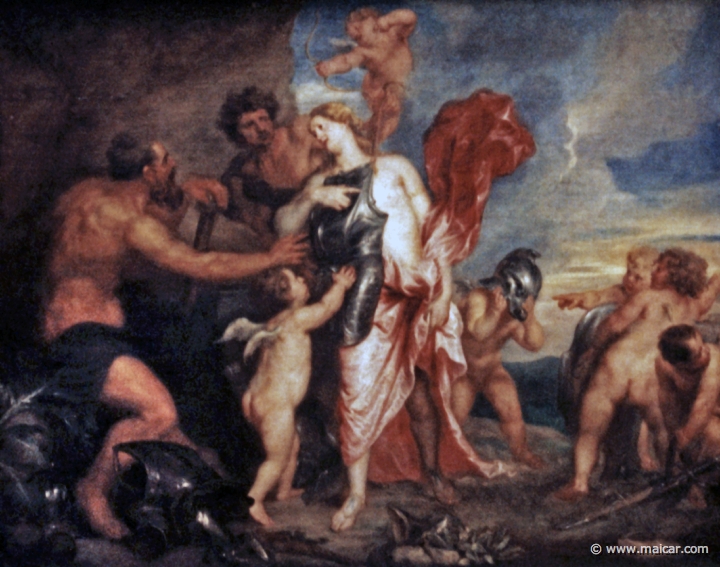

For the gods he built palaces and thrones of marble, gold and bronze. For himself he made golden maidens and automans to help him with his work. For Helios he made a golden boat. For Apollo and Artemis he made bows and arrows. For Athena and/or Zeus the Aegis. For Hermes his winged sandals and helmet. For Aphrodite her girdle.
He built things for mortals as well as the immortals, fashioning gold and silver dogs to guard King Alcinous' palace. He also built a palace for King Aeetes as thanks to his father Helios, who had rescued Hephaestus during the war with the Gigantes. He also made for him fountains with gold, silver, bronze and iron basins that gushed out water, milk, wine and oil, and bulls with bronze hooves that breathed fire. For King Minos he built the bronze giant Talos who ran round the island of Crete three times a day guarding it. He made a wine bowl for Menelaus and a sceptre for his brother Agamemnon.
For many heroes he made weapons. For Perseus his sword, for Achilles' armour, for Heracles' armour, a quiver and bronze rattles to chase off the Stymphalian Birds, for Eos' son Memnon armour,  for Diomedes a cuirass, and for Aphrodite's son Aeneas, armour.
He was helped in his forge by the Cyclopes, his automans and his sons/helpers the Cabeiri/Cabiri/Kabiri/Kabeiroi.
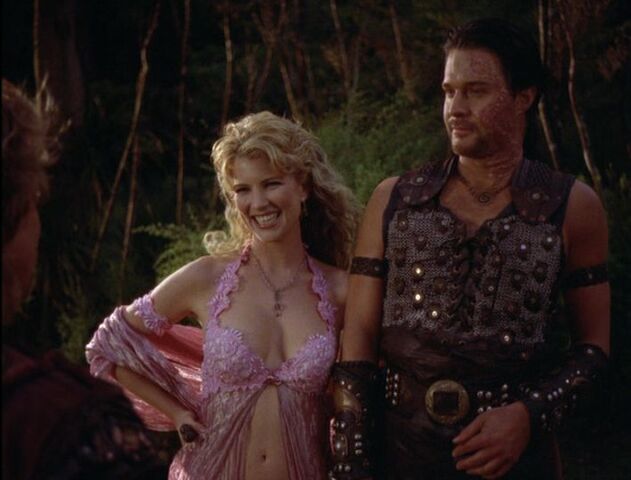
Aphrodite and Hephaestus from Hercules The Legendary Journeys


Though Aphrodite is his most infamous partner Hephaestus, despite being lame and ugly, did have other lovers, even another wife. Aglaea/Aglaia was the youngest Charite/Grace (daughters of Zeus and Eurynome) and was given as either an alternative wife for Hephaestus or his second wife after he divorced Aphrodite. She was a goddess of beauty, splendor, glory, magnificence and adornment and in an interesting twist was a handmaiden of Aphrodite along with her sisters, she was also sometimes a messenger for Aphrodite. With him she had four children- Eucleia/Eukleia (Good Repute and Glory), Plutarch strangely said she was a child of Heracles and Myrto (whose brother was Patroclus) who died a virgin and became a goddess; Eupheme (Acclaim, Praise, Good Omen), her opposite was Momus the god of satire and mockery, and sometimes she was said to have nursed the Muses and had a son Krotos/Crotus, a hunter who kept company with the Muses and invented applause, with Pan; Euthenia (Prosperity), her opposite was Penia/Penae, the personification of poverty and need and Philophrosyne (Welcome, Friendliness, Kindness). These sisters became members of the younger Charites and attendants of Aphrodite.
Hephaestus attempted to rape Athena when she came to him for weapons and he was overcome by beauty. She fled from him but his seamen spilt on her leg, she wiped it off and cast it down to earth, causing Gaia to be impregnated by it. From this union Erichthonius/Erichthonios a future king of Athens was born. He was put in a box by Athena and given to the Athenian king Cecrops' daughters- Herse, Pandrosus and Aglaurus to mind but Herse and Aglaurus opened the box and went mad from the sight killing themselves. They saw the infant either with two snakes or in a form half human and half serpent.
Along with Apollo, Hermes and Ares he tried to woo Persephone with a gift. He offered her a colourful necklace but either she or her mother Demeter turned the suitors away.
Aitna/Aetna was a nymph, a daughter of Ouranos and Gaia or Gaia and the Hecatonchire Briareus. She was arbitrator between Demeter and Hephaestus over Sicily and with Zeus or Hephaestus became mother to the Palici/Palaci/Palikoi, gods associated with geysers, and Thalia/Thaleia a nymph associated with plant life and shoots who was abducted by Zeus in the form of an eagle and is sometimes said to be the mother of the Palici rather than the sister, sometimes Adranus/Adranos is given as the father of the Palici with Thalia.
With Cabeiro/Kabeiro, a sea nymph, he had the Cabeiri/Cabiri/Kabeiroi/Kabiri and the Kabeirides, they were a mystery group of deities who varied in number and were chthonic (associated with the underworld). They varied in depiction, starting out as deities who protected sailors then becoming an old man and his son, Axiocersus and Cadmilus and a female duo, Axierus and Axiocersa. Strabo said their mother was a daughter of Proteus and Rhea but that they had no father. They became craftsmen who helped Hephaestus.
With Anticleia/Antikleia, a mortal woman, he had the bandit Periphetes/ Corynetes a bandit who was lame like his father and had one eye. He killed travellers with a bronze club and was killed by a boulder by Theseus.

Ardalos/Ardalus was a son who invented the flute and built a temple to the Muses.
Cerycon/Kerykon a bandit and king of Eleusis was given as another son though sometimes his father was Poseidon or Branchus. He challenged people to a wrestling match and killed the loser. Theseus killed him.
Olenos/Olenus was another son and a king who fathered Helice/Helike and Aex, nymphs who nursed Zeus when he was an infant. (Obviously this would mean he was around before Zeus and therefore could not be a son of Hephaestus who came after Zeus was grown).
Palaimonios/Palaemonius was a son and one of the Argonauts.
Philottus/Philottos was another son, possibly the same Philottus who was married to Niobe and killed himself when she brought down the wrath of Apollo and Artemis after insulting their mother Leto, leading to the death of all their sons and daughters.
Pylius/Pylios was another son, who cured Philoctetes/Philocthetes of his wound when a snake bit him when he trespassed on the shrine of the nymph Chryse. (In other sources it was Machaon or Podalirius, both sons of Asclepius, who healed Philoctetes.)
Hyginus gives him another son, Spinther, but says nothing about him.

He was depicted as a cripple, usually ugly and at work over his forge or anvil. Sometimes his feet were back to front and he had a stick to aid him. The donkey, crane and fennel plant were sacred to him. The fennel plant was used as a torch in ancient times as it burnt slowly. His symbols were the tongs, anvil and hammer.

His Roman counterpart was Vulcan/Vulcanus, initially a god of fire he was associated with it as both a useful and harmful element. People prayed to him to prevent harmful fires. He was linked to male fertility as well. He was the patron of trades linked to ovens. He was thought to originate from Velchanos, a Cretan god of fire who accompanied the Great Goddess (Cybele), and who was associated with vegetation and springtime.
He was also father to Cacus/Kakos a fire breathing giant who ate humans and nailed their heads to his door who was killed by Hercules after he stole some of the cattle that Hercules had stolen from Geryon for his Tenth Labour. He was given a sister Caca, who some say betrayed him to Hercules. Another son was Caeculus/Kaikalos, a king whose mother was impregnated by a stray spark from her hearth. She exposed her son and he was found by a fire by a group of girls who brought him to his real uncles, the Depidii. He grew up with shepherds before founding the city Praeneste. He could conjure and extinguish fire and was unharmed by it though his eyes were damaged by smoke, making them smaller than normal. He fought against Aphrodite's son Aeneas with Turnus. A third son was another Roman king, Servius Tullius. His mother was Ocrisia, a noblewoman who became slave to Tanaquil, wife of king Tarquinius but was still treated with respect. She either became wife to a friend of Tarquinius or a Vestal Virgin. She was impregnated by a phallus that appeared within the flames she was tending.


Friday, 11 November 2011

The Twelve Olympians


The chief hierarchy of the gods, they sometimes varied but were usually given to be- Zeus, Hera, Poseidon, Demeter, Athena, Dionysus, Apollo, Artemis, Ares, Aphrodite, Hephaestus and Hermes. Rarely Dionysus was swapped with Hades but generally Hades was not considered a member due to dwelling in the Underworld rather than Olympus. Quintus Ennius, a Roman writer swapped Bacchus (Dionysus) with Vesta (Hestia) so as to have six males and six females. To explain this, Hestia/Vesta later gave up her position so that Dionysus/Bacchus could be a member without there being thirteen.

Zeus/Jupiter- the king of the gods, youngest of the six (Hades, Poseidon, Hera, Demeter, Hestia, and Zeus), he drew lots with his brothers when they overthrew the Titans and won the heavens. He is the god of the skies, thunderstorms and rain. His symbols are the lightning/thunderbolt, the eagle, the bull, the oak and the sceptre.
His first wife was Metis, the Titaness of Wisdom and mother of Athena, his second is Themis the Titaness of divine order who he has the Horae with, and his third is Eurynome the Titaness of pasture lands, whom he has the Charites with. Hesiod, in the Theogony then gives Zeus' sister Demeter the goddess of agriculture to be his fourth wife and with him parent to Persephone, Mnemosyne the Titaness of memories is given as his fifth wife and the mother of the Muses with him, Leto the Titaness of motherhood is his sixth wife and with him parent to the twins Artemis and Apollo, and Hera his sister and the goddess of marriage is his seventh and final wife, and with him mother to Ares, Eileithyia and Hebe.
He is the father of the heroes Heracles, Perseus, the kings and later three judges of the dead- Minos, Rhadamanthus and Aeacus, and Helen of Troy, amongst many others.

Hera/Juno- the goddess of marriage, wife to Zeus and queen of the gods and goddesses. She was said to have been fostered by Okeanos and his wife Tethys. Zeus seduced her in the form of a bird before marrying her. She is given to be the most beautiful of the goddesses, more beautiful than even Aphrodite. Gaia gave her the Garden of the Hesperides as a wedding gift, in it golden apples grow and are tended by the Hesperides and the many headed dragon Ladon.
She is said to have given birth to Hephaestus/Vulcan without a father in response to Zeus birthing Athena/Minerva without a mother. When Hephaestus was born either Hera cast him down from Olympus because he was ugly or Zeus threw him down because he helped Hera when she was in chains, as a result Hephaestus was lamed.
With Poseidon and Athena she sought to overthrow Zeus, they chained him down but Thetis rescued him. As a result Hera was chained between the sky and the abyss.
As a goddess of marriage she did not have affairs despite her husband having many.
Her symbols are the peacock, the cow, the milkway, the pomegranate, the lily, the sceptre and the crown.

Poseidon/Neptune- the god of the seas, rivers, earthquakes and horses. He is depicted as bearded and carrying a trident. He is a tempermental god and once conspired with Athena and Hera to overthrow Zeus but they were thwarted thanks to Thetis. He is given as the father of many giants and cyclopes.
He competed with Athena over the rights to the city Attica, she offered the people an olive tree whilst he offered a salty spring, they picked Athena's gift and the city was renamed Athens. Some say Poseidon actually created the horse as a gift.
In another version of the creation myth he created the horse to impress Demeter, it was through trial and error and many other creatures such as the zebra were created as a result before he finally created the horse.
With Demeter, in horse form, they sired Arion/Areion, a talking horse. He is also the father of the hero Theseus with the princess Aethra, and Pegasus the winged horse and Chrysaor a man or winged boar, with Medusa. Medusa was cursed by Athena for defiling her temple by being raped by Poseidon in it.
His wife was the Nereid (sea nymph) Amphitrite, daughter of the sea Titan Nereus, known as the Old Man of the Sea, and his wife Doris, a sea nymph.
His symbols are the trident, the horse and the dolphin.

Demeter/Ceres- the goddess of agriculture, the harvest and to an extent marriage. Demeter and her daughter Persephone are infamous for being key figures in the Eleusinian Mysteries. She and her daughter were, amongst other goddesses, also associated with the Maiden, Mother and Crone mythos.
With Zeus she had Persephone and with Poseidon she had the talking steed Areion after she took the form of a mare to escape her brother and he raped her in the form of a stallion, with him she also had Despoine, a minor goddess. With the mortal lord Karmanor she had a son, Eubouleos and a daughter, Khrysothemis who were associated with the ploughed earth and harvest respectively. With the mortal prince Iasion, who was killed by a jealous Zeus, she had the twin boys, Ploutos and Philomelos.
Persephone was her most beloved child and when she was taken by Hades, Demeter wandered the earth in despair looking for her. As a result of her depression the crops failed and famine spread across the world and the weather turned bad. Seeing mankind's suffering, Zeus commanded Hades to return Persephone but she had eaten in the Underworld and was forever tied to it, so Demeter sees her for half of the year, and Hades sees her for the other half, alternatively, Demeter has her for nine months whilst Hades gets three. This resulted in the belief that in Spring and Summer the weather was good because Persephone and Demeter were united, in Autumn it turned bad as their approach drew near or had already happened and in Winter Demeter was in mourning for her daughter.
She is, like Poseidon, associated with the horse. The cornucopia, a horn overflowing with wheat, flowers etc, is usually her symbol as well as an ear of wheat.

Athena/Minerva- the goddess of war, wisdom, strategy, and weaving. She was also given the title of Pallas Athena/Athene after slaying the giant Pallas or, in alternate stories, accidentally killing her friend Pallas. She is a virgin goddess and the daughter of Zeus and Metis.
When Zeus was told that Metis would birth a child more powerful than the father he swallowed her to prevent such a fate but she was already pregnant. After time he suffered from a severe headache and one of the gods was forced to open it with an axe. Out of the wound Athena sprang fully grown and armoured.
Though she had no children she fostered Erichthonius who was created when Hephaestus tried to rape her and his seamen hit Gaia and impregnated her. Erichthonius was given in a box to three sisters to guard but they got curious and opened the box and saw a snake or an infant with a snake or a half-man, half-snake, and two of them went mad and killed themselves. Erichthonius grew up to be a king of Athens.
In one story she turned a crow from white to black when it reported that the sisters had opened the box.
She is said to have turned Medusa into a gorgon after her temple was soiled by Poseidon raping Medusa there.
She and Poseidon competed over Athens for the right to have the city named after them, Poseidon offered the people a salty spring and Athena offered an olive tree, the people picked her gift and Athens was named.
She was a friend to heroes giving advice to Odysseus, Heracles and Perseus, giving Perseus the world's first bridle to tame Pegasus with.
At the wedding of Thetis and Peleus an uninvited Eris threw a gold apple labelled 'to the fairest one', this started a competition between the goddesses for it. Prince Paris was asked to pick between Athena, Aphrodite and Hera. Athena offered him wisdom and glory in and for all battles, Aphrodite offered him the most beautiful woman in the world, Helen, and Hera offered him Europe and Asia. Paris picked Aphrodite and as a result Athena and Hera aided the Greeks against the Trojans in the Trojan War.
Athena's association with weaving and the loom is prominent in the tale of Arachne, a weaver who boasted that she was better at it than Athena. Athena came to her disguised as an old woman to warn her but Arachne would not heed and requested a competition. Arachne weaved the gods committing infedelity whilst Athena depicted her success in winning Athens from Poseidon. Arachne's work was perfect but Athena was angered by her choice of topic and jealous so she destroyed it, Arachne then hung herself in despair but Athena turned her into a spider out of pity.
She is shown with her aegis, her shield that has Medusa's head on it, an owl, and a maned helmet. The snake is also associated with her.

Dionysus/Bacchus- the god of wine, drinking, partying, festivals. There are two versions of his birth both of which involve Zeus sewing him in his thigh. The first gives his mother as the mortal Semele who was killed when she asked Zeus to appear in his true form after prompting from a disguised Hera. Zeus rescued the fetus and sewed it into his thigh. The second version gives his mother as Persephone, the baby Dionysus is killed by Titans sent by a jealous Hera, they left his heart though, which Zeus sewed into his thigh, or gave to Semele to eat (probably an attempt to unite the two stories) and recreated him from.
As a baby he was fostered by his aunt Ino and her husband Athamas after being given to them by Hermes, Rhea or Persephone. Ino was the stepmother of Phrixus and Helle, who were infamous for riding the golden ram Chrysomallus, whose fleece was the Golden Fleece. Ino was said to have been a cruel stepmother who blamed them for a famine and bribed an oracle to support her and ask for their sacrifice.
Hera struck either Ino or Athamas with madness leading to the murder of their son Melicertes and their own deaths. Zeus however intervened to turn Ino into the white goddess Leucothea, a sea deity, and her son Melicertes into the god Palaemon. Athamas also killed their son Learchus in his madness thinking he was a ram/lion/deer hunting him down.
Ino's sisters Autonoe and Agave were also cursed with madness and killed their own relations. It is believed that all this madness came from Dionysus who was famous for inflicting people with insanity, particularly women. In fact these mad women even had a title- Maenads or Bacchae. They included the women who had nursed and raised him, which included the nymphs of Nysa who either took him after Ino's death or raised him instead of Ino depending on the source.
His companion and tutor was Silenus, a man originally depicted with a horse's ears and tail and sometimes legs, a little like an equesterian satyr/faun. He was always drunk and said to be wise, when he wandered and got lost once he was found by servants of King Midas. Midas treated him well and as a result Dionysus rewarded him with what he wanted and he picked the golden touch. After he found he could not eat nor drink and his daughter became a golden statue he asked for the gift to be revoked and Dionysus granted the request.
Dionysus also became the husband of Ariadne after finding her on the island Theseus abandoned her on, some stories say Dionysus demanded Theseus do this whilst others say he simply found her after the deed had been done. He is listed to have had several lovers and children.
Dionysus' symbols were the thyrsus, his staff which had a pinecone on the top, the vine and the wine goblet.

Apollo- Also known as Phoebus (radiant) Apollo was the twin of Artemis and a son of Leto and Zeus. He was a god of light, prophecy, archery, music, poetry and healing and later a god of the sun, displacing Helios as his Artemis displaced Selene as goddess of the moon.
He was associated with the Phythia/Oracle of Delphi and said to have given her, her prophecies. The Phythia was named after Python, a dragon of Delphi that chased the pregnant Leto and was slain by Apollo in revenge.
His son Asclepius was a healer god who angered Zeus by taking his gifts too far by resurrecting the dead, chiefly Hippolytus. Zeus then struck him down with lightning, in revenge Apollo killed the Cyclopes who had made the lightning bolt. Zeus then punished Apollo by having him labour as a shepherd for King Admetus, who treated him well.
He had many lovers and children but was equally rebuked by several including the nymph Daphne whose father rescued her from rape by turning her into a laurel tree, and the infamous princess of Troy Cassandra who he cursed to speak prophecies that no one would believe.
It is said that he turned crows from white to black after one told him that his lover Coronis, Asclepius' mother, had taken another lover. Apollo dismissed it as lies and punished the crow, when he found out it was true he made the bird sacred.
Hermes as an infant stole Apollo's cattle and with one's intestines and a tortoise shell he invented the lyre. Apollo tracked down the cattle and hearing the music of the lyre he exchanged the cattle for it.
He cursed Midas with the ears of an ass when he said Pan's music was better than Apollo's. The satyr Marsyas challenged Apollo to a music contest after finding Athena's discarded aulos (like a flute). They were equal until Apollo challenged Marsyas to play his instrument upside down or to sing at the same time, he could not do it and a result Apollo flayed him alive.
His symbols were the bow and arrows, the lyre, the laurel wreath and the crow.

Artemis/Diana- Daughter of Leto and Zeus, twin to Apollo and a goddess of the hunt, wildlife and childbirth and later the moon. She was a virgin hunter who expected her companions to keep their virgnity. She was known for cursing those companions that lost their virginity whether it was willingly or not and for cursing people who spied her bathing.
When Actaeon saw her bathing she turned him into a stag and his own dogs killed him. In some myths she had Adonis killed by a wild boar in an act of revenge against Aphrodite for causing Hippolytus' death.
The giant Orion hunted with her and was either killed by a giant scorpion sent by Gaia after he boasted that he could kill every living thing or by Artemis either in defence after he touched her or tried to seduce a follower or because Apollo, wary of his sister's chastity, tricked her into doing it.
She tricked the giants Otos and Ephialtes into killing each other when they threatened to kidnap her by jumping between them in the form of a doe.
She punished her nymph Callisto after she was impregnated by Zeus by turning her into a bear and with her brother she killed the children of Queen Niobe after Niobe boasted she was superior to Leto. She also punished King Agamemnon after he killed a sacred stag by calming the winds so his fleet could not sail to Troy. He sacrificed his daughter Iphigenia to her but Artemis took her at the last moment and left a deer in her place.
All animals were sacred to her but deer and dogs were usually associated with her like her brother the bow and arrows were also her symbols.

Ares/Mars- the god of the violent and cruel aspect of war, a son of Hera and Zeus. Few of the gods liked him, he was a rival to Athena and his lover was Aphrodite. Deimos (terror/dread), Phobos (fear), and Adrestia (war goddess) were his children by Aphrodite and his companions. His sisters Enyo, a war goddess, and Eris, strife/discord, were also his companions. Ironically he is also sometimes given as the father of Eros, love, and Harmonia, harmony, and Anteros, requited love.
He was tried and acquitted for the murder of Halirrhothius, a son of Poseidon who raped Ares' daughter Alcippe.
Hephaestus caught Ares and Aphrodite in a net making love after Helios told him of their affair. He then invited the other gods to come and mock them.
The giants Otus and Ephialtes put him in a bronze urn so he could not stop their takeover of Olympus. He was a prisoner for thirteen months, saved when the giants' stepmother Eriboea told Hermes and he rescued him.
Some say he and not Artemis killed Adonis because he was jealous of Aphrodite loving him.
His symbols were the helmet, spear, shield, armour, vultures and dogs.

Aphrodite/Venus- A daughter of either Ouranos, forming when his genitals hit the ocean, which would make her sister to the Erinyes who formed from his blood, or of Zeus and Dione. She is the goddess of love and beauty and was married to Hephaestus by Zeus so that the gods would not fight over her. One version of the tale is that she was Hephaestus' reward for freeing Hera from the throne he had stuck her to. She was infamously unfaithful to Hephaestus, taking several lovers including Ares.
Eros fell in love with Psyche when Aphrodite asked him to make Psyche fall in love with the ugliest man because she was jealous of her beauty. Eros made love to her in the dark never revealing his form to her, her jealous sisters suggested he must be a monster so Psyche shone a lamp in his face while he was sleeping and recognised him for a god, he fled in anger. She went to Aphrodite for advice to win him back and Aphrodite set her several tasks- to seperate grains in a time limit, ants helped her, to get wool from violent golden sheep, a river god advised her to pluck it from the bushes when they went to rest and to get a box of beauty from Persephone. She opened the box after getting it and fell asleep, Eros forgave her and awoke her and then married her.
She cursed Myrrha with lust for her own father Cinyras whom she seduces as a disguised prostitute. When he discovered the truth he chased her and the gods turned her into a Myrrh treem Cinyras then committed suicide. From this Adonis was born. Aphrodite gave him to Persephone to raise, when he grew up handsome Aphrodite wanted him back but Persephone refused. They fought over it and Zeus intervened, Adonis was to spend a third of the year with Aphrodite, a third with Persephone and a third with whoever he wanted, he chose Aphrodite. He was killed by either a boar sent by Artemis or Ares, or Ares disguised as a boar.
Eris threw a golden apple addressed 'to the fairest' at Thetis and Peleus' wedding. Aphrodite, Athena and Hera all fought over it until Zeus asked Prince Paris to choose who deserved it. Aphrodite offered him the most beautiful woman in the world Helen so he picked her.
She brought the statue Galatea to life for her creator Pygmalion who had fallen in love with her image.
When Hippolytus chose to worship Artemis over Aphrodite she made his stepmother Phaedra fall in love with him. He rejected her and she claimed to his father Theseus that he had raped her, after making Hippolytus promise not to speak of her love. Theseus cursed him and Poseidon caused a bull from the sea to panic his horses causing his death. Artemis told Theseus the truth and vowed revenge on Aphrodite.
Despite being a goddess of love she was vain, petty, jealous and vengeful.
Her symbols were the dolphin, dove, sparrow, swan, girdle, mirror and the seashell.

Hephaestus/Vulcan- the lame son of Hera, god of the forge, fires, technology, metal, and blacksmiths. He was born by Hera who was angry at Zeus birthing Athena, but when he was born she threw him away in disgust resulting in his lameness. In another version it was Zeus who threw him down for trying to rescue Hera.
He crafted the gods' armour and weapons and weapons and armour for some heroes. He created automatons to help him and was helped by cyclopes.
He avenged himself against Hera by creating for her a throne from which she could not get up, he freed her only after Dionysus got him drunk. Aphrodite was given to him as a wife by Zeus either as a reward for freeing Hera or to stop the other gods from fighting over her beauty.
He tried to rape Athena but she escaped him and his semen hit Gaia impregnating her with Erichthonius. Despite his ugly looks he did have several lovers and children.
He made the Necklace of Harmonia, a cursed necklace given to Harmonia, a daughter of Ares and Aphrodite and wife to Cadmus. He probably cursed her as revenge against Ares and Aphrodite.
He created the first woman Pandora on Zeus' orders as punishment for mankind, crafting her from the earth.

Hermes/Mercury- the messenger god a son of Zeus and the Pleiade Maia. He is the god of thieves, travellers, trade, athletic contests and wit, a trickster and a guide to the dead.
As a baby he stole the cattle of Apollo and with their entrails and a tortoise shell he invented the lyre, which Apollo took in exchange for the cattle. A man, Battos, saw the theft and was bribed by Hermes to keep silent. Hermes returned to him in disguise and he revealed the theft however and was turned to stone as punishment.
He killed the hundred eyed Argus at Zeus' behest who was guarding Io in her heifer form and he assisted the heroes Perseus and Odysseus, giving Perseus his winged sandals and Odysseus a herb to counter Circe's poisons.
He punished Agraulos by turning her to stone when she refused to let him have access to her sister Herse whom he had fallen for.
Hermes and Zeus disguised themselves as peasants to test the generosity of man, they were denied shelter by all except for Baucis and Philemon, a poor but kind couple. They flooded the town and turned Baucis and Philemon's home into a temple, which they guarded.
His symbols were his winged sandals (Talaria), his winged herald's staff (caduceus), the tortoise, hawk and ram.