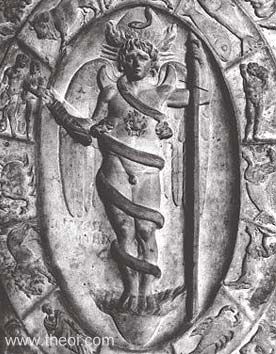
There are several versions of the creation myth in Greek mythology, the first primordial beings were known as the Protogenoi, they are- Chaos, Phanes, Phusis, Erebos, Aether, Thalassa, Hemera, Nyx, Ananke, Khronos, Eros, Gaia, the Ourea, the Nesoi, Ouranos, Tethys, Okeanos, Hydrus, Pontos and Tartarus.
Chaos, Phanes, Ananke, Khronos, Eros, Nyx and Okeanos have all been considered as the first beings. Hesiod says that Chaos came first and from her came Gaia, Erebus, Nyx, Eros and Tartarus. Then from Nyx and Erebus came Aether and Hemera,and from Gaia came Ouranos and with him they formed the first twelve Titans.
The Orphica suggests Ananke came first, fully formed with her consort Khronos/Chronos (not to be confused with Cronus), and together they brought about the universe from an egg, and it is from this egg that Phanes hatched. Phanes owes his origins to Orphic tradition, a type of cult/religion in the ancient world, here Phanes is listed as the god of procreation and new life and the first ruler of the universe, he is the father of Nyx and passes his reign onto her via his sceptre. Nyx in turn passes it to Ouranos, it is then seized by Chronus and then Zeus.
The Orphic Theogonies also give Thesis as the goddess of creation and mention Phusis a goddess of nature alongside her. It also says that Hydrus/Hydros the primordial being of water emerged first with Thesis, and mud which turned into Gaia. Gaia and Hydrus became parents to Khronos and Ananke, or Phanes.
Nyx is sometimes listed as the first being rather than Chaos, Phanes and Eros are both considered her sons, although Phanes is sometimes given as her father. Hesiod and Aristophanes both list her as the child of Chaos. It is Orphic fragments who says she is Phanes' daughter.
Parmenides says Eros came first whilst Hesiod says he came after Chaos and Aristophanes lists him as a child of Nyx. Originally a primordial god of love he was gradually turned into a companion and child of Aphrodite having more in common with his more known Roman form Cupid.
So we have a rough summary of several creation theories. Now I will go into more depth about who or what these beings were thought to be.
Chaos/Khaos was considered female in aspect, an abyss, the gaping nothing and also the first being in the universe from which everything else came. Personality wise there is not much to go on, Chaos was a thing and a being, a personification of nothingness, also known as the void or air. Ovid described Chaos as "a rude and undeveloped mass".
She was either the first being or a child of Khronos and Ananke, she was parent to Erebus and Nyx, and possibly Aether, Hemera and Eros, and occasionally the Moirae. Sometimes a formless, motionless mass or sometimes all the elements together. Chaos was also viewed as the gap between heaven and earth. Chaos was also seen as the womb in which the cosmic egg was laid by the wind and then hatched into Eros.
Phanes/Protogonos/Protogonus/Erikepaios/Ericapaeus- was a child of Khronos and Ananke, he hatched from the silver Cosmic World-Egg/ Orphic Egg, a being both male and female with gold wings and a serpent coiled around him. He was also known as Protogonos/Protogonus or Phanes-Protogonos, Protogonos meaning First-born. He is described as the god of reproduction, new life, light (Phanes meaning "I bring to light") and goodness, and the first ruler of the universe and is sometimes given as a parent or consort of Nyx. He was said to be king of the universe before gifting his sceptre and title to Nyx.
He could be linked to Eros and Mithras, also said to have hatched from the cosmic egg or to have come after Chaos and Gaia. Sometimes he was a child of Hydrus and Gaia. Nonnus says Hermes disguised himself as Phanes to save Dionysus/Zagreus from Hera. Respecting Phanes, Hera bowed before him.
He was also called Ericapaeus or Metis, and said to have been disguised as Metis when Zeus mated and swallowed her.
He was depicted as a hermaphrodite wearing a helmet with golden wings and a serpent wrapped around him.
Phusis/Physis- She is considered a primordial goddess of nature associated with Thesis.
Erebos/Erebus- is the primordial god of darkness, a son of Chaos and husband to his sister Nyx. With whom he had many offspring- Aether, Cer, Eros, Hemera, Charon, the Hesperides, Hypnos, the Moirae, Momus, Moros, Nemesis, Oneiroi, Phlegethon, Styx, and Thanatos. (Although Nyx is sometimes said to have produced many of her offspring without a consort). There is very little mentioned about Erebus.
Nyx used his darkness to darken the skies.
Hyginus sometimes states he was father to Geras, the god of old age.
He was associated with the Underworld, said to be split into two- Erebus, where the dead went first when they died, and Tartarus, where the Titans were imprisoned. Later Erebus was interchangeable with Tartarus.
Nyx- is the primordial goddess of the night, a daughter of Chaos, sometimes Phanes, she was wife to her brother Erebus. She is the mother of Aether, Charon, Epiphron, Hemera, Hypnos, Moros, Nemesis, Styx, Thanatos, Achlys, Apate, Eris, Erinyes, Geras, Hesperides, Keres, Momus, Oizys, Oneiroi, Phanes, Philotes, Moirae, and Lyssa. Some sources says many of her children came about through parthenogenesis, whilst others list all or most of them as children with her consort Erebus. Zeus and Themis have also been listed as the parents of the Moirae opposed to Nyx, and Lyssa is said to have been the child of Nyx and Ouranos.
Hesiod states that she lived in the Underworld with her children Hypnos, Thanatos and Hemera, and presumably her consort Erebus.
When Zeus pursued Hypnos in a rage after Hypnos put him to sleep at Hera's behest, Hypnos fled to Nyx and hid behind her. Fearing the ancient goddess, Zeus abandoned his pursuit.
Orpheus portrayed her as an oracle dwelling in a cave with Cronus who was chained and drunk on honey. Outside the cave the nymph Adrasteia (possibly one of Zeus' nurses) played cymbals and drums in rhythm with Nyx's prophesising.
Medea and Circe invoked her when casting spells.
Nyx is described as beautiful and blue-black and usually wearing a cloak of darkness or having black wings.
Her Roman counterpart was Nox.
Aether/Aither- is the god of air/space/heaven who is a son of Nyx and Erebus. (See
Children of Nyx.)
Hemera-is the goddess of the day, daughter to Nyx and Erebus and consort to her brother Aether. Hesiod says she and Nyx dwelled in a house in the Underworld, passing each other as they left and returned. (See
Children of Nyx.)
Thalassa- is a sea goddess, the daughter of Aether and his sister Hemera, she is the consort of Pontus, and mother of Telchines and Halia, a goddess who gave Poseidon six sons and a daughter and was raped by her sons after Aphrodite drove them mad. As there were many sea deities, there is little about Thalassa as others took more importance.
She was clothed in seaweed and had crab claws for horns.
Pontus- is a sea god who is given as a son of Gaia with whom he fathered Nereus, Thaumas, Phorcys, Ceto and Eurybia. With Thalassa he sired the Telchines and Halia. He was effectively replaced by Poseidon as the gods took over the Titans and even the Protogenoi.
Gaia from God of War
Gaia/Gaea/Ge- is an earth and mother goddess. She is a child of Chaos who created her own consort Ouranos. She was the first to emerge from Chaos, followed by Tartarus, Eros, Erebus and Nyx. She then created Ouranos (sky), Ourea (mountains), and Pontus (sea). She had many offspring including the Titans, the Olympians, the Cyclopes, the Hekatonkhires (hundred-handed), the sea gods and the Gigantes amongst others.
With Ouranos she had the Twelve Titans- Coeus, Crius, Hyperion, Iapetus, Oceanus, Cronus, Rhea, Phoebe, Tethys, Theia, Themis and Mnemosyne; the Hekatonkhires- Briareus, Cottus and Gyes; and the Cyclopes- Arges, Brontes and Steropes; and Aetna, a mountain nymph who acted as judge when Demeter and Hephaestus quarrelled over Sicily, and with Zeus or Hephaestus was mother to the Palici.
When Ouranos hid their monstrous children away she urged her children to overthrow him, only the youngest Cronus was brave enough to do so and she gave him an adamantine sickle to do so. Cronus cut his father's testicles when he came to lie with Gaia and from the union of his blood and Gaia came forth the Meliae (ash nymphs), the Erinyes- Alecto, Megaera and Tisiphone, and the Gigantes- Eurymedon, Porphyrion, Alcyoneus, Agrios, Clytius, Enceladus, Ephialtes, Otus, Eurytus, Gration, Hippolytus, Leon, Mimas, Pallas, Pelorus, Polybotes, Theodamus and Thoon.
When Cronus imprisoned the Cyclopes, Hekatonkhires and Gigantes back within her she grew angry and helped Zeus to overthrow him. It was she and Ouranos (or just she) who prophesied that Cronus would be overthrown by his child as he had overthrown his father. Cronus ate his children to prevent this but his wife grew tired of watching her children be devoured and went to Gaia (or Gaia and Ouranos) for advice, they persuaded her to trick Cronus by giving him a rock wrapped in swaddling clothes to swallow instead of Zeus. In some accounts Gaia raised Zeus.
In anger at Zeus for imprisoning her Titan children in Tartarus after the Titanomachy she persuaded the Gigantes to rise up against him and the gods. They fought in Gigantomachy and the Gigantes were defeated by the gods thanks to the aid of Heracles when a prophecy said the aid of a mortal was required to defeat them.
With Tartarus she had Typhon/Typhoeus, the father of all monsters, her last son and sometimes his consort Echidna is given as her daughter. Campe/Kampe is thought to be another sibling, she is a dragon with a woman's head and torso and a scorpion's tail, she guarded the Cyclopes and Hekatonkhires for Cronus and was killed by Zeus. Gaia persuaded Typhon to attack Zeus, in vegeance for the Titans and the Gigantes. Typhon was manlike with serpents for legs and fingers, he was tall enough to reach the stars, had wings and attacked with fire and storm winds. Typhon tore out Zeus' sinews and hid them but Hermes recovered them. In some accounts the half-serpent half-female monster Delphyne guarded them and was slain by Apollo. Zeus then defeated Typhon and sealed him under Mt. Etna.
With the sea god Pontus, Gaia had the sea goddess Ceto who was Phorcys' consort, Phorcys/Phorkys god of dangers in the deep sea, Eurybia a sea goddess, the Old Man of the Sea Nereus who fathered the Nereids with Doris, and Thaumas, a sea god who fathered the Harpies and Iris with the Oceanid Electra.
With Poseidon she had Antaeus a half-giant who wrestled travellers and built a temple with their skulls. He had the power to heal so long as he remained on the ground, Heracles killed him with a bearhug. A goddess Tinjis/Tingis/Tinga was said to be his wife and Heracles consorted with her after he murdered Antaeus, and they had a son, Sufax. With Poseidon Gaia also had a daughter, Charybdis a beautiful nymph cursed into the form of a whirlpool monster with flippers and teeth, Zeus cursed because she won too much land for her father with the tides.
With Oceanus she had Creusa, mother to Hypseus, King of the Lapiths, and Triptolemus, a man linked to Demeter. Triptolemus was either a priest of Demeter or in fact another name for Demophon, a son of King Celeus that Demeter tried to make immortal in thanks for Celeus' hospitality, but she was stopped by Celeus' wife Metanira.
With Zeus she had a son, King Manes of Maeonia.
With Aether she had Aergia, the goddess of sloth who guarded Hypnos' court. Sometimes Ouranos was also a son of Aether and Gaia.
She may have been mother to Pheme, the personification of fame.
Argus Panoptes, the many eyed guardian of Io that Hermes killed may have been a son of Gaia, possibly with Arestor.
Hyllus/Hyllos, Anax, Asterios, Damasen who killed a drakon in Lydia, Alpos who was killed by Dionysus, Syceus/Sykeus who was turned into a fig tree by Gaia, and Azeus/Azeios who fought during the Titanomachy, were giant sons, as were the Gegeness who had six arms and attacked the Argonauts.
When Hephaestus tried to rape Athena, she ran from him but his semen struck her leg. Athena wiped it off and discarded it onto Gaia, impregnating her with Erichthonius/Erichthonios. Gaia gave the infant to Athena who in turn put him in a box and gave him to the princesses of Athens, Herse, Pandrosus and Aglaurus, to mind. Curiosity overrode Aglaurus and Herse and they opened the box, discovering either a half-infant half-serpent or an infant with a serpent encoiled about him, they went mad and killed themselves. He grew up to become king of Athens and with the naiad Praxithea he had a son, Pandion.
After the great deluge, survivors Deucalion and Pyrrha wanted to repopulate the earth, they consulted an oracle of Themis who instructed them to throne the bones of their mother over their shoulder, this meant rocks. So from the rocks that Deucalion threw came men and from the rocks Pyrrha threw came women, all born of Gaia.
She may have produced a scorpion to kill Orion when he boasted that he would kill everything on earth, in other accounts Apollo or Artemis killed him.
When Zeus and Hera married she gave Hera a garden of golden apple trees, this became the Garden of the Hesperides, guarded by the Hesperides, Ladon and to an extent, Atlas.
Hermes took Apollo and Cyrene's son Aristaeus/Aristaios to Gaia who raised him and made him immortal, he was the founder of bee-keeping.
Her Roman counterpart was Terra/Tellus/Terra Mater. Her partner was Caelus/Coleus, a sky god, Tellumo or Tellurus, or Jupiter and she was linked to Ceres.
Ouranos/Uranus- is the god of the sky, Gaia's son and consort, he fathered many children with her. When he imprisoned their monstrous children in Tatartus Gaia gave their son Cronus a sickle to castrate him with when he came to mate with Gaia. It is said that Aphrodite formed from these genitals in the sea. Uranus is actually a Greek name rather than Roman. He was the son of Gaia, Aether and Gaia, Aether and Hemera, or Nyx. He fathered the Titans, the Cyclopes, and the Hecatoncheires with Gaia, and when he was castrated by Cronus the Meliae (ash nymphs), the Gigantes, Erinyes, and Aphrodite, and sometimes the Telchines, sprang from his blood.
He loathed his children and pushed them back into Gaia, into Tartarus, which caused her so much pain and grief that she persuaded her youngest, Cronus, to castrate Ouranos with an adamantine sickle. After his castration he could no longer mate with Gaia so he, the sky, was fixed in place.
With Gaia he prophesised that Cronus would be overthrown by his child as Ouranos was. Cronus tried to prevent this by swallowing his children by failed when Rhea, advised by Ouranos and Gaia, hid Zeus and fed Cronus a stone instead. Zeus then overthrew Cronus and saved his siblings.
As the sky he was depicted as a dome of brass or bronze by the Greeks.
His Roman counterpart is Caelus/Coelus. He was linked to the Roman god of nocturnal thunder, Summanus. Cicero and Hyginus called him a son of Aether (light) and Dies (day/daylight), and with Dies he was a parent of Mercury. He was also father to Janus, Saturn and Ops/Opis, with Trivia or Terra/Tellus. With the title Nocturnus he was god of the night sky and Sol's opposite.
Ananke/Anangke/Anance/Anagke - is the goddess of destiny, inevitability and necessity and the consort of Khronos. Sometimes given as the mother of the Moirae for obvious reasons, she was pictured as either a woman with a spindle, or as a woman with the lower body of a serpent like a naga or lamia who was coiled with her half serpentine consort Khronos with the cosmic egg between them.
She seems to have been an all powerful deity beyond the Titans and gods with her consort who gradually faded from popularity over time. She was said to have appeared fully formed at the beginning of time and from the cosmic egg the universe came to be. She and her consort kept the heavens and time going. Sometimes she is said to be a daughter of Hydrus/Hydros and Gaea/Gaia. With Khronos her offspring included Chaos, Aether, Phanes and Erebos/Erebus, and by herself she was sometimes mother to the Moirae. In one picture she was winged and holding a torch.
Her Roman counterpart was Necessitas.
Khronos or Chronos/Chronus- was Ananke's consort and the god of time, he was pictured with the head of a man, a bull and a lion and a serpent's body, coiled up with Ananke or as a bearded man. He was confused and even merged with the titan Cronus/Kronos. With Ananke he hatched the cosmic egg, out of which Eros or Phanes sprung, and he encircled the heavens with her driving heaven and time forward. He was also called Aeon/Aion (eternity) and was depicted on Gaia holding the zodiac wheel. Alternatively, Aion was a seperate deity of unbounded time whilst Chronos was restricted to set time i.e past, present future, he was linked to eternity. He either appeared fully formed or his parents were Hydrus and Gaia. With Ananke he fathered Phanes, Eros, Chaos and Aether, and sometimes with Nyx he fathered Hemera and Moirae.
Aion was sometimes depicted as an old man and was linked to the Horae. To the Romans he was the guarantor of Roman rule. His Roman counterpart was the female goddess of eternity, Aeternitas. She was depicted holding a cornucopia, leaning on a sceptre with one foot on a globe and thus was linked to eternity, prosperity and domination. The phoenix was her symbol and she was sometimes viewed as a daughter of Jupiter.
The Ourea were children of Gaia, they were ten deities of the mountains.
The Nesoi were the goddesses of islands.
Tethys- is a goddess of fresh water and a sea goddess, the daughter of Gaia and Ouranos and sister/consort to Okeanos. With Okeanos she was parent to the Okeanids, the Potamoi (rivers) and the Nephelai (clouds).
She is given as Hera's nurse during the war against the Titans. In honour of Hera she refused to let the constellation Ursa Minor set in Okeanos as this was the constellation of Callisto/Kallisto, a nymph Zeus seduced in the form of Artemis and impregnated.
Okeanos/Oceanus- is a sea god, the son of Gaia and Ouranos and brother/consort to Tethys. He was seen as the giant river that encircled the world. With Tethys he was parent to the Oceanids, the Nephelai, and the Potamoi.
He chose not to rebel against Ouranos or to fight in the Titanomachy.
When Heracles travelled over the ocean in Helios' golden bowl, he threatened Okeanos when the bowl was tossed about in the waves, amused, Okeanos left him alone.
He was shown with a beard, sometimes horns and either a serpent or fish lower half.
Tartarus/Tartaros- is given as a child of Chaos or Gaia and Aether, the god of the pit of Tartarus, a hellish place where the damned went. With Gaia he is given as a parent of Echidna and Typhon, presumably Kampe and sometimes the Gigantes, though usually they came from Ouranos' blood mixing with Gaia. He is given as parent to the Telchines with Nemesis, though they are also considered children of Pontus and Gaia, Thalassa, Poseidon or the blood of Ouranos and Gaia. Nine in number they had flippers and dog heads, inhabited Rhodes and were skilled metalworkers. In some early myths Rhea gave them the infant Poseidon to guard. They started used their skills for malvolent deeds and were killed by the gods for this.