Tuesday, 6 November 2012

Other Gods- Pan


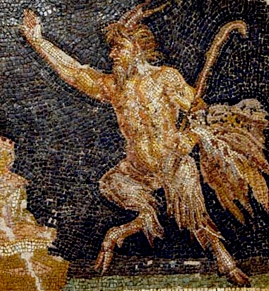
Pan- god of shepherds, flocks, the wilderness, hunters and rustic music. He was a son of Hermes though his mother varies, candidates were Thymbris, a Naiad who may have alternatively had Pan with Zeus, Penelopeia/Penelope, a Dryad of Mt. Cyllene where Hermes was born, she is thought to be the daughter of Dryopos said to be a mother of Pan, and the reason some writers suggested it was Penelope, Odysseus' wife who was Pan's mother, Dryope/Driope, a Naiad and Hamadryad, though this was probably a confusion with Penelope, as they were both considered daughters of Dryopos seduced by gods in tortoise form (Dryope by Apollo), or Sose, a Naiad and prophetess.

With the nymph Eupheme who nursed the Muses he had a son, Krotos/Crotus, a satyr who was a companion of the Muses. With Symaethis/Symaethos, a Naiad, he fathered Akis/Acis the river god who loved Galatea/Galateia, a Nereid loved and slain by the jealous cyclops Polyphemos. With the Naiad Isemenis/Isemenos he had a son, Krenaios/Crenaeus. He was sometimes said to be father to Silenus/Seilenos, Dionysus tutor and drunk companion who had horse ears, tail and legs, his mother is not given and alternatively he was a son of Hermes or Gaia. With the nymph Echo/Ekho he was parent to Iynx, a nymph who charmed Zeus to love her or Io and was cursed to be a wryneck bird by Hera, alternatively she was a daughter of Peitho and Pan and Echo's daughter was Iambe, a Thracian woman who cheered Demeter with jokes when she despaired over Persephone's disappearance. In one version of Echo's myth, it was Pan who killed her, commanding his followers to rip her to shreds when she scorned his love, Gaia gathered her pieces and only her voice remained, more popularly she was cursed by Hera for distracting her from Zeus' affairs.

A satyr/faun from Fantasia


His other sons are the Panes/Paneides/Paniskoi, twelve in number they may simply be other aspects of Pan- Kelaineus/Celaeneus, Argennon, Aigikoros/Aegicorus, Eugeneios/Eugenius, Omester, Daphoineus/Eugenius, Phobos/Phobus, Philamnos/Philamnus, Xanthos/Xanthus, Glaukos/Glaucus, Argos/Argus, and Phorbas. Satyr like sometimes they were also given goat heads. They helped Dionysus fight the Indians.

Three more Panes were Pan's brothers- Agreus/Argeus, Nomios/Nomius and Phorbas, sons of Hermes with Sose and Penelope respectively, Phorbas' mother is unknown. Agreus was a hunter and Nomios a shepherd and the three joined with Dionysus in his fight with the Indians.

Another Panes was Sybarean Pan/Pan Sybarios, the offspring of a shepherd Krathis and a female goat. This was a Roman story.


Faun from Pan's Labyrinth


He pursued the nymph Syrinx, a virgin follower of Artemis, the river nymphs transformed her into reeds to escape Pan and from them he made the first panpipes. He pursued the nymph Pitys who transformed into a pine tree to escape him. He seduced the moon titaness by wrapping himself in a goatskin or sheepskin.

When Pan was born he had goat's legs and horns and was abandoned by his mother or nurse. Hermes however was delighted with him and took him up.

He can be linked to Aegipan, a son of Zeus and Aega/Boetis/Aix, confusingly given as a descendant of Hephaestus who was nursemaid to Zeus and wife to Pan, a daughter of King Olenus, son of Hephaestus, or Melissus king of Crete, or the Titans Perses and Helios who was confined in the cave where she suckled Zeus because her brightness frightened the other Titans. Zeus may have wore her skin as his aegis, which explains why in some versions she is a goat. Aegipan was half goat and half fish and also said to be father to Pan, he helped Hermes retrieve Zeus' sinews when Typhon stole them.


Pausanias says he found Demeter when she hid herself in grief and anger after Persephone's abduction and Poseidon's rape.

He is sometimes said to have given Artemis her hunting dogs and taught her twin Apollo the gift of prophecy.

He was a companion to Rhea, a mountain goddess, and to Dionysus.

The popular story of Apollo and the satyr Marsyas' music contest is sometimes retold with Pan being Apollo's challenger. The mountain god Tmolus is the judge and he rewards victory to Apollo, all but King Midas agree and as punishment, Apollo curses Midas with donkey ears. The only difference between this tale and that with Marsyas is that Marsyas is flailed by Apollo for his insolence but obviously Apollo could not do the same to a fellow god.

His most famous story is a curious one from Plutarch, that of his death. During the reign of the Emperor Tiberius a sailor, Thamus, claims a voice called to him across the ocean telling him to proclaim that the great god Pan was dead. Salomon Reinach suggests he misheard 'Thamus Panmegas tethneke', which actually means ''the all-great Tammuz is dead', Tammuz being a Summerian god of vegetation and food.

His animals were the goat and tortoise and his plants the pine, reed and beech.

His Roman counterparts are Faunus/Phaunos and Silvanus. Faunus was given as a Greek deity by Nonnus, a son of Poseidon and Circe/Kirke. The Roman deity was a horned god of the forest, fields and wilderness, usually given goat legs he was depicted as a faun, the Roman name for satyr. Virgil says he came from Arcadia. As a god of prophecy he was known as Fatuus and those who slept in precincts on the fleeces of sacrificed lambs were told the future in their dreams.
His wife, sister or daughter was Fauna/Fatua, and his son was Latinus/Lavinius, king of the Latins and father to Lavinia, who was meant to be wed to the king Turnus but was instead given to the Trojan hero Aeneas, resulting in a brief war. Pan had Latinus with Marica, a nymph. Sometimes he was said to have been a mortal king of Latium, son of Picus who was turned into a woodpecker after scorning Circe's love, and Canens, a nymph of song who killed herself after her husband's transformation. Picus was said to be a son of Saturnus/Saturn or Mars. After his mortal death Faunus became a god.
He may have initially been depicted without horns until he was linked to Pan.
He was also known as Inuus, another name for Fatuus/Fatulcus, a god of copulation.

Silvanus was a Roman guardian of forests, also associated with the boundaries between fields. He protected cattle, promoting their fertility and warding wolves off from them. The syrinx (pan flute) was sacred to him and he was usually depicted as an old man. Women may have been exempt from his worshipping him as he was a god of the labour men did in the fields.
He was said to love Pomona, the goddess or nymph of fruitful abundance and orchards, a Numia (guardian spirits). She rejected him and Picus and married Vertumnus/Vortumnus/Vertimnus the god of seasons who tricked her by disguising himself as an old woman. Sometimes he was said to have loved Cyparissus/Kyparissos, a boy who loved a stag which he accidentally killed, in his grief he turned into a cypress tree. Usually Apollo is said to love the boy. Servius says Silvanus accidentally killed the deer and transformed the boy in his grief, and carries the cypress tree with him as a reminder.
He may also have been a Roman counterpart for Silenus, Dionysus' tutor and drunk companion.


Wednesday, 8 August 2012

Minor Goddesses

Bia- the goddess of force, a daughter of Styx and the Titan Pallas who was killed by Athena. Sister to Nike, Cratos/Kratos and Zelus, with her siblings she sat by Zeus' throne.

Nike- the goddess of victory, she was winged and brought good luck. A daughter of Styx and Pallas and sister to Bia, Cratos/Kratos and Zelus. She was Zeus' charioteer during Titanomachy. She was depicted holding a wreath, bowl and cup, incense burner, lyre or palm branch. Her Roman counterpart was Victoria.

Enyo- a war goddess, linked to Ares and Eris. With Ares she may have had a son, his attendant Enyalios. Alternatively, Enyalios was a son of Kronos and Rhea. Like Ares she delighted in warfare, violence and bloodshed. She was given as a daughter of Zeus and Hera and thus was sister to Ares, Hebe and Eileithyia, who was said to be her twin.

She stayed neutral in the battle between Zeus and Typhon, and took part in the Trojan War, the Seven Against Thebes, and Dionysus' war with the indians.

Her Roman counterpart was Bellona, who was depicted with a helmet, spear and torch.

Eileithyia/Ilithyia- the goddess of childbirth and midwives. She was a daughter of Zeus and Hera who could be linked to Artemis who was associated with childbirth and midwives.

When Hera got Zeus to vow that a member of Perseus' family would become High King, Zeus agreed believing that Heracles, a descendant of Perseus, was about to be born. Hera forced Eileithyia to sit cross-legged with her clothes in knots, preventing the birth of Heracles and his mortal twin, and Eurystheus, another descendant of Perseus, was born first. Hera would've prevented Heracles birth entirely if his mother Alcmene's servant Galanthis had not lied to Eileithyia and claimed the child was already born. Eileithyia jumped up in surprise and thus Heracles was born, in rage Eileithyia or Hera turned Galanthis into a polecat/weasel.

Hera kept her from Leto as well to make her birth of Apollo and Artemis difficult but the other goddesses in attendance of the births sent Iris to bribe her with a golden necklace. Eileithyia then attended the birth.

She was depicted carrying a torch.

She was mother Sosipolis, protector of Elis who was said to be a child god wearing a starry robe and carrying a cornucopia. Rarely she was also said to be mother of Eros.

Her Roman counterpart was Lucina.

Hebe- the goddess of youth and a cupbearer to the gods. She was the daughter of Zeus and Hera and thus sister to Eileithyia, Enyo and Ares.

She served the gods ambrosia, attended Aphrodite, drew baths for Ares and helped Hera with her chariot. She was Heracles' fourth and final wife, given to him when he became a god. Their union ended his feud with Hera. With him she was mother to Anicetus/Aniketos and Alexiares, twins who remained as children and were the gods of the defence of towns and gatekeepers of Olympus.
Ganymedes, the Trojan prince her father Zeus abducted, was either her male counterpart or replacement as cupbearer to the gods.

Ovid says she restored Iolaus, Heracles' nephew, to his youth.

She was depicted as winged and in her role as a cupbearer or young bride.

Her Roman counterpart was Juventas. A goddess of young men, when they reached manhood they offered a coin to her.

Tyche/Tykhe- the goddess of fortune, chance and fate. A daughter of Hermes and Aphrodite or Zeus and Aphrodite, or she was an Oceanid.

She was depicted wearing a mural crown (crown like the towers or walls of a city), carrying a cornucopica or with the wheel of fortune.

When bad things happened it was sometimes said to be the judgement of Tyche. She was a companion of Nemesis, the goddess of retribution, and Ploutos/Plutus, the god of plenty, who was also sometimes said to be her son. Usually Ploutos was a son of Iasion and Demeter.

Her Roman counterpart was Fortuna. A daughter of Jupiter she was depicted as veiled and blind, holding a cornucopia and a ship's rudder, and she protected the grain supplies. A goddess of fortune and luck both good and bad, she was given the titles Fortuna Dubia (doubtful fortune), Fortuna Brevis (fickle fortune) and Fortuna Mala (bad fortune).

Her counterpart was Bonus Eventus, the personification of good outcome, a god of agriculture whose partner was Lympha, the deity of fresh water.

Chione/Khione- the goddess of snow, a daughter of the North wind Boreas and Athenian princess Orithyia. Boreas tried to woo Orithyia but when he was unsuccessful he abducted her and raped her, with her he had Chione, Cleopatra and the Boreads (Calais and Zetes), her sisters were the tragic Procris, who was wife to Cephalus who accidentally killed her, Creusa who was a lover of Apollo's, Chthonia who was sacrificed by their father so he could win a battle, and Protogeneia and Pandora who committed suicide after this as they had made a pact to kill themselves if one of them died. Her brothers were Pandorus, Metion and the future king Cecrops.

Chione's sister Cleopatra was the seer and Thracian king Phineus' first wife, with whom he had two sons who his second wife Idaea tricked him into blinding.

With Poseidon Chione had a son, Eumolpus/Eumolpos, but she threw him into the ocean to avoid her father's wrath. Poseidon rescued the infant and entrusted him to his daughter Benthesikyme, he was married to one of Benthesikyme's daughters (his own niece) but loved another and was banished for this. He then became a priest of Demeter.

Harmonia- the goddess of harmony, and a daughter of Ares and Aphrodite, her siblings were Anteros (unrequited love), Deimos (fear), possibly Eros (love), and Phobos (panic). Sometimes she was said to be a daughter of Zeus and Electra/Elektra, a Pleiad he raped, making her sister to Dardanus, founder of Dardania (later Troy), and Iasion, a lover of Demeter who was killed by the jealous Zeus.

She was viewed as Eris opposite. She was married to Cadmus/Kadmos, a prince and brother of Europa who founded Thebes whilst searching for her. When his men were killed by a dragon he killed it and from its teeth sowed men to help him build Thebes, on Athena's advice, but the dragon was sacred to Ares who made him do eight years of penance.

At their wedding Harmonia received a peplos (long garment women wore) from Athena, and the infamous necklace from Hephaestus. As Hephaestus was outraged with Aphrodite's affair with Ares of which Harmonia was a result, he cursed the necklace which doomed her family. The necklace, known as the Necklace of Harmonia, was described as golden in the shape of two serpents whose mouths formed the clasp. They rendered the wearer young and beautiful. In some sources it was given to Cadmus by Europa or Hephaestus to give to his bride, alternatively it came from Athena or Aphrodite. Sometimes Hephaestus gave a cloak with it, or it was a cloak rather than a necklace and came from Athena and Hephaestus.

Semele inherited the necklace from Harmonia. Jocasta, Queen of Thebes, who unwittingly married her son Oedipus was said to have worn it. Eriphyle was bribed with it by Polynices in exchange for her urging her husband Amphiaraus to take part in the Seven Against Thebes though she knew he would die. Amphiaraus demanded that his sons avenged him and Alcmaeon did by killing his mother for which the Erinyes tormented him. He married Phegeus' daughter Arsinoe/Alphesiboea and gave her the necklace. He was killed by Phegeus' sons when he tried to get the necklace back from him for the river god Achelous to give to his daughter Callirrhoe who he had either wed or was offered as a bride. Arsinoe was sold into slavery by her brothers for scolding them. Callirrhoe then asked Zeus that her sons by Alcmaeon grew old immediately so that they could avenge their father. Zeus granted her request and they killed Phegeus and his sons. The curse ended when Alcmaeon's sons, Amphoterus and Acarnan, dedicated the necklace to a temple of Athena at Delphi. A tyrant Phayllus is said to have stolen it and given it to his mistress. Their son went mad and set fire to the house killing his mother.

With Cadmus Harmonia had a son, Polydorus, who became king of Thebes when the ruler Pentheus was killed, but died young while his son Labdacus was a child. Labdacus too had a short reign and died young, either in battle or he was killed by Maenads. Harmonia and Cadmus also had daughters. Semele who was impregnated with Dionysus by Zeus but died in terror when she asked Zeus to come to her as he did to Hera, after Hera tricked her into asking for this. Ino who became Dionysus' foster mother and was also the wicked stepmother of Phrixus and Helle, her husband Athamas was stricken with madness and killed their son Learchus, thinking he was a ram/fawn/lion. Athamas then tried to kill Ino and their son Melicertes and she was forced to jump into the sea with him. Alternatively Ino too was mad and boiled Melicertes in a cauldron. Zeus turned the pair into the marine deities Leucothea (white goddess) and Palaemon. Autonoe and Agave were other daughters, they became Maenads and killed Agave's son, the current Theban king Pentheus. Agave carried his head back on a stick thinking him a lion and only realised the truth when she met Cadmus. Autonoe was mother to Actaeon who was turned into a stag by Artemis for spying her bathing naked and was killed by his own hounds. The sisters may have been driven mad because they were jealous of Semele and suggested that her lover Zeus was a man who merely claimed he was a god.

Cadmus abandoned his throne to his grandson Pentheus and he and Harmonia went to Illyria to escape their misfortune. Cadmus felt he was cursed for killing Ares' dragon and remarked that if the gods loved a serpent so he wished to be one and so they transformed him. Harmonia begged for the same fate so she could be with her husband. When they died they went to the Isles of the Blessed.

Her Roman counterpart was Concordia the goddess of agreement, understanding and marital harmony. She was usually depicted with a sacrificial bowl, a cornucopia or a caduceus. She was shown in the company of Pax (peace) and Salus (well-being) or Securitas (security) and Fortuna.

Pandia/Pandeia- goddess of the full moon, beauty and youth. A daughter of Zeus and Selene and sister to Herse/Ersa, Nemea and sometimes the Nemean Lion. She had the fifty Menae/Mene for half-sisters, daughters of Selene and Endymion.

Herse/Ersa- goddess of the dew. A daughter of Zeus and Selene and sister to Pandia, Nemea and sometimes the Nemean Lion. Half sister to the fifty Menae.

Menae/Mene/Menai- fifty goddesses of the lunar months. They were the daughters of the moon titan Selene and the mortal King Endymion of Elis. Their half sibilings were Pandia, Herse/Ersa, Nemea, and the Nemean Lion.

Brizo- a goddess worshipped by women in Delos, she protected sailors and fishermen and interpreted dreams. Food was offered to her but never fish.

Aidos/Aedos- a goddess of modesty, respect, shame and humility. A companion of Nemesis she was said to be the last goddess to leave earth when the Golden Age ended. Alternatively it was Astraea/Astrea the goddess of innocence and purity who was the last to leave, abandoning earth during the Iron Age.

Sometimes Aidos was said to be a daughter of Prometheus.

Asclepius and Epione, the goddes of soothing pain's daughters, Hygieia/Hygiea/Hygeia- a goddess of health, cleanliness and sanitation, Panacea/Panakeia- the goddess of medicines, Iaso- the goddess of recuperation, Aceso- the goddess of healing, and Aglaea/Aglaia- the goddess of splendor (probably confused with the Charite of the same name.

Aura- Titaness goddess of the breeze. Nonnus says she was a daughter of Cybele whilst other sources say she was a daughter of the Titan of air and stalking prey Lelantus/Lelantos and the Okeanid Periboea/Periboia. She could be linked to the naiad Nicaea/Nikaia, also said to be a daughter of Cybele seduced by Dionysus.

A virgin huntress who said that Artemis' body was too womanly to belong to that of a virgin. In anger with Nemesis' help Artemis brought about vengeance by having Dionysus rape Aura. She became pregnant and went mad killing men, and even swallowed one of her twin sons. Artemis rescued the other,  Iakkhos/Iacchus who became a demigod attendant of Demeter. Alternatively, Dionysus loved her and requested Aphrodite to inspire her to love him back but when she gave birth to their twins she went mad.

Ariadne- the goddess of passion and mazes. Formerly a princess of Crete and daughter of Minos, she persuaded the inventor Daedalus to give her a ball of thread that would find the way of the labyrinth, this she gave to the hero Theseus as she loved him. She fled with Theseus only to be left on the island Naxos, either because Theseus did not want to wed her or because Dionysus demanded it. Dionysus married her, gifting her with the Corona Borealis, a diadem he later placed in the heavens.

With Dionysus she had the sons Oenopion, Staphylus, Thoas, Peparethus, Phanus, Eurymedon, Enyeus, Ceramus, Maron, Euanthes, Latramys and Tauropolis. Oenopion was a king of Chios associated with wine making who may have been a son of Theseus. He blinded Orion when Orion tried to rape his daughter Merope, when Helios restored his sight he returned to kill Oenopion but he hid in an underground fortress built by his followers, or an iron fortress built by Hephaestus. Staphylus was linked to grapes, said to be a general for his uncle Rhadamanthys, he founded Peparethos and was an Argonaut. Sometime he too was a son of Theseus'. He cast out his daughter Rhoeo in a casket in the sea when she became pregnant by Apollo, believing her pregnant to a mortal. She became mother to Anius. Thoas was king of Lemnos and possibly another son of Theseus. His daughter Hypsipyle sneaked him from the island in a boat or hid him when the women of Lemnos killed the men after Aphrodite cursed them with a bad odour causing their husbands to sleep with slaves. He became king of Tauris where Agamemnon's daughter Iphigenia became a priestess when Artemis took her there. When Iphigenia tricked him into giving her a chance to free her brother Orestes who he wanted to kill, he pursued them but Athena persuaded him to let them go. He was killed by Chryses, a priest of Apollo.

She was killed by Artemis or hung herself after Theseus abandoned her, or Perseus when Dionysus fought him and the Argives. Alternatively, Perseus turned her into stone with the head of Medusa. Dionysus then likely retrieved her from the Underworld and made her immortal as he had done with his mother Semele. Plutarch says when Theseus' ship was in a storm he sailed to an island and put the pregnant Ariadne ashore but when he went to secure the ship it was swept out to sea and Ariadne died before her child was born.

Thyone- goddess of inspired frenzy. Formerly the mortal princess Semele she was killed inadvertently by her lover Zeus when a jealous Hera in disguise suggested that her lover was not a god compelling Semele to ask Zeus to come to her as he did to Hera when he granted her a boon. The sight frightened her to death and to save the infant Dionysus, Zeus took the foetus from Semele and sewed it in his thigh until it was ready to be born. Alternatively, Dionysus was Zagreus, a son of Zeus and Persephone murdered by the Titans, Zeus took his heart and got Semele to swallow it causing it to be reformed as Dionysus.

Dionysus rescued Semele from the Underworld and brought her back as the goddess Thyone.

Other Goddesses- Muses


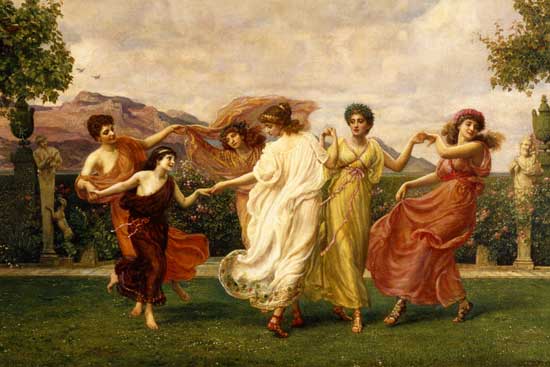
Muses/Mousai/Musae- the goddesses of literature, science, knowledge, music, song, dance and art. They were usually nine in number and thought to be daughters of Zeus and the Titaness of memory, Mnemosyne. In other traditions they were the daughters of Ouranos and Gaia, or Apollo, or Harmonia, daughter of Aphrodite and Ares. They were named Kleio/Cleio/Clio, Euterpe, Thaleia/Thalia, Terpsikhore/Terpsichore, Erato, Polyhymnia/Polymnia, Ourania,/Urania, Melpomene and Kalliope/Calliope.

Apollo was said to be their leader and they usually accompanied him. He was said to be father to three of the Muses, either Kephiso/Cephisso, Apollonis and Borysthenis, or Nete, Mese, Hypate (the chords on a lyre).
There were additionally three or four others, usually said to be the daughters of Ouranos and Gaia, they were Melete (Practice/Occasion/Thought/Meditation), Aoide/Aoede (Song/Tune), and Mneme (Memory), or Melete, Aiode, Arkhe, and Thelxinoe. The Roman Varro described them as ' one who is born from the movement of water, another who makes sound by striking the air, and a third who is embodied only in the human voice.'

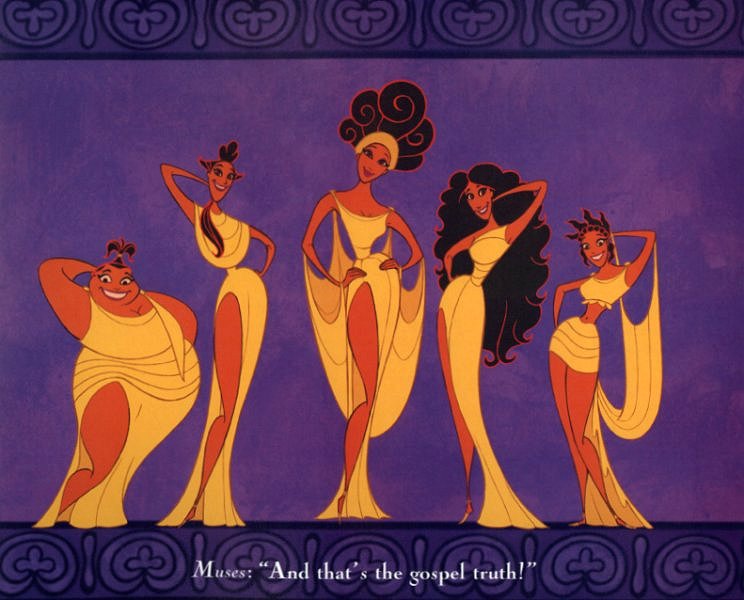
Muses from Disney's Hercules


Clio was the Muse of history, she was depicted with scrolls, and was sometimes said to be mother to Hymenaios/Hymenaeus, the god of weddings and an Erote. Sometimes he was a son of Calliope or Terpsichore with Apollo. Apollodorus says that Aphrodite made her fall in love with the mortal Pieros/Pierus, king of Macedon, or king Oebalus of Sparta, or king Amyclas because she had chided Aphrodite over her affair with Adonis, the result was a son, Hyacinthus/Hyakinthos/Hyacinth. This son was a lover of Apollo's, killed by a discus thrown by Apollo, it was either an accident or it said that Zephyrus, the west wind who was jealous of their love, blew the discus at him.

Euterpe was the Muse of lyric poetry/music. She was depicted with the aulos/double-flute. She may have had a son, Rhesos/Rhesus, with the river god Strymon, though his mother is also given to be Calliope or Terpsichore. Homer said his father was Eioneus/Deioneus, the father-in-law of Ixion whom Ixion murdered. He was a Thracian king who fought on the side of the Trojans during the Trojan War. He was murdered in his tent and Diomedes and Odysseus stole his horses.

Thalia was the Muse of comedy and bucolic/idyllic poetry, and she was depicted with a comic mask, a shepherd's crook and a wreath of ivy. Sometimes she had boots and a bugle/trumpet. With Apollo she was sometimes said to be mother to the Corybantes/Korybantes, seven/nine men who danced with shield and spear. Alternatively, Apollo had them with the nymph Rhetia, or Zeus fathered them with Calliope.

Terpsichore was the Muse of choral song and dance and depicted with a lyre. She was sometimes given as the mother of the Sirens with the river god Achelous/Akheloios, alternatively their mother was Melpomene, the princess Sterope, or Gaia. Some authors say Hera persuaded them to challenge the Muses to a singing contest, they did so and lost and the Muses plucked their feathers and they fell into the sea. Alternatively, they died when Odysseus heard their singing but escaped their lure. She was also given a son with Apollo, Linus/Linos, though he was more likely a son of Calliope.

Erato was the Muse of erotic poetry/lyrical poetry/love poetry and depicted with a lyre or kithara/cithara (a professional version of the lyre) and a wreath of myrtle and roses. Sometimes she held the golden arrow of Eros or was accompanied by Eros. In one story Zeus gave her to Malos and with him she had a daughter, Kleophema/Cleophema. She may have married Phlegyas, a son of Ares, and with him had Coronis/Koronis, Apollo's lover who became mother to Asclepius, and was killed by Artemis for betraying Apollo.

Polyhymnia was the Muse of religious hymns, sacred poetry, eloquence, agriculture, and pantomine. She was depicted as looking serious and meditative, cloaked with a veil, usually with one finger to her mouth. Nonnus says that at Harmonia's wedding she spoke with her hands and eyes rather than her voice.


Urania was the Muse of astronomy and was depicted holding a globe and being cloaked with the stars. Sometimes Linus/Linos and Hymenaeus were said to be her sons, with Apollo.

Melpomene was the Muse of tragedy and was depicted with the tragic mask, a sword/knife/club, cothurnus boots and a wreath of ivy or cypress. Sometimes she was said to be mother to the Sirens.

Calliope was the Muse of epic poetry and was depicted with a tablet and stylus or scroll, a book, or a lyre and she was crowned. The oldest and wisest of the Muses she was mother to the infamous, tragic poet Orpheus, with Apollo, and possibly Linus/Linos too. Orpheus was torn apart by Maenads, though his head remained singing and it floated with his lyre to Lesbos where it was enshrined. The Muses gathered up his body and buried it beneath Mt.Olympus and put his lyre in the heavens. His head prophesised until his father silenced it. Linus/Linos taught Orpheus and Heracles music, he was killed by Heracles with his own lyre for scolding him too often. Alternatively, their father is sometimes given to be King Oeagrus of Thrace who may have been a son of Ares or Pierus, or a descendant of Atlas and a son of Charops/Charopus, a loyal follower of Dionysus. Calliope married him. With Ares she may have been mother to Mygdon, Edonus, Biston, and Odomantus/Odomas.

The Muses accompanied Apollo, Dionysus and the Charites.

When Thamyris boasted that he could sing better than them they punished him by blinding him and turning him mute.
When King Pierus boasted that his nine daughter, the Pierides, could sing better than the Muses, the Muses entered a contest with them and when the girls lost they turned them into birds.

The Thracian king Pyreneus lured them into his palace promising them shelter but once they were within he tried to trap them. They escaped by turning into birds, insane he tried to leap after them and fell to his death.

They judged the contest between Apollo and the satyr Marsyas. Apollo played the lyre and Marsyas the flute Athena had invented and discarded, when Apollo played his lyre upside down and Marsyas could not do the same, the Muses awarded victory to Apollo and he flayed Marsyas alive. Alternatively, Apollo sung alongside his lyre and Marsyas could not do the same.

They awarded the hunter Crotus/Krotus who a satyr and companion of theirs and a hunter and musician, a place in the heavens as Saggitarius.
Apollodorus says that they taught the sphinx her infamous riddle.

Wednesday, 1 August 2012

Other Goddesses- Horae


Horae/Horai/Hours- the goddesses of seasons and portions of time. Later they became linked to justice and order. They watched over the heavenly constellations and guarded the gates of Olympus.
Daughters of Zeus and Themis, or Helios and Selene or just Helios, they were named-Thallo/Thalatte (Spring), Auxo and Carpo/Karpo/Carpho/Xarpo (Autumn), who were linked to nature, and Eunomia (Good Order, Good Pasture), Eirene/Irene (Peace, Spring), and Dike (Justice), who were linked to order. Other names included Auxesia, Damia, Euporia/Euporie (abundance), Orthosie (prosperity), Pherousa (substance, farm estates), Hegemone, Eiar (spring), Theros (summer), Kheimon/Cheimon (winter), and Phthinoporon (autumn). They were confused and linked to the Charites.

Thallo was the Horae of spring, buds and shoots, another name for her may have been Hegemone who was mentioned as leader of the Horae. Auxo was either the Horae of summer or probably linked to Auxesia, was also linked to spring growth and said to accompany Persephone, for whom Auxesia was another name. She was linked to Damia, Horae of the fertile earth. They were originally maidens of Crete who were wrongly stoned to death.  Carpo was the Horae of autumn and fruit of the earth, she could be linked to Demeter.

Eunomia was the Horae of good order and conduct and linked to the stability of a state and civil order. Eirene was the Horae of peace and spring was linked to Ploutos the god of wealth and plenty. Dike was the Horae of justice, judgement and rights of custom and law. Sometimes she was said to be a daughter of Nomos/Nomus the daimon of law, with Eusebia the daimon of peity. She was also mother to Hesychia, daimon of quiet and rest, who guarded Hypnos' domain. In one story Dike was born a mortal and placed on earth to keep mankind just, as this was impossible Zeus brought her to Olympus.

Later twelve were created, representing the individual twelve hours of the day between sunrise and sunset. Auge (first light), Anatole/Anatolia (sunrise), Mousika/Musica (hour of music/study), Gymnastica/Gymnastika/Gymnasia (hour of exercise), Nymph (hour of bathing), Mesembria (noon), Sponde (rituals poured after lunch), Elete (prayer, first hour of afternoon), Acte/Akte/Cypris (eating/pleasure), Hesperis (evening), Dysis (sunset), and Arktos (night).

They were linked to the weather and promoted fertility.

With the Charites and Muses they accompanied Apollo.

When Aphrodite came forth from the sea they dressed her.

With the Charites and Peitho they crowned the first woman Pandora with garlands.

Pausanias says they were Hera's handmaidens and with the Charites made her crown.

They also made Ariadne's wedding crown with Aphrodite.

They also accompanied Persephone and Helios.

They were also said to have nursed Hermes, Dionysus, and Apollo's son Aristaeus.

They served ambrosia at Thetis' wedding to Peleus.

Eunomia was described as young and beautiful,  carrying a cornucopia, sceptre and torch. Irene had a Roman counterpart in Pax, the goddess of peace and spring who carried a sceptre, olive branches and torch.

Saturday, 28 July 2012

Other Goddesses- Charites


Charites/Kharites/Graces/Gratiae- There were three in number usually, Aglaea/Algaea/Aglaia (Splendor), Euphrosyne (Mirth), and Thalia (Good Cheer), Cleta/Kleta to the Spartans. The goddesses of grace, charm, beauty, nature, pleasure, fertility, play, relaxation and floral decoration. They acted as attendants for Aphrodite and/or Hera.

They were usually thought to be daughters of Zeus and Eurynome (Titaness of water meadows, an Okeanid and Zeus' third wife), or Zeus and Eunomia (goddess of good order, a Horaie and daughter of Zeus and Themis), or Eurymedousa. They were also thought to be daughters of Helios and Aegele/Aigle (Okeanid), or Dionysus and Kronois, or Dionysus and Aphrodite.

Other names include Auxo (probably a name taken from the Hourai), Charis/Kharis/Grace, Hegemone, Phaenna, Pasithea/Pasithee, Eudaimonia, Paidia, Pandaisia, Pannykhis, and Antheia.

Aglaea was the goddess of beauty, splendor, glory, magnificence and adornment, also named Charis (grace) and Kale (beauty). She was wife to Hephaestus after he divorced Aphrodite and with him became mother to the younger Charites- Eucleia/Eukleia (Good Repute), Eupheme (Acclaim), Euthenia (Prosperity), and Philophrosyne (Welcome).
Sostratus says that Aphrodite bickered with the Charites over who was most beautiful, the seer Teiresias chose Kale/Aglaea and Aphrodite turned him into an old woman as punishment but Kale gave him beautiful hair. Charis/Kharis/Grace were probably just other names for her.

Euphrosyne was the goddess of joy, mirth and merriment. Sometimes she was companion to Acratus/Akratos, the spirit of unmixed wine who was an attendant of Dionysus.

Thalia was the goddess of good cheer, festivity and rich banquets. Pandaisia was probably another name for her.

Hegemone was the goddess of plants.

Pasithea was the goddess of rest and wife to Hypnos, the god of sleep, given to him by Hera in exchange for putting Zeus to sleep for a second time and risking his wrath.

Antheia was the goddess of flowers.

They were often in the company of Apollo, the Muses and the Horai.

Nonnus mentioned how when Aphrodite competed with Athena over weaving helped her, Pasithea made the spindle turn, Peitho dressed the wool, and Aglaea gave Aphrodite the yarn and thread.

Their Roman counterparts were the Gratiae/Graces.

Hesiod describes them as 'fair cheeked' with 'beaming' or 'sparkling' eyes, whilst Sappho calls them 'rosy-armed', and Ibycus says they are 'blue-eyed'.

Friday, 27 July 2012

Other Goddesses- Cybele

Cybele/Kybele/Matar/Magna Mater/Meter Theon- mother goddess, also a goddess of protection, nature, mountains, and wild animals. Originally an Anatolian goddess, she was linked to Gaia, Rhea and Demeter.

She could also be linked to Artemis as a wilderness and animal goddess and Dionysus as a goddess associated with wild cats (Dionysus was linked to tigers) whose procession was usually accompanied by wine and music.

Pausanias describes Cybele as being born as both male and female, and called Agdistis, born from Zeus' semen falling onto Gaia while he slept. The gods fearing this being cut the male organ away and from it grew an almond tree, the female remaining was sibling. A nymph, Nana, ate an almond from the tree and became impregnated with Attis.

Attis was exposed as a child and suckled by a he-goat. He grew up and was to marry a princess but the goddess appeared before him and he, and the king, went mad and cut off his genitals, Cybele then asked Zeus to give him a form that would not rot or age. He became a god of vegetation, depicted a shepherd with a crook or panpipes. Sometimes he was killed by a boar sent by Zeus in punishment for introducing the cult of Cybele. With Cybele he was her priest attendant as well as lover.

The Corybantes/Korybantes and Dactyl were her followers. The Corybantes were male armed, crested dancers who drummed, they drummed to drown out infant Zeus' crying so that Cronus would not hear, alternatively the Kuretes, Rhea's attendants, did this. The dactyl were linked to her and/or Rhea, they were small phallic beings who practised metalwork and magic and were usually ten in number.

She turned Atalanta and Hippomenes/Melanion into lions for making love in Zeus' temple. Alternatively, Zeus himself, Rhea or Aphrodite did this, Aphrodite because they did not honour her properly.

Sabazios may have been a son of hers, he was a horseman and Phrygian/Thracian sky god, he was later linked to Dionysus.
Aura the Titaness goddess of the breeze is sometimes said to be a daughter of hers, alternatively she was the daughter of the Titan Lelantos/Lelantus and the Okeanid Periboea/Periboia. She was raped by Dionysus after saying Artemis was too womanly to be a virgin and went mad. Alternatively, Dionysus loved her and compelled Aphrodite to make her love him but she went mad giving birth to their twins. She ate one son and the other, Iakkhos/Iacchus was rescued by Artemis and became a demigod attendant of Artemis.
Another daughter was Nicaea/Nikaia, a Naiad, and a daughter with the river god Sangarius/Saggarios, she was a follower of Artemis seduced by Dionysus with Hypnos' help. One story says she was loved by the shepherd Hymnus but killed him causing Eros to take vengeance. Dionysus got her drunk and impregnated her while she was asleep, after giving birth she hung herself. Their daughter was Telete daimon of Bacchic orgies.

King Gordius/Gordias of Phrygia was a lover of hers or consort and they are said to have adopted Midas, the infamous king with the golden touch. Alternatively, Midas was simply Gordias' son.

She is depicted with a polos (high, cylindrical hat) and a chiton usually in a lion drawn chariot.

The Romans called her Magna Mater (Great Mother).

Other Goddesses- Amphitrite

Amphitrite- a sea goddess, wife to Poseidon and either a Nereid (daughter of Nereus and Doris), or an Okeanid (daughter of Okeanos and Tethys).

Eustathius says he saw at Naxos with her sister the Nereids and abducted her. Another tale says she fled to Atlas, Poseidon sent minions to find her and one, Delphinus found her and wooed her on Poseidon's behalf. For his success, Poseidon created a dolphin constellation.

When Minos demanded that Theseus prove he was a son of Poseidon by fetching a signet ring he threw into the sea, Theseus went after it and found himself in Poseidon's home. Down there Amphitrite, according to the Bacchylides gave him a purple cloak and garland, according to Pausanias and Hyginus she gave him a gold crown and the ring.

She attended the birth of Apollo with Rhea, Dione, Themis and Ichnaea.

Sometimes she is said to have turned Scylla into a monster out of jealously. Scylla was a nymph or naiad, possibly a daughter of Phorcys or Crataeis, she was loved by either Poseidon or Glaucus and out of jealousy Amphitrite or Circe poisoned the waters she bathed in causing her to be turned into a monster with tentacle legs, four/six dog heads at her waist, long necks, a cat's tail and four eyes.

She turned the Alkyonides/Alcyonides into halycons when they threw themselves into the sea. They were the seven daughters of Alyconeus/Alykoneus the eldest of the Gigantes who was killed by Heracles, after he attacked him when he was driving away the cattle of Geryon, he killed him with a club after dragging him from his homeland. His daughters were called- Alkippe/Alkippa/Alcippe, Anthe, Asteria/Asterie, Drimo, Methone, Pallene, and Phthonia/Chthonia/Phosthonia. 

With Poseidon she was mother to Triton, the half-man, half-fish sea god who could still the waves with a conch shell; Rhode the nymph who was Helios wife (though she may have been a daughter of Poseidon and Halia, a sea nymph, or Polyphe, an Okeanid); Cymopoleia/Kymopoleia, a sea nymph of violent storms at sea who was married to the Hekantonkherie Briareus/Briareos, also a god of sea storms; and Benthesicyme/Benthesikyme, a sea nymph and wave goddess who was married to Enalos. Homer described her as mother to dolphins, seals, fish and other creatures of the sea.

Pindar described her as 'goddess of the golden spindle'. She had nets in her hair, and crab claws at her forehead, and was usually shone in a throne or in a chariot with her husband. Bacchylides described the Nereids as having fire at their limbs and golden ribbons in their hair and described Amphitrite as 'august ox-eyed' whilst Pausanias called her blue eyed. Venilia, goddess of the calm waters and the wind was also considered a wife of Neptune.

Her Roman counterpart was Salacia/Salachia the goddess of salt water and sometimes springs. She wore a crown of seaweed.